
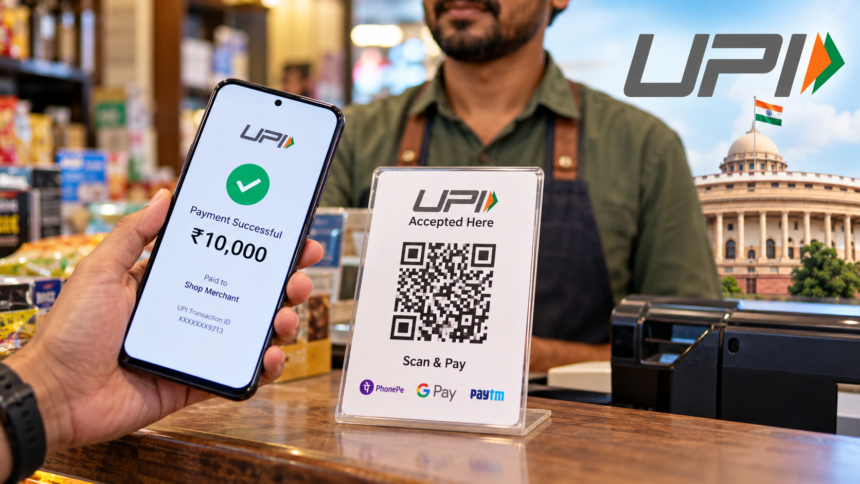
UPI MDR: UPI payments have become a routine part of everyday life, from small purchases to high-value shopping. However, a new Merchant Discount Rate (MDR) framework is set to change the cost structure for certain merchant transactions from October 15, 2026.
Under the revised framework, a 0.4% MDR will apply to specified Person-to-Merchant (P2M) UPI transactions above ₹2,000. The charge is part of the merchant payment ecosystem and is not a direct fee imposed on customers. Person-to-person UPI transfers will continue to remain free.
What Is the MDR on a ₹10,000 UPI Payment?
For a standard eligible merchant transaction of ₹10,000, the 0.4% MDR works out to ₹40.
This means that if a customer pays ₹10,000 through UPI for a purchase, the customer is not required to pay an additional ₹40 as a UPI charge. The MDR is deducted within the merchant-side payment settlement system and is shared among participants in the payment ecosystem, including banks and payment service providers.
So, in a simple example, a ₹10,000 transaction would attract ₹40 as MDR before considering any applicable tax treatment. The actual amount received by the merchant can depend on the applicable settlement arrangement and the merchant’s payment service provider.
The revised framework also places a ₹300 maximum MDR per transaction for transactions of ₹75,000 and above.
Which UPI Payments Will Remain Free?
The new MDR rules do not apply to every UPI transaction.
All Person-to-Person (P2P) UPI payments will remain free, regardless of the amount transferred. Merchant payments of up to ₹2,000 will also remain outside the MDR framework. In addition, eligible small merchants receiving up to ₹1 lakh per month through UPI QR codes under the P2PM category will continue to receive zero MDR.
According to the Finance Ministry, around 96% of P2M transactions are expected to remain unaffected by the new MDR framework.
The government has also clarified that banks have been advised to ensure merchants do not pass the MDR directly on to customers. UPI app providers are also not permitted to impose separate platform or hidden charges under this framework.
Special MDR Rates for Some Sectors
The 0.4% rate is not applicable uniformly across every category of merchant transaction.
For essential and thin-margin sectors such as railways, telecommunications, insurance, fuel and agricultural inputs, eligible transactions above ₹2,000 will attract a fixed MDR of ₹5 per transaction.
A separate lower rate has been specified for certain capital-market transactions. Payments involving mutual funds, securities, stockbrokers and dealers will attract an MDR of 0.02%, subject to a maximum of ₹300 per transaction.
The revised framework is therefore based on the transaction amount as well as the category of merchant and payment. A ₹10,000 UPI payment will not automatically attract the same MDR in every situation.
Disclaimer
This article is intended for general informational purposes and is based on government and payment-system information available regarding the revised UPI MDR framework. The applicable charge can vary according to the transaction category, merchant classification and payment arrangements. Readers and merchants should check the latest NPCI, bank or payment-service-provider guidelines before relying on the information for a specific transaction.