
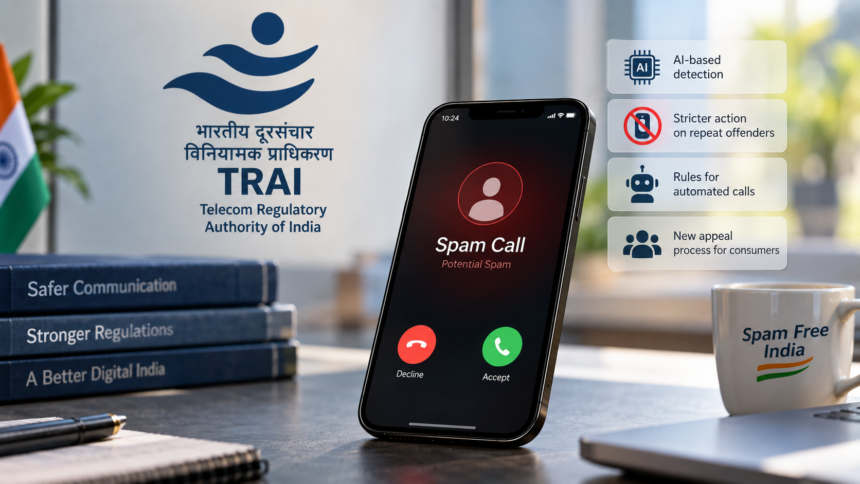
The Telecom Regulatory Authority of India (TRAI) has introduced tighter rules to curb spam calls and unwanted commercial messages in the country. The amendments, announced on September 18, 2026, bring artificial intelligence-based spam detection into the regulatory framework and introduce stricter measures against repeat offenders.
The revised rules also place new requirements on companies using automated calling systems and give consumers an option to appeal when they are dissatisfied with the outcome of a spam complaint.
The changes amend the Telecom Commercial Communications Customer Preference Regulations, 2018. TRAI had released the draft amendments for public consultation on March 13, 2026.
AI-Based Spam Detection and Faster Action
Under the revised framework, telecom operators will be required to use AI and machine learning systems to identify mobile numbers suspected of sending unsolicited commercial communications. Information about suspected spam numbers will also have to be shared with other telecom operators.
The threshold for initiating action has been reduced. Previously, action could be triggered after five complaints. Under the new rules, action can begin when three unique complaints are received within 10 days, provided the sender’s number is also identified as suspected spam by the AI system.
If five or more numbers associated with the same sender are flagged within 10 days, telecom operators will be required to conduct a further investigation.
Depending on the findings and the nature of the violation, measures can include fresh KYC verification, physical verification, suspension of outgoing services and disconnection of numbers in cases involving repeated violations.
New Rules for Robocalls and AI-Generated Calls
Companies using automated calling systems, including robocalls and AI-generated voice calls, will have to inform telecom operators about their use in advance. They will also need to provide details of the numbers being used for such communications.
Automated calls that have not been declared will be treated as unsolicited commercial communications. TRAI has also introduced a termination charge of up to ₹0.05 per minute for such calls.
However, designated regulated and authorised calls will be exempt from this provision.
Consumers Can Appeal Spam Complaint Decisions
The revised framework also introduces an appeal mechanism for consumers. If a customer is not satisfied with the resolution of a spam complaint, an appeal can be filed within 15 days.
Consumers can submit appeals through the TRAI DND app, telecom operators’ apps or online portals. They can also use 1909 to submit an appeal through a call or SMS.
TRAI has additionally restricted companies from using a customer’s enquiry to send marketing communications beyond seven days. The original enquiry must be documented in writing or through a verifiable digital method.
Restrictions on Caller ID and Spam Reporting Apps
The new rules also affect call management and caller identification applications. Such apps will not be permitted to automatically block or label entire designated commercial numbering series, including 140xx, 1600xx and 1601xx, as spam.
These numbering series are used for regulated promotional, service and transactional communications. Consumers will, however, continue to have the option of blocking individual numbers on their own devices.
Apps that provide users with a facility to report spam will also be required to forward those reports to the designated digital platforms of telecom operators.
TRAI has further directed telecom operators to suspend message headers or templates that are found to be misused within six hours of detecting the misuse. Telemarketers held responsible for such violations can face one-year disconnection of their telecom resources and blacklisting.
Disclaimer
This article is based on information regarding TRAI’s regulatory amendments available at the time of writing. Rules, procedures and implementation details may be subject to further clarification or updates by the regulator. Readers should refer to official TRAI announcements for the latest information.