
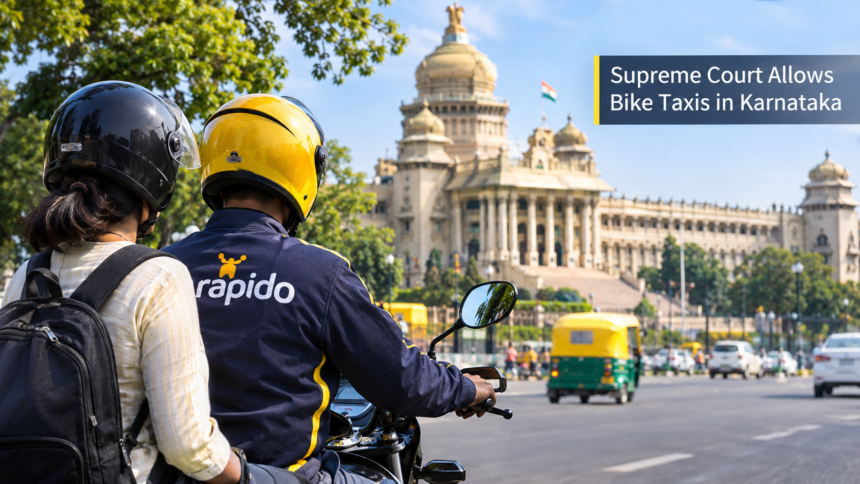
New Delhi: Bike taxi services will continue operating in Karnataka after the Supreme Court dismissed the state government’s appeal against a Karnataka High Court order permitting these services. The decision, delivered on Friday, provides significant relief to ride-hailing companies Ola, Uber and Rapido, which had challenged the restrictions on bike taxi operations.
With the Supreme Court rejecting the state’s challenge, the Karnataka High Court’s January 23 order remains effective. The High Court had lifted the restrictions on bike taxis and allowed operators to apply for the necessary registrations and permits. It had also instructed transport authorities to examine applications for registering motorcycles as transport vehicles and granting contract carriage permits.
Supreme Court Upholds Karnataka High Court Decision
The Karnataka government had approached the Supreme Court challenging the High Court’s decision to overturn an April 2025 order passed by a single-judge bench. The earlier order had prohibited bike taxi services until the state government introduced a dedicated policy for regulating the sector.
The High Court division bench, comprising Chief Justice Vibhu Bakhru and Justice CM Joshi, had accepted appeals filed by ANI Technologies, the operator of Ola, along with Uber, Rapido and the Bike Taxi Welfare Association.
In its January 23 ruling, the High Court observed that motorcycles could be classified as transport vehicles under the Motor Vehicles Act, 1988. It further clarified that the state government could not reject permit applications solely because the vehicles were two-wheelers.
The court directed transport authorities to examine applications for vehicle registration and contract carriage permits. However, it also made clear that authorities could introduce suitable conditions to regulate bike taxi operations.
Why Did Karnataka Introduce a Ban on Bike Taxis?
The Karnataka government imposed restrictions on bike taxi services in March 2024, citing concerns about women’s safety, alleged misuse of the existing policy framework and the absence of electric two-wheelers on ride-hailing platforms.
The restrictions became effective on June 16, 2025, following the single-judge court’s order directing operators to stop services until a specific regulatory policy was introduced.
However, the High Court subsequently questioned the decision to impose a complete ban. It observed that bike taxi services were legally operating in 13 states and highlighted the constitutional protection provided to individuals under Article 19(1)(g), which guarantees the right to practise any profession or carry on a trade or business.
The division bench described the state’s restrictions as a “de facto prohibition”. It also observed that appropriate regulatory conditions could be introduced to manage bike taxi services instead of stopping their operations entirely.
What the Supreme Court Ruling Means for Ola, Uber and Rapido
The Supreme Court’s decision to reject Karnataka’s appeal keeps the High Court’s January ruling in force. As a result, bike taxi operators can continue with the process of obtaining the registrations and permits required to provide services in the state.
The High Court had also referred to the Central Motor Vehicle Aggregator Guidelines, 2025, which permit bike taxi operations subject to approval from the respective state governments.
The latest ruling is a setback for the Karnataka government’s efforts to maintain the prohibition. It provides relief to ride-hailing platforms and bike taxi operators, although their services must comply with applicable registration requirements, permit conditions and regulations issued by transport authorities.
Rapido Co-Founder Pavan Guntupalli Welcomes Supreme Court Verdict
Reacting to the Supreme Court’s decision, Rapido Co-founder Pavan Guntupalli welcomed the ruling and said it would bring greater clarity to the bike taxi sector in Karnataka.
He said, “We welcome today’s decision by the Hon’ble Supreme Court; it brings important clarity to the bike taxi category in Karnataka and marks a landmark moment for the sector in India. Over the years, bike taxis have demonstrated their value by helping commuters navigate congested cities, strengthening first- and last-mile connectivity, and creating flexible earning opportunities for captains. The verdict recognises the role the category already plays on the ground and provides a stronger foundation for its continued growth and integration into the mobility ecosystem.”
Guntupalli further explained that the decision represented more than a legal development for the company. He emphasised the importance of creating transport solutions that reflect the everyday travel needs of people across India.
He added, “For Rapido, this is more than a legal outcome. It is an affirmation of something we have consistently believed in: that India needs mobility solutions designed around the way people actually travel. Two-wheelers are among the most widely owned and accessible mobility assets in the country, and enabling people to use them productively can create meaningful value for commuters, captains and cities alike. We look forward to working with the Government of Karnataka to take the category into its next phase, safe, responsible, regulated and at scale.”
Disclaimer
This article is based on publicly available information and reported legal developments at the time of publication. Court decisions, regulatory requirements and government policies may be subject to further changes or clarification. Readers are advised to refer to official court orders and government notifications for the latest updates. This content is intended for general informational purposes and should not be considered legal advice.