
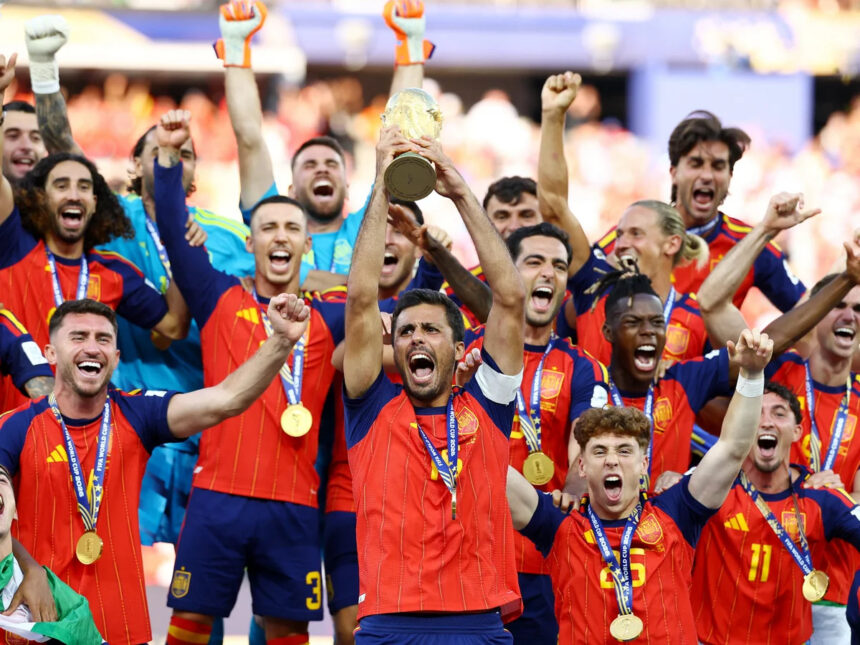
Spain are world champions once again. La Roja secured their second FIFA World Cup title after edging past defending champions Argentina with a 1-0 victory in an intense final, thanks to an extra-time goal from Ferran Torres.
The result ended Argentina’s hopes of retaining the World Cup and denied Lionel Messi the dream ending to his international career, as Spain produced another disciplined and dominant display on football’s biggest stage.
Ferran Torres Delivers the Decisive Goal
After a tightly contested 90 minutes with neither side able to break the deadlock, Spain finally found the breakthrough in the 106th minute of extra time.
The winning move began with Pedro Porro, whose delivery into the box was cleverly flicked on by Nico Williams. Ferran Torres timed his run perfectly and calmly slotted the ball home, giving Spain the lead they had been chasing throughout the match.
That single goal proved enough to seal the championship.
Spain’s Tactical Discipline Pays Off
Spain once again showcased the possession-based football and defensive organization that carried them throughout the tournament.
Rather than forcing attacks, Luis de la Fuente’s side remained patient, controlled possession, and gradually wore down Argentina’s defense before capitalizing on their opportunity in extra time.
Their disciplined approach was reflected in an outstanding defensive record.
Throughout the tournament, Spain conceded just one goal while keeping six clean sheets, underlining the importance of defensive stability in winning major international tournaments.
Argentina’s Title Defense Comes to an End
Argentina entered the final as one of the tournament’s most dangerous attacking teams, but Spain’s organized defense prevented the reigning champions from finding the back of the net.
The defeat also ended Argentina’s bid to become the first nation since Brazil in 1962 to successfully defend the FIFA World Cup title.
Despite creating moments of promise, Argentina struggled to convert their opportunities against a resilient Spanish backline.
Red Card Makes Argentina’s Task Even Harder
Argentina’s challenge became even more difficult when Enzo Fernández was sent off before extra time, leaving his side with ten men during the decisive phase of the match.
Playing with a numerical disadvantage, Argentina spent much of extra time defending as Spain continued to press for the winning goal.
Goalkeeper Emiliano Martínez produced several crucial saves to keep Argentina in the contest.
Spain also came close on multiple occasions, with Nico Williams seeing a goal ruled out after a VAR review, while another effort from Ferran Torres was disallowed for offside before he eventually scored the winner.
Lionel Messi Denied a Fairytale Ending
The final also marked an emotional moment for Lionel Messi, whose hopes of ending his World Cup journey with another title slipped away.
Deep into stoppage time, Messi produced one final moment of brilliance, threading a perfectly weighted pass into the penalty area for Marcos Senesi.
However, Senesi’s close-range effort was brilliantly blocked by the Spanish defense, denying Argentina a dramatic equalizer.
Instead of celebrating another historic triumph, Messi watched Spain lift the World Cup trophy as La Roja completed a memorable campaign.
Spain Celebrate Another Historic World Cup Triumph
With this victory, Spain added a second FIFA World Cup title to their football history, 16 years after winning their first championship in South Africa.
Their latest triumph was built on exceptional teamwork, tactical discipline, defensive resilience, and clinical finishing when it mattered most.
For Argentina, the defeat marks a disappointing end to their title defense, while Spain’s victory reaffirms their place among international football’s elite as they celebrate another unforgettable World Cup success.