
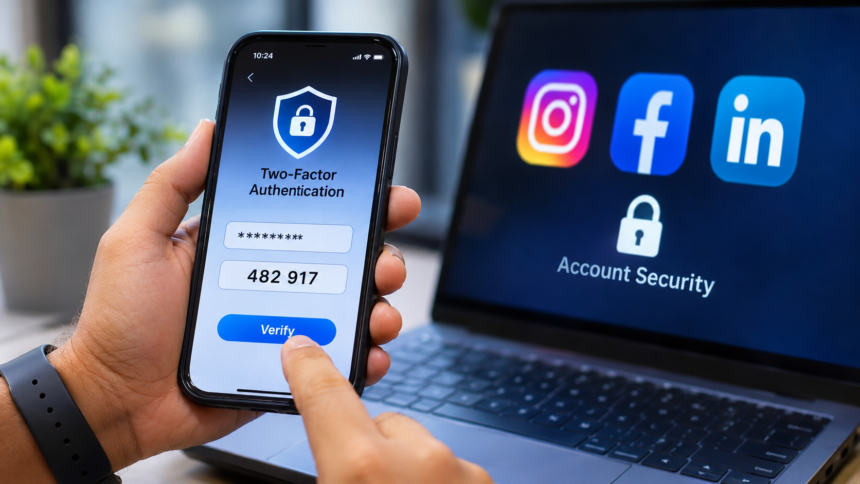
Social media platforms have become an important part of everyday life, helping individuals, businesses and organisations stay connected. However, as people increasingly rely on these platforms, their accounts have also become attractive targets for cybercriminals.
A hacked Instagram, Facebook or LinkedIn account can result in identity theft, financial scams, reputational damage and the misuse of private information. Using a strong password is an important first step towards online safety, but it is no longer enough to protect an account completely.
Cybercriminals can steal passwords through phishing messages, obtain them from data breaches or gain access through malicious software. Reusing the same password across multiple platforms also increases the risk, as one compromised account could expose several others.
What Is Two-Factor Authentication and How Does It Work?
Two-factor authentication (2FA) provides an additional layer of security by asking users to verify their identity through a second method after entering their password. This verification may involve an authenticator application, a security key or a one-time code.
With 2FA enabled, knowing the account password alone is generally not enough for someone to gain access. An attacker would also need to pass the additional verification step, making unauthorised access more difficult.
However, different 2FA methods offer different levels of protection. Verification codes sent through SMS can be vulnerable to SIM-swapping attacks, in which criminals take control of a victim’s phone number. Authenticator apps and security keys generally offer stronger protection than SMS-based codes.
Although two-factor authentication cannot prevent every type of cyberattack, it can significantly reduce the chances of someone accessing an account without permission.
Important Steps to Strengthen Social Media Security
Enabling 2FA should be part of a wider approach to protecting online accounts. Users should create a separate, strong password for every platform rather than relying on the same password everywhere. A trusted password manager can help store and manage these credentials securely.
It is equally important to stay alert while browsing. Avoid opening unfamiliar links or suspicious messages, and never share verification codes with anyone. Users should also review their account login activity regularly and remove access from unknown devices or applications.
Keeping recovery details updated is another important step. Phone numbers and email addresses linked to an account should remain current so that users can recover access if they lose control of their profiles.
Businesses and content creators need to take additional care because a compromised account can be misused to circulate scams, publish misleading information or promote fraudulent offers. Regular security reviews and limiting account access to authorised people can help reduce the risk of a breach.
Why Account Protection Is Everyone’s Responsibility
Social media hacking is no longer just a technical concern. It has become an important issue involving personal privacy, financial safety and digital identity.
Two-factor authentication does not eliminate every security threat, but it provides an extra barrier against unauthorised access. When a single stolen password can put someone’s personal information and online reputation at risk, ignoring this additional protection can be costly.
The best approach is to secure accounts before an attack takes place. Strong passwords, two-factor authentication and regular security checks can make social media accounts much harder for cybercriminals to compromise. Taking preventive action is far better than trying to recover an account after it has been hacked.
Disclaimer
This article is intended for general information and cybersecurity awareness. Security features and protection methods may vary across social media platforms and devices. No security measure can guarantee complete protection against cyberattacks. Users should follow the latest security recommendations provided by their respective platforms and seek professional assistance if they suspect their accounts have been compromised.