
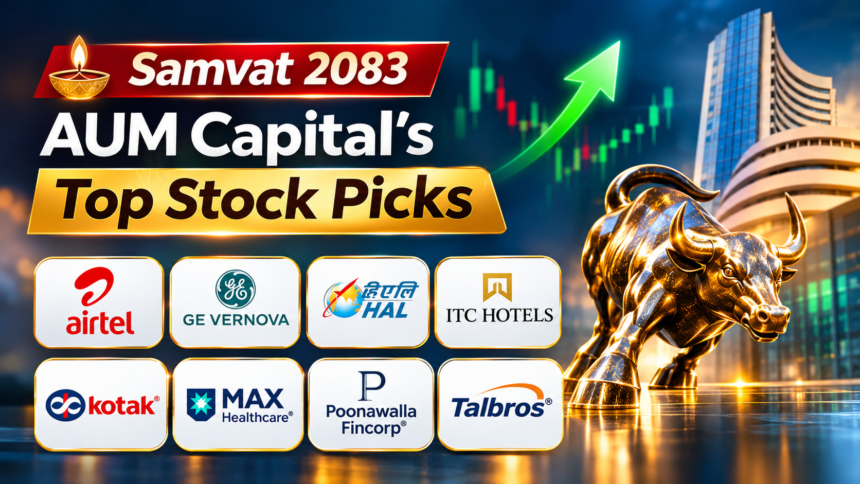
As Samvat 2083 begins, investors are looking for opportunities in companies with strong business fundamentals, sustainable growth prospects and the potential to generate long-term returns. Wealth management firm AUM Capital has identified eight stocks that it believes are worth tracking during the new investment year.
In its investment note, the firm expressed confidence in India’s long-term economic growth and highlighted businesses with strong competitive positions, financial performance and expansion opportunities.
The recommendations cover sectors such as telecom, power infrastructure, defence, hospitality, banking, healthcare, financial services and automobile components. Here is a closer look at the eight stocks and the investment rationale behind each selection.
1. Bharti Airtel: Strong Growth and Improving Cash Flow
Bharti Airtel continues to demonstrate strong operational performance across its telecom and digital businesses. In Q2FY27, consolidated revenue increased 16.7% year-on-year to Rs 60,878 crore. EBITDA grew 18.2% to Rs 34,946 crore, while profit after tax (PAT) climbed 31% to Rs 8,888 crore.
The company’s average revenue per user (ARPU) improved to Rs 271, supported by tariff increases, premium customer additions and higher data consumption. Its strong ARPU position is helping improve margins and cash generation.
Growth has also remained healthy across different business segments. Airtel’s Homes business recorded 25% revenue growth, taking its customer base to 15.4 million. Airtel Business expanded 11%, while Airtel Africa delivered nearly 30% constant-currency revenue growth. Digital TV maintained stable performance, supported by increasing IPTV adoption.
Airtel also benefits from valuable subsidiaries, including Indus Towers, Airtel Payments Bank and Nxtra Data Centres. Airtel Payments Bank has more than 125 million monthly active users, while Nxtra is positioned to benefit from increasing demand for data centres, cloud computing and artificial intelligence.
With the nationwide 5G rollout largely completed, mobile capital expenditure is moderating. Free cash flow has increased to approximately Rs 19,000 crore, supporting debt reduction. Net debt-to-EBITDA improved to 1.18 times from 1.63 times a year earlier.
The stock trades at approximately 9 times EV/EBITDA and 33-34 times estimated FY27 earnings. Further tariff increases, ARPU improvement, Africa operations and data centre expansion could support future growth.
2. GE Vernova T&D: Strong Order Book and Power Infrastructure Opportunities
GE Vernova T&D India benefits from an established position in the power transmission equipment industry, supported by advanced technology access through its parent company and experience in executing complex projects.
The growing demand for renewable energy, including solar and wind power, is increasing the need for transmission networks, grid stability and long-distance electricity evacuation. Expanding nuclear and non-fossil fuel capacity also creates additional opportunities for the company.
Its Q2 performance remained strong. Revenue increased 32% year-on-year to Rs 20.3 billion, while EBITDA grew 39% to Rs 5.5 billion. The EBITDA margin improved to 27.1%, up 135 basis points. Net profit increased 44% to Rs 4.3 billion. Management continues to maintain its EBITDA margin guidance in the mid-20% range.
The company’s order backlog stands at Rs 214.4 billion, providing visibility for more than three years based on FY26 revenue. New order intake during Q2 increased 52% to Rs 24.4 billion, while management expects approximately 30% growth over the next three years.
GE Vernova T&D has secured the Khavda-South Olpad HVDC project and emerged as the lowest bidder (L1) for Power Grid’s Bhadla package. The company also has opportunities in HVDC and FACTS technologies, with additional projects expected to be tendered.
The broader transmission opportunity is estimated at around USD 40 billion for 2027-2030. Demand from data centres, grid digitisation, renewable energy and conventional transmission infrastructure is expected to support the sector.
The parent company’s Electrification business has an order backlog of USD 42.2 billion. Meanwhile, GE Vernova T&D’s export revenue has grown at a compound annual growth rate of 22% between FY21 and FY26. Exports contribute approximately 31% of revenue, and export order inflows during the first half doubled, increasing 107%.
3. Hindustan Aeronautics (HAL): Strong Defence Order Pipeline
Hindustan Aeronautics Limited (HAL) holds a leading position in India’s aerospace and defence industry. Its established capabilities, government backing and strong entry barriers provide a competitive advantage.
The company has a record order book of Rs 2.55 lakh crore, equivalent to approximately 7.7 times its FY26 revenue. Additional opportunities worth around Rs 90,000 crore are also under discussion, offering significant visibility for future business.
HAL reported revenue of Rs 33,050 crore in FY26, with EBITDA margins of approximately 30%. During Q1FY27, revenue increased 14% and profit after tax grew 15%.
Its financial position remains strong, with no net debt and more than Rs 43,000 crore in cash and investments. This provides flexibility for future investments and shareholder returns.
The Repair and Overhaul (ROH) business contributes more than 60% of revenue. Meanwhile, increased production of Tejas LCA Mk1A, HTT40 and helicopter platforms could support the next stage of growth.
HAL is also investing in future programmes, including LCA Mk2, AMCA, aeroengines, UAVs, SSLV and advanced helicopter projects.
The company’s Maharatna CPSE status provides greater operational and financial flexibility. Government initiatives such as Make in India and increased defence indigenisation also support its long-term business prospects.
4. ITC Hotels: Expansion Plans and Strong Hospitality Demand
Following its demerger from ITC Limited in January 2025, ITC Hotels has emerged as an independent hospitality company. The separation allows the business to focus more directly on expansion, operational performance and capital allocation.
The company operates across several hospitality segments, including luxury, upper-upscale, premium, mid-scale and heritage properties. Its portfolio includes ITC Hotels, Mementos, Welcomhotel, Storii, Fortune, WelcomHeritage and Epiq Collection.
As of Q2FY27, ITC Hotels operated more than 13,600 keys. It aims to expand its network to over 250 hotels with more than 22,000 keys by 2031.
The company is following an asset-light expansion strategy, focusing on management contracts and partnerships. During H1FY27, it signed agreements for 20 hotels, taking its managed pipeline to 84 properties, representing approximately 8,200 keys.
Financial performance was also encouraging. Q2FY27 revenue, excluding real estate, increased 17% year-on-year. EBITDA grew 28%, while PAT rose 52%.
Revenue per available room (RevPAR) increased 21%, supported by 14% growth in average room rates (ARR) and a 500-basis-point improvement in occupancy to 76%.
ITC Hotels is also developing properties in important destinations such as Puri, Visakhapatnam, New Delhi, Bhubaneswar and ITC Grand Bharat. Recent additions, including Welcomhotel Ahmedabad and ITC Kumarakom, further strengthen its portfolio.
A debt-free balance sheet, healthy cash reserves and strong free cash flow provide financial support for its expansion plans.
5. Kotak Mahindra Bank: Strong Capital Position and Asset Quality
Kotak Mahindra Bank continues to report healthy growth across its lending and deposit businesses. Its advances increased to Rs 5.77 lakh crore, representing underlying year-on-year growth of approximately 19%.
Deposits grew 23.2% to Rs 6.51 lakh crore, providing adequate funding to support loan growth. The bank’s balanced expansion across advances and deposits strengthens its overall financial position.
Its capital adequacy remains among the strongest in the banking industry. The Common Equity Tier-1 (CET-1) ratio stood at 21.4%, while the overall Capital Adequacy Ratio (CAR) was 21.9%.
Asset quality is another important strength. Gross non-performing assets (GNPA) stood at 1.04%, while net non-performing assets (NNPA) remained at 0.24%, reflecting disciplined lending and risk management.
The acquisition of Deutsche Bank India’s retail, private banking and wealth management businesses is expected to strengthen Kotak’s presence among affluent customers and contribute to future earnings and return on equity.
The bank also operates several valuable subsidiaries. Kotak Securities benefits from retail investor participation, while Kotak AMC generates recurring income through its asset management business. Kotak Life Insurance, investment banking and wealth management further diversify its revenue streams.
The bank’s strong deposit franchise, capital position, asset quality and diversified financial services businesses support its premium valuation compared with several industry peers.
6. Max Healthcare Institute: Capacity Expansion and Strong Financial Performance
Max Healthcare Institute has established itself as a leading hospital chain in North India. Its strong brand, clinical capabilities and presence in major urban markets support its competitive position.
The company operates across multiple medical specialties, including oncology, cardiology, neurology, orthopaedics, gynaecology, paediatrics, ENT and ophthalmology. Increasing demand for specialised and complex medical procedures is supporting its growth.
Max Healthcare plans to expand its capacity from approximately 6,000 beds to 9,000-10,000 beds over the coming years. The expansion will include existing hospital upgrades, new projects and strategic acquisitions in markets such as Delhi-NCR, Mumbai, Lucknow, Mohali and Nagpur.
Nearly 70% of the planned capacity additions will come through brownfield expansion. This approach is expected to support faster occupancy growth and improve capital efficiency while reducing execution risks.
The company is also expanding adjacent businesses, including oncology services, Max@Home and Max Labs. Improvements in average revenue per occupied bed (ARPOB) provide another growth opportunity.
In its latest reported performance, network gross revenue increased 20% year-on-year to Rs 3,219 crore, while EBITDA grew 18% to Rs 820 crore.
The company maintains a conservative financial position, with net debt-to-EBITDA below one time. Annual operating cash flow is approximately Rs 2,000 crore, helping fund a significant portion of its expansion requirements.
Occupancy levels remain around 75-78%, EBITDA margins are approximately 27-28%, and return on capital employed (ROCE) stands at 23-28%.
7. Poonawalla Fincorp: Improving Profitability and Diversified Lending
Poonawalla Fincorp is witnessing strong growth in its lending business. Its assets under management (AUM) reached Rs 74,008 crore, registering 55% year-on-year growth. Management is targeting annual growth of 35-40% over the medium term.
Profitability indicators have also improved. Return on assets (ROA) increased to 2.18%, while profit after tax reached Rs 375 crore. Net interest margin (NIM) plus fees remained above 9%, indicating improving operating leverage and portfolio yields.
The company’s asset quality has strengthened following a reduction in stress within its legacy portfolio. GNPA declined to 1.20%, while NNPA fell to 0.61%. Better collections and a declining credit cost trend are supporting earnings visibility.
Poonawalla Fincorp has a diversified retail and MSME lending platform. Its business includes gold loans, consumer durable finance, education loans, commercial vehicle finance and prime personal loans.
The company is also focusing on technology-led operations. AI-based underwriting, collections and customer servicing are expected to improve operational efficiency and support future margin expansion.
Management sees opportunities to improve ROA through three major factors: higher lending yields, better operating leverage and lower credit costs. These improvements could support earnings growth beyond the pace of AUM expansion.
Its financial position is supported by a recent Rs 2,500 crore QIP, capital adequacy of 18.68%, a reported liquidity pool of Rs 6,526 crore and AAA credit ratings.
8. Talbros Automotive Components: Market Leadership and New Orders
Talbros Automotive Components Limited (TACL) has a strong position in India’s automotive gasket market, with a domestic market share of more than 50%. Its engineering capabilities, established customer relationships and industry entry barriers support its competitive position.
The company serves several automotive segments, including passenger vehicles, two-wheelers, commercial vehicles and off-highway applications.
Its joint ventures with Marelli of Italy and Marugo Rubber of Japan provide access to international technologies and help expand its product capabilities.
TACL reported a 23% year-on-year increase in group turnover to Rs 387 crore in Q1FY27. Net profit increased 35%, supported by healthy demand, operating leverage and a better product mix.
The company also secured new orders worth more than Rs 1,000 crore during the quarter, strengthening its future business visibility.
Its capital efficiency indicators include a reported ROCE of -24% and ROE of approximately 20%, alongside a focus on disciplined capital allocation and balance sheet management.
Disclaimer
This article is intended for informational and educational purposes only. The stock recommendations and investment views mentioned above are based on AUM Capital’s investment note and the information provided. They should not be considered independent investment advice or a guarantee of future returns.
Stock market investments are subject to market risks. Investors should independently evaluate company fundamentals, financial performance, valuations and risk factors before making investment decisions. It is advisable to consult a SEBI-registered investment advisor before investing.