
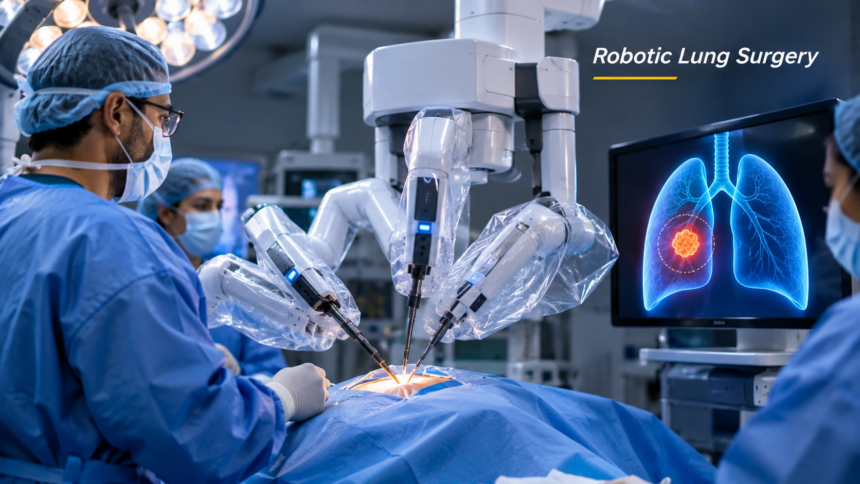
Doctors are increasingly using advanced robotic-assisted surgical techniques to treat eligible lung cancer patients while preserving more healthy lung tissue. Anatomical segmentectomy, particularly when performed with robotic assistance, allows surgeons to remove the cancer-affected portion of the lung without necessarily removing an entire lobe.
New Delhi: A lung cancer diagnosis often raises several concerns for patients, especially regarding surgery and its impact on their ability to breathe. Questions about lung function, recovery time and returning to normal daily activities are common when patients consider surgical treatment.
Traditionally, removing an entire lobe of the lung, a procedure known as lobectomy, has been a standard approach to lung cancer surgery. However, improvements in medical imaging, early diagnosis and surgical technology have expanded treatment possibilities for selected patients with early-stage disease.
One such option is anatomical segmentectomy, which involves removing only the affected segment of the lung while retaining more of the surrounding healthy tissue. Robotic-assisted surgery can help surgeons perform these technically demanding procedures with greater precision through minimally invasive techniques.
In an exclusive interaction with News9, oncologists and thoracic surgeons explained how these developments are changing lung cancer treatment and why preserving lung function is an important consideration.
Lung Cancer Surgery: Why Preserving Healthy Lung Tissue Matters
The human lungs are divided into lobes, which are further separated into smaller anatomical sections called segments. During a lobectomy, an entire lung lobe is removed, whereas segmentectomy involves removing only one or more affected segments.
For patients with small tumours located towards the outer regions of the lung, this approach may help retain more healthy lung tissue. Preserving lung capacity can be particularly valuable for people with existing respiratory conditions or those who need to maintain their breathing function over the long term.
Dr Rajesh Mistry, Senior Director (Group) and Director, Department of Oncology; Consultant Surgeon, Thoracic, Foregut and Head & Neck Oncology, Kokilaben Dhirubhai Ambani Hospital, Mumbai, told News9 that the success of lung cancer surgery should also be measured by how well patients recover and manage their everyday lives after treatment.
He explained that anatomical segmentectomy can be a suitable option for carefully selected patients with small, peripheral tumours, as it allows surgeons to remove the affected portion while retaining more healthy lung tissue.
Dr Mistry further highlighted the role of minimally invasive robotic-assisted procedures, including those performed using systems such as da Vinci. Enhanced three-dimensional visualisation and improved instrument movement can help surgeons carry out precise tissue removal.
According to him, the objective is to achieve effective cancer treatment while reducing the impact of surgery on patients’ breathing, recovery and daily activities.
How Robotic-Assisted Surgery Helps in Lung Cancer Treatment
Although segmentectomy involves removing a smaller portion of the lung, it is a technically challenging operation. Surgeons must carefully identify and separate the blood vessels and airways supplying the cancer-affected segment without damaging those connected to the remaining healthy lung tissue.
Robotic-assisted surgical systems provide enhanced three-dimensional views of the operating area and instruments with a greater range of movement. These capabilities can help surgeons work more precisely in restricted anatomical spaces.
Dr Vijay CL, Consultant Thoracic, Thoracoscopic (VATS) and Robotic Surgeon, SPARSH Hospitals, Bengaluru, told News9 that anatomical segmentectomy requires considerable surgical accuracy because of the need to distinguish between the small blood vessels and airways supplying different lung segments.
He explained that, for patients with appropriately located small tumours, removing only the affected segment can help preserve surrounding healthy lung tissue and support the maintenance of lung function.
Dr Vijay also discussed the advantages of robotic-assisted thoracic surgery using systems such as da Vinci. The technology offers enhanced three-dimensional visualisation and flexible surgical instruments, helping doctors perform complex procedures through minimally invasive techniques.
He emphasised that robotic technology supports the surgeon’s skills and clinical judgement rather than independently performing the operation. The surgeon remains responsible for controlling the system and making decisions throughout the procedure.
Why Early Detection of Lung Cancer Is Important
The stage at which lung cancer is diagnosed plays an important role in determining the available treatment options. When the disease is identified early, surgery may offer the possibility of curative treatment for eligible patients.
However, anatomical segmentectomy is not appropriate for every lung cancer case. Doctors must evaluate the tumour’s size and location, the patient’s overall health and lung function, and whether the cancer can be completely removed with adequate surgical margins.
Dr Salim, VP, Surgical Oncology, Aster MIMS, Calicut, told News9 that early diagnosis can provide patients with more opportunities for surgical treatment.
He noted that although lobectomy has traditionally been a standard surgical option, developments in diagnostic imaging and surgical techniques have made lung-preserving procedures possible for selected patients.
According to Dr Salim, anatomical segmentectomy can help remove small, peripheral tumours while retaining more of the surrounding healthy lung tissue. The primary objective remains complete cancer removal with sufficient surgical margins while preserving as much lung function as medically appropriate.
He also highlighted the contribution of robotic-assisted thoracic surgery, explaining that improved visualisation and greater instrument mobility can support accurate dissection in difficult-to-reach areas.
Dr Salim described this development as part of a more personalised approach to lung cancer treatment, where surgeons determine the extent of tissue removal according to the tumour’s characteristics and the patient’s medical condition.
Disclaimer: This article is based on expert opinions and medical information shared by the doctors quoted above. It is intended for general informational and educational purposes and should not be considered a substitute for professional medical advice, diagnosis or treatment. The suitability of robotic-assisted surgery or anatomical segmentectomy depends on individual medical circumstances. Patients should consult qualified oncologists and thoracic surgeons before making treatment decisions.