
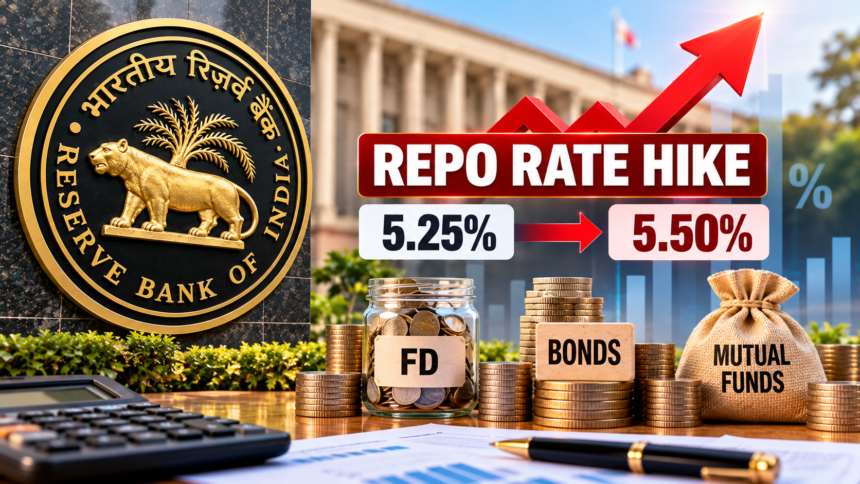
New Delhi: The Reserve Bank of India’s decision to raise the repo rate by 25 basis points to 5.50 per cent could gradually improve returns for savers, while creating some short-term pressure on existing bond investments. The impact, however, will vary depending on the investment—whether it is a fixed deposit, a newly purchased bond or a long-duration debt mutual fund.
The RBI’s October 7 decision marked its first repo rate increase since February 2023. With the central bank shifting towards a calibrated tightening approach, fixed-income investors are now assessing the possible direction of deposit rates and bond yields.
Nishchay Nath, Founder & CEO of BondScanner, said the hike was largely expected by the bond market. According to him, the 10-year government bond yield had already moved above 7 per cent in the weeks leading up to the policy announcement. He said the next market move would depend more on factors such as RBI guidance, liquidity, crude oil prices and the rupee.
How the Repo Rate Hike Could Affect Fixed Deposits
For FD investors, a rise in interest rates is generally positive, but existing deposits do not automatically benefit from the change. An FD continues to earn the interest rate agreed upon when it was opened until maturity. Banks may, however, increase rates for new deposits and renewals.
Adhil Shetty, CEO of BankBazaar, said the 25-basis-point increase could benefit savers gradually as banks revise their deposit rates. New FDs are likely to reflect any increase sooner, while existing deposits will continue at their contracted rates.
Investors expecting interest rates to rise further may also consider FD laddering. Under this approach, money is divided among deposits with different maturity dates. This can provide periodic access to funds while allowing investors to reinvest portions at potentially higher rates later.
Current FD Rates
The following rates were advertised on the respective banks’ websites on October 2, 2026, for deposits below ₹1 crore with a 1–2 year tenure, as compiled by BankBazaar:
| Bank Category | Bank | FD Rate* |
|---|---|---|
| Public-sector | Bank of Baroda | 6.60% |
| Public-sector | SBI | 6.45% |
| Private | Yes Bank | 7.00% |
| Private | Kotak Bank | 6.65% |
| Private | HDFC Bank | 6.45% |
| Small finance bank | Utkarsh SFB | 8.10% |
| Small finance bank | Suryoday SFB | 7.80% |
| Small finance bank | ESAF SFB | 7.75% |
What Happens to Existing Bonds?
The effect of a repo rate hike is different for bond investors. Bond prices generally move in the opposite direction to market yields. Therefore, if yields rise further, the market value of existing fixed-rate bonds can come under pressure.
Long-duration bonds are usually more sensitive to changes in interest rates. As a result, investors holding longer-maturity securities could see larger mark-to-market movements.
Nath said existing bondholders could see their bond prices decline on paper, particularly in longer maturities. However, the coupon rate and maturity value of a fixed-rate bond do not change simply because market yields move higher.
For investors buying new bonds, higher market yields could provide better entry opportunities. Short-duration bonds generally have lower interest-rate sensitivity than longer-duration securities.
Impact on Debt Mutual Funds
Debt mutual funds can also respond differently depending on their portfolio duration and the securities they hold.
Vinay Pai, MD & Head of Fixed Income, Equirus Group, said persistent inflation and expectations of additional rate increases could push yields higher, particularly at the shorter end of the yield curve. In such an environment, shorter-duration fixed-income strategies could face relatively less interest-rate risk than long-duration funds.
Investors should also consider credit quality, liquidity and their investment horizon before choosing a debt product.
Rajeev Radhakrishnan, CFA, CIO – Fixed Income & Head of Research (Fixed Income), SBI Mutual Fund, said the absence of specific measures to normalise liquidity could keep overnight rates below the repo rate. He added that additional open-market sales could play a role in liquidity normalisation.
What Investors Should Keep in Mind
The latest rate hike does not mean investors should immediately move all their money into one type of fixed-income product. Existing FDs remain protected by their contracted interest rates until maturity, while bonds and debt funds can experience temporary market-value fluctuations as yields change.
For savers, spreading investments across different maturity periods can provide greater flexibility if interest rates move higher. Bond and debt-fund investors, meanwhile, should distinguish between a temporary mark-to-market decline and the actual interest and principal payments promised by the underlying securities.
Disclaimer: The information provided in this article is for general informational purposes only and should not be considered investment or financial advice. Interest rates, bond yields and market conditions can change, and actual returns may vary depending on the product, bank, fund, investment period and applicable terms. Investors should carefully review the relevant product documents and consult a qualified financial adviser before making investment decisions.