
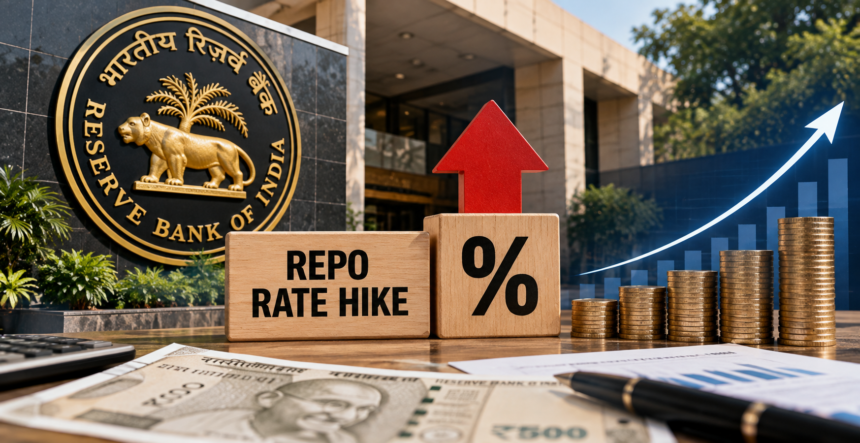
A 25-basis-point increase in the Reserve Bank of India’s (RBI) repo rate could improve the profitability of large banks, with net interest margins (NIMs) potentially expanding by 6–10 basis points and earnings per share (EPS) estimates rising by 3–5 per cent, according to a report by IIFL Capital.
The report highlights the potential benefits of higher interest rates for large lenders, while noting that the impact could vary across public sector banks and private sector banks. It also points to tighter liquidity conditions and changing valuations across the banking sector.
RBI Rate Hike Could Boost Bank Earnings
The Monetary Policy Committee (MPC) unanimously increased the repo rate by 25 basis points to 5.5 per cent and changed its policy stance from ‘neutral’ to ‘calibrated tightening’.
According to IIFL Capital’s sensitivity analysis, the rate increase could lead to a 6–10 basis-point expansion in NIMs for larger banks and an upward revision of 3–5 per cent in their EPS estimates.
Public sector banks, however, are expected to experience a smaller improvement in NIMs, although the impact on their earnings per share could be relatively higher. The extent of the benefit will depend on how changes in interest rates affect individual banks’ lending and funding costs.
Banking Sector EPS Growth Could Reach 20% by FY28
The brokerage also sees scope for stronger earnings growth across India’s banking sector if the RBI raises interest rates by a cumulative 50 basis points.
Under this scenario, EPS growth could accelerate to a compound annual growth rate (CAGR) of 20 per cent over FY26–FY28, compared with the current estimate of 14 per cent.
The potential improvement reflects the expected impact of higher interest rates on bank profitability, although the actual outcome will depend on how effectively lenders adjust their lending rates and manage funding expenses.
Repo-Linked Loans and Tightening Liquidity
Banks with a larger proportion of repo-linked loans could benefit more quickly from changes in policy rates because their lending rates can be repriced faster than those of lenders with a greater share of fixed-rate loans.
IIFL Capital expects this difference in rate transmission to influence the extent and timing of benefits across individual banks.
At the same time, liquidity in the banking system has tightened, declining from a recent peak of Rs 11 trillion to Rs 5 trillion. The current level is equivalent to around 2 per cent of net demand and time liabilities (NDTL).
The report expects liquidity conditions to tighten further because of increased currency circulation and regulatory measures. These include US dollar sell-buy swaps, variable rate reverse repo (VRRR) operations, open market operation (OMO) sales and foreign exchange market interventions.
As liquidity becomes tighter, the weighted average call rate (WACR) and three-month certificate of deposit (CD) rates are expected to increase gradually. These rates had declined by 15 basis points and 100 basis points, respectively, following the announcement of the Foreign Currency Non-Resident (Bank) [FCNR(B)] deposit window.
Large Private Banks Offer a More Attractive Risk-Reward Profile
The report also examined changes in banking sector valuations during the current calendar year.
Mid-sized banks have recorded valuation increases of 5–25 percentage points year to date (CYTD), while public sector banks have experienced valuation declines of 5–25 percentage points. HDFC Bank and other large private sector banks have seen comparatively limited valuation changes, according to the report.
Against this backdrop, IIFL Capital considers large private sector banks to offer a relatively more attractive risk-reward proposition than other segments of the banking industry.
The brokerage’s assessment reflects the combination of potential earnings upgrades, changes in interest rates and the differing valuation trends across banks. However, the actual impact of monetary tightening will depend on individual lenders’ loan portfolios, funding structures and ability to pass on rate changes.