
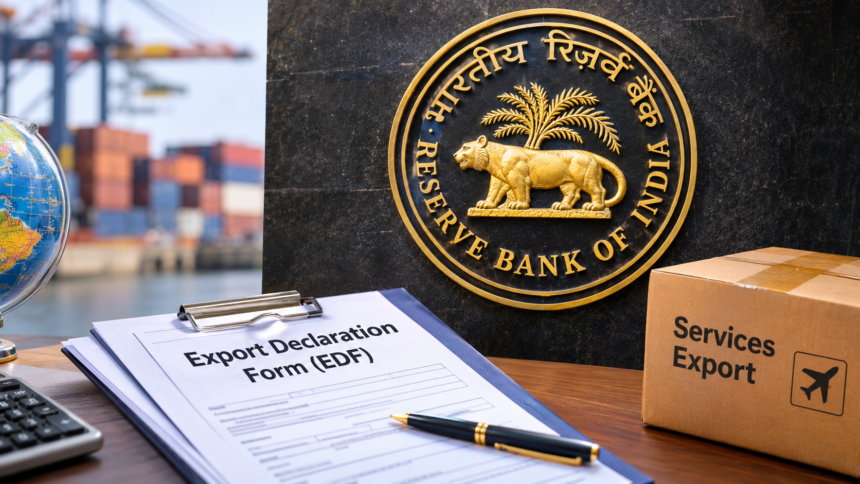
The Reserve Bank of India (RBI) has introduced revised reporting requirements for service exporters under the Foreign Exchange Management (Export and Import of Goods and Services) Regulations, 2026, which came into effect on October 1, 2026.
Under the new framework, service exporters are required to submit an Export Declaration Form (EDF), declaring the full value of exported services within 30 days from the end of the month in which the invoice is issued.
However, an amendment issued by the RBI on November 2, 2026, clarified that resident individuals are not required to submit a separate EDF. They only need to provide the necessary payment information to their bank to receive foreign earnings. Other service exporters are also exempt from separate EDF filing when the payment received is ₹10 lakh or less.
The RBI has also issued frequently asked questions (FAQs) dated October 20 to explain the applicability of the regulations, filing procedures and important deadlines. Here are the key details exporters, freelancers and service providers should understand.
Who Needs to File an EDF for Exported Services?
The EDF requirement mainly applies to service exporters other than resident individuals when the value of an individual inward remittance exceeds ₹10 lakh or its equivalent in foreign currency.
Resident individuals are exempt from submitting a separate declaration. Their EDF requirement is considered fulfilled once they provide the required payment details to their authorised dealer (AD) bank for receiving and crediting the foreign payment.
This exemption is particularly relevant for individuals earning money from international clients. Freelancers, content creators, YouTubers and people receiving income through platforms such as Google AdSense do not need to submit a separate EDF.
Other service exporters receiving payments of ₹10 lakh or below are also exempt from separate EDF filing.
Do the New RBI Rules Apply to Transactions Started Before October 1?
No. The revised regulations do not apply retrospectively to transactions initiated before October 1, 2026.
Such transactions will continue to be governed by the rules that were applicable when they began. The same provision applies to service invoices issued before October 1, even if the corresponding payment is received after that date.
EDF Filing Deadline and Extension Rules
The deadline for submitting an Export Declaration Form depends on the type of export transaction.
For software exports, non-individual exporters must submit the EDF within 30 days from the end of the month in which the invoice is raised.
For other service exports, the declaration must be submitted within 30 days from the end of the invoice month or on or before receiving the payment.
In cases involving advance payments, the EDF must be filed within 30 days from the end of the month in which the invoice is issued.
Exporters may also request additional time if they are unable to meet the prescribed deadline. Authorised Dealer banks have the authority to extend the filing period after examining the reasons provided by the exporter and determining whether the request is reasonable.
Is SOFTEX Filing Still Required for Software Exports?
No. The SOFTEX filing system has been discontinued with effect from October 1, 2026.
Under the revised arrangement, non-individual software exporters operating in the Domestic Tariff Area (DTA) can submit their EDF through an Authorised Dealer bank or Software Technology Parks of India (STPI).
Software exporters operating in Special Economic Zones (SEZs) can submit the declaration to the Development Commissioner of their respective SEZ.
Another important requirement is that non-individual service exporters receiving more than ₹10 lakh must submit the EDF before the foreign payment is credited to their bank account.
Exporters looking for information about their bank’s specific procedures can visit its official website. Under Regulation 19(4), AD banks are required to publish their trade-related policies and the main features of their standard operating procedures (SOPs).
Other Important Changes Clarified by the RBI
The RBI has also explained several additional provisions under the revised export and import regulations.
EDF/GR (Guaranteed Remittance) waiver letters have been discontinued. In cases where exported goods have no realizable value, exporters must declare a zero value in the EDF.
The regulations also allow authorised dealers to record voluntary EDF submissions and voluntary import invoice declarations in the E/IDPMS (Export/Import Data Processing and Monitoring System).
For service imports, the existing information requirements will continue to apply to resident individuals and transactions valued at ₹10 lakh or less. Authorised dealers must also report the applicable inward and outward remittances through E/IDPMS.
The RBI has further clarified the scope of the simplified reconciliation procedure. This facility is available only when the original goods bill or service invoice value does not exceed ₹10 lakh. The limit cannot be determined simply by considering whether the remaining outstanding amount has fallen below ₹10 lakh.
Disclaimer: This article is intended for general informational purposes only and should not be treated as legal, financial or regulatory advice. Requirements may vary depending on the nature of the transaction and the exporter’s circumstances. Readers should refer to the latest RBI notifications and consult their authorised dealer bank to confirm the applicable filing procedures and compliance requirements.