
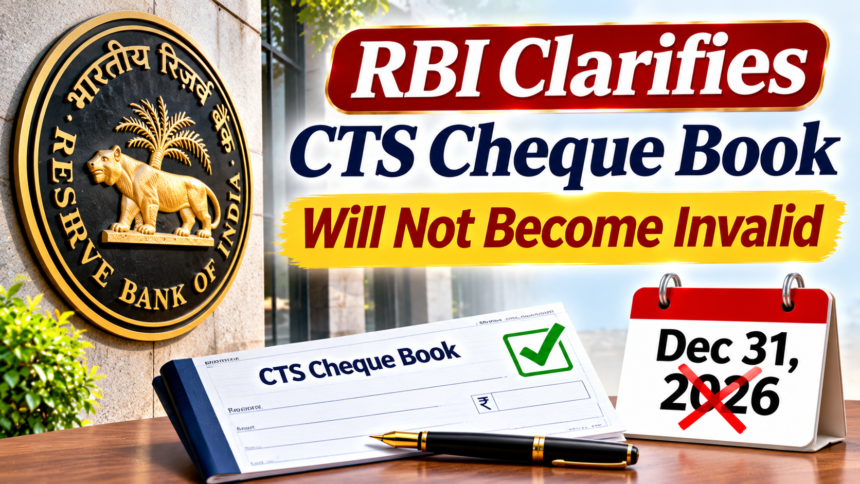
New Delhi: The Reserve Bank of India (RBI) has dismissed social media claims suggesting that existing Cheque Truncation System (CTS) cheque books will become invalid after December 31, 2026. The central bank clarified on Saturday that it has not announced any such change and has no plans to introduce new cheque book security standards from January 1, 2027.
The clarification came after several posts circulated online claiming that banks would stop accepting existing CTS cheque books and introduce new ones with updated security features at the beginning of 2027.
Responding through its official account on X, the RBI described these claims as factually incorrect and misleading. It advised customers to depend on official central bank notifications rather than unverified information circulating on social media.
RBI Clarifies Rules on Existing CTS Cheque Books
The RBI has confirmed that it is not introducing any measures requiring customers to replace their existing CTS cheque books after December 31, 2026.
In its clarification, the central bank stated, “RBI is not introducing any such measures with regard to the CTS cheque books.”
The statement directly addresses the viral claim that existing cheque books would become invalid at the end of 2026 and that new security requirements would apply from January 1, 2027.
According to the RBI, the information being circulated is incorrect and should not be treated as an official banking announcement.
The central bank has also urged members of the public to follow only the information and notifications issued through its authorised communication channels.
Will Customers Need New Cheque Books from January 1, 2027?
Based on the RBI’s clarification, customers are not required to replace their existing CTS cheque books because of the December 31, 2026 deadline mentioned in the viral messages.
The central bank has not announced any new cheque book security standards that would take effect on January 1, 2027.
Customers should therefore avoid acting on unverified social media posts suggesting that their current cheque books will automatically become unusable.
For accurate information about banking rules and regulatory changes, the RBI has advised the public to refer to its official announcements.
RBI Proposes Changes to Agricultural Loan Documentation
Separately, the Reserve Bank of India has proposed changes to agricultural lending requirements and the calculation of priority sector lending (PSL), including the treatment of certain trade-credit exposures.
These proposals are included in the draft Reserve Bank of India (Priority Sector Lending – Targets and Classification) Directions, 2026.
The proposed framework is intended to strengthen the monitoring and documentation of agricultural loans. The RBI has invited comments and feedback on the draft until November 26.
Under the proposed rules, banks would need to maintain more detailed records when verifying agricultural loans backed by gold.
These records would include the location of agricultural land under cultivation, details of crops being grown and information about the hypothecation of crops, wherever applicable.
The proposed requirements would help banks maintain appropriate documentation while assessing agricultural lending under the priority sector framework.
New Agricultural Loan Assessment and Verification Requirements
The RBI has also suggested changes to the way banks determine sanctioned loan amounts for agricultural activities.
Under the proposed guidelines, lending decisions would be based on the applicable scale of finance and an assessment of the borrower’s agricultural credit requirements.
This means the sanctioned loan amount should not depend only on the type or value of collateral offered by the borrower.
Banks would also be required to maintain records of field visits conducted by their officials to verify how agricultural loans are being used.
For landless agricultural labourers and sharecroppers who do not have land ownership records or lease agreements, banks would need to maintain alternative verifiable documents.
These documents would be used to establish whether such borrowers qualify for classification under priority sector lending rules.
The proposed changes remain part of the draft framework, with public comments invited until November 26.
Meanwhile, regarding CTS cheque books, the RBI’s position remains clear: the claims about existing cheque books becoming invalid after December 31, 2026, are misleading, and no such replacement requirement has been announced.
Disclaimer: This article is intended for general informational purposes and is based on the RBI clarification and draft regulatory proposals described above. Banking regulations, lending requirements and implementation timelines may be revised through official notifications. Readers should consult the Reserve Bank of India’s official website or their respective banks for the latest verified information before making banking or financial decisions.