
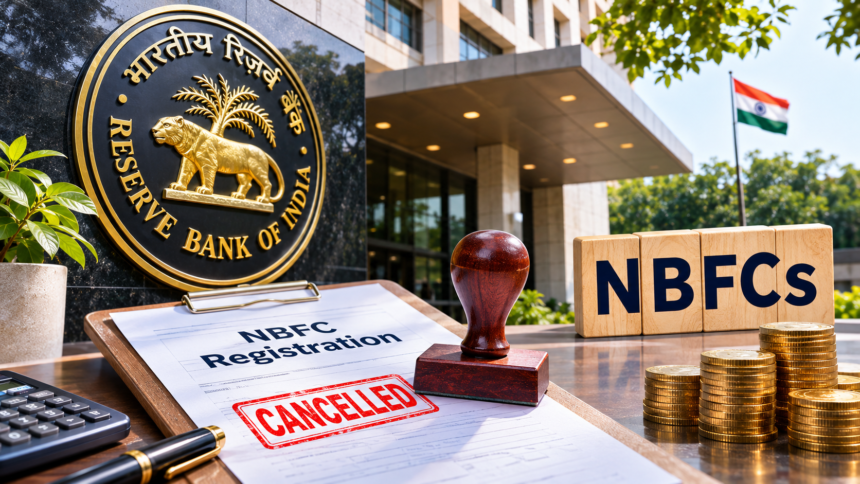
RBI Latest News 2026: The Reserve Bank of India (RBI) has taken regulatory action involving 63 financial companies, including 49 Non-Banking Financial Companies (NBFCs) whose Certificates of Registration (CoRs) have been cancelled. In a separate development, 13 NBFCs and one Housing Finance Company (HFC) voluntarily surrendered their registrations.
The RBI announced these developments on November 16, 2026. The cancellation orders covering the 49 NBFCs were issued between October 1 and October 29, 2026, under Section 45-IA (6) of the Reserve Bank of India Act, 1934.
The 14 voluntary surrender cases involved different circumstances, including companies leaving the NBFC business, becoming eligible for exemption from registration and ceasing to exist as legal entities.
The central bank has clarified that companies whose registration certificates have been cancelled are no longer permitted to conduct business as NBFCs under the RBI Act.
RBI Action Against 63 Finance Companies: What Happened?
The RBI’s announcement covers two separate categories of regulatory action.
The first involves 49 NBFCs whose registration certificates were cancelled directly by the central bank under Section 45-IA (6) of the RBI Act, 1934. The relevant orders were issued between October 1 and October 29, 2026.
The second category consists of 14 companies that voluntarily surrendered their registrations. This group includes 13 NBFCs and one HFC. Their certificates were subsequently cancelled under the applicable provisions of the RBI Act and the National Housing Bank Act, 1987.
It is important to understand that all 63 companies were not subjected to compulsory cancellation for the same reasons. The 14 voluntary surrender cases arose from specific business and legal circumstances.
Why Did 14 Companies Surrender Their Registrations?
According to the RBI announcement, the 14 companies that voluntarily surrendered their certificates fall into three categories.
1. Six companies exited the NBFC business
These companies decided to discontinue their non-banking financial activities:
- Manish Synthetics Private Limited
- Amar Plaza & Holdings Private Limited
- Viconic Vyapaar Private Limited
- Right Treasure Finance & Leasing (India) Private Limited
- Bravo Capital Services Private Limited
- CGR Mercantile Finance Private Limited
2. Five companies qualified for registration exemption
These entities fulfilled the prescribed conditions for classification as unregistered Type I NBFCs. Consequently, they did not require registration under Section 45-IA of the RBI Act.
The companies are:
- Astrex Enterprise Private Limited
- Capital Finvest Limited
- Merlin Homes Private Limited
- Mastermind (India) Private Limited
- KLUG Investments Private Limited
3. Three companies ceased to exist as legal entities
The remaining companies had ceased to exist following corporate actions such as amalgamation, merger, dissolution or voluntary strike-off.
They include:
- Manibhavnam Home Finance India Private Limited
- Sun Source Leafin Private Limited
- Lianer Distributors Private Limited
Manibhavnam Home Finance India Private Limited was the only HFC in this category. The other two companies were NBFCs.
Can These Companies Continue Providing Loans?
Companies whose NBFC registration certificates have been cancelled cannot continue conducting activities that require registration as a non-banking financial institution under Section 45-I of the RBI Act, 1934.
However, cancellation of an NBFC registration does not automatically mean that every other business activity of the company has been discontinued. The restriction specifically concerns activities covered by the relevant regulatory provisions.
Why Does the RBI Cancel an NBFC Licence?
Under the RBI Act, the central bank has the authority to cancel an NBFC’s Certificate of Registration under specified circumstances.
Possible grounds include:
- Failure to satisfy the statutory requirements for registration.
- Non-compliance with conditions attached to the registration certificate.
- Failure to follow applicable RBI directions and regulatory requirements.
- Failure to maintain or submit prescribed financial records and accounts.
- Other grounds covered under the relevant provisions of the RBI Act.
However, the RBI’s November 16 announcement does not specify the individual grounds for cancelling the registrations of all 49 NBFCs.
Therefore, it would be incorrect to describe every affected company as a loan defaulter, fraudster or an entity involved in financial misconduct without supporting evidence.
The voluntary surrender cases must also be treated separately from the 49 cancellations initiated by the RBI.
What Should Customers Do If They Have an Existing Loan?
Customers should not immediately assume that their loans or financial obligations have been cancelled because a company appears in the RBI’s announcement.
Anyone dealing with an NBFC should first verify the lender’s exact legal name and current regulatory status.
Customers can take the following precautions:
- Verify RBI registration: Check whether the lender holds a valid Certificate of Registration through the RBI’s official records.
- Confirm the legal company name: Do not rely only on a brand name or mobile application when checking a lender’s identity.
- Read loan agreements: Understand the interest rate, processing fees, repayment schedule and other applicable conditions.
- Avoid unverified loan applications: Do not share banking or personal information with unknown lenders.
- Maintain payment records: Keep loan agreements, repayment receipts and official communication safely.
Those who already have outstanding loans should continue to seek clarification through the lender’s official communication channels. Cancellation of an NBFC’s registration does not automatically remove a customer’s existing repayment obligations.
Where necessary, customers should obtain appropriate legal or regulatory guidance.
RBI Cancellation vs Voluntary Surrender: Know the Difference
Although both actions result in the cancellation of registration, the circumstances behind them are different.
| Particulars | RBI-initiated cancellation | Voluntary surrender |
|---|---|---|
| Number of entities | 49 NBFCs | 13 NBFCs and 1 HFC |
| Initiated by | RBI | Company |
| Main reason | Cancellation under the RBI Act | Exit, exemption or cessation as a legal entity |
| Regulatory outcome | Registration cancelled | Registration surrendered and cancelled |
| NBFC business permitted | No | No |
The distinction is important because voluntary surrender does not necessarily indicate regulatory wrongdoing. Some companies had decided to leave the business, while others no longer required registration under the applicable framework or had ceased to exist.
The latest action reflects the RBI’s regulatory oversight of non-banking financial institutions. For customers, the most important step is to verify the current registration status of a financial company before borrowing money or entering into a financial arrangement.
Disclaimer: This article has been prepared for informational purposes based on the RBI announcements dated November 16, 2026. Regulatory actions and their implications may vary depending on the circumstances of individual companies. Readers should verify company registration details through official RBI records and seek appropriate professional advice before making financial or legal decisions.