
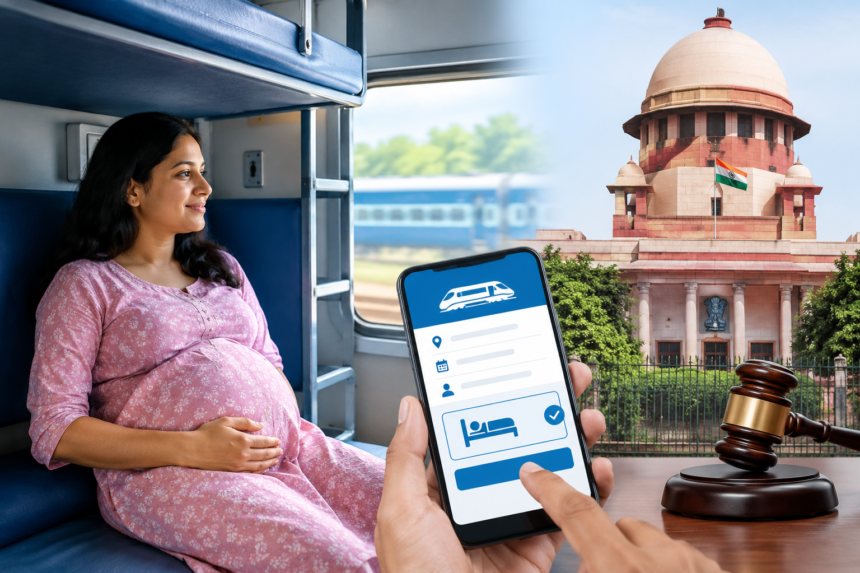
The Delhi High Court has sought responses from the Centre and the Indian Railway Catering and Tourism Corporation (IRCTC) on a Public Interest Litigation (PIL) seeking an online facility for pregnant women to request lower berths while booking train tickets.
A bench comprising Chief Justice Devendra Kumar Upadhyaya and Justice Tejas Karia issued notices to the Centre and IRCTC on Wednesday, September 16. The court has asked the authorities to clarify their position on the issues raised in the petition. The matter is scheduled to come up for hearing again on September 30.
The PIL was filed by advocate Anunay Sahay, who has asked the Railways and IRCTC to introduce a suitable online mechanism through the IRCTC website and mobile application. Under the proposed system, pregnant passengers could request a lower berth, subject to availability and appropriate verification.
Petition Seeks Online Facility for Pregnant Passengers
The petition points out that existing railway rules already permit pregnant women to be considered for lower berths, depending on availability. However, the petitioner has claimed that women currently need to visit a Passenger Reservation System (PRS) counter and submit a pregnancy certificate issued by a registered medical practitioner to avail themselves of the facility.
According to the plea, requiring a physical visit creates an additional hurdle for pregnant women at a time when railway reservation services have largely shifted to digital platforms.
The petition has questioned why pregnant passengers should be required to visit a reservation counter when several other reservation-related facilities for eligible categories can be accessed online.
IRCTC’s Lower-Berth Quota Under Question
The plea also refers to the “Lower Berth/Senior Citizen” quota mentioned in IRCTC’s e-ticketing terms and conditions.
The petitioner has argued that IRCTC’s digital platform is part of the railway reservation system and should therefore provide access to facilities available under the existing reservation policy, including consideration for lower berths by pregnant women.
The petition alleges that the present arrangement is arbitrary, unreasonable and discriminatory. It has invoked Articles 14, 15(3) and 21 of the Constitution in support of its arguments.
Several possible methods for verifying eligibility have been suggested in the plea. These include online self-declaration, uploading a certificate issued by a registered medical practitioner, or allowing the booking with subsequent verification by the Ticket Examiner during the journey.
The petitioner has also proposed changes to the existing lower-berth allocation algorithm so that pregnant women can be recognised as an eligible category, subject to berth availability.
IRCTC Had Earlier Said Suggestion Would Be Considered
Before filing the PIL, Anunay Sahay said he had approached the Railway Minister, Railway Board and IRCTC regarding the issue on August 30, 2026.
According to the petition, IRCTC responded on September 1, stating that the suggestion had been noted for future enhancements and would receive “very serious thought”.
The PIL now seeks directions to the authorities to develop a practical, non-discriminatory and technologically feasible method for verifying pregnancy without making a physical visit to a reservation counter compulsory for obtaining the lower-berth facility.
It has also requested the respondents to disclose through an affidavit the measures being considered or taken to introduce such a system, along with the proposed timelines for implementation.
Railways Plans Special Trains for Festive Season
Separately, Indian Railways is preparing additional train services ahead of the upcoming festive season, when passenger demand is expected to increase during Dussehra, Diwali and Chhath Puja.
Northern Railway has announced several special train services connecting Delhi with major destinations in Uttar Pradesh and Bihar.
The additional services are intended to provide passengers with more travel options and reduce pressure on regular trains, which are expected to experience increased demand during the festival period.