
Investing money in Post Office savings schemes is often considered a way to secure savings and earn regular returns. However, a case reported from Karnataka has raised concerns about the handling of customer deposits at a local post office.
In this incident, a woman deposited a total of ₹1,00,500 in a Post Office Senior Citizen Savings Scheme (SCSS) and a savings account. The postmaster reportedly accepted the money and issued two receipts carrying his signature and the official stamp. However, the woman never received the SCSS account certificate or savings account passbook.
The matter took a serious turn when it emerged that the deposited money had not been recorded in the department’s official accounts and the postmaster had allegedly disappeared with the funds.
After examining the case, the Gadag District Consumer Commission held the Postal Department responsible for a deficiency in service and directed it to refund the deposit with interest. The Commission also ordered compensation for mental harassment and legal expenses.
How Did the Post Office Deposit Disappear?
The incident dates back to November 14, 2023, when a woman named Lalita visited the Kodikoppa Branch Post Office in Karnataka.
She deposited ₹1,00,000 to open a Senior Citizen Savings Scheme account and paid another ₹500 for a Post Office savings bank account.
Following the deposits, the postmaster handed her two cash receipts bearing his signature and the official stamp. However, the required SCSS certificate and savings account passbook were never provided.
Despite making repeated requests for the account documents, Lalita did not receive them. She eventually approached the authorities and filed a formal complaint against the Postal Department.
Post Office Denies Having Records of the Deposits
During the proceedings, the Postal Department disputed the woman’s claim. Officials stated that there was no departmental record of the alleged SB-26(T) receipts or any corresponding entry showing that the money had been deposited.
However, Lalita produced both original cash receipts before the Consumer Commission. The documents carried the postmaster’s signature and the official postal stamp.
After reviewing the evidence, the Commission observed that the woman’s claim could not be rejected simply because the receipts were not issued in the prescribed format.
It further noted that maintaining proper records of customer deposits and issuing the necessary account documents were the responsibility of the concerned postal official. The department was therefore held accountable for the failure to provide the promised banking services.
Consumer Commission Orders Refund of ₹1,15,500
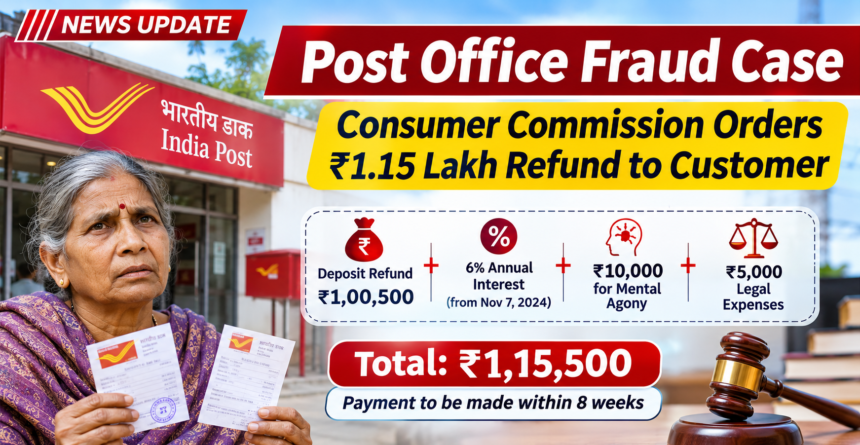
In its order dated October 29, 2024, the Gadag District Consumer Commission directed the Postal Department to return the woman’s original deposit of ₹1,00,500.
The Commission also awarded the following compensation:
- Deposit refund: ₹1,00,500
- Interest: 6% per annum, calculated from November 7, 2024, until the actual payment date.
- Compensation for mental agony: ₹10,000.
- Legal expenses: ₹5,000.
The total amount specified, excluding the applicable interest, comes to ₹1,15,500.
The Commission directed the authorities to complete the payment within eight weeks.
The decision places responsibility on the Postal Department for the failure to properly account for the customer’s deposited money and provide the required account documents.
Disclaimer
This article is intended solely for general informational and news purposes. The information has been presented based on the details available about the reported case and the Consumer Commission’s order. Readers are advised to verify legal orders and official information through the concerned authorities before making any financial or legal decisions. This website does not provide legal or financial advice and is not affiliated with the Department of Posts or any government authority.