
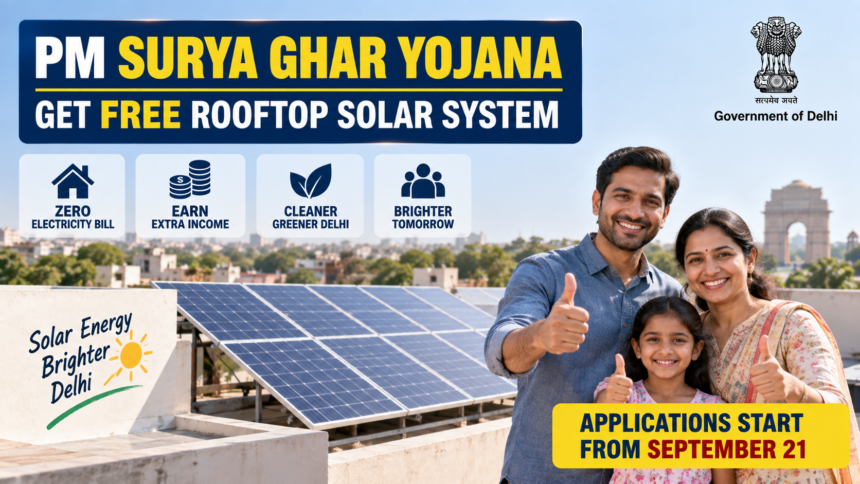
The Delhi government has started the registration process for rooftop solar systems under the PM Surya Ghar: Muft Bijli Yojana. The dedicated Delhi PM Surya Ghar portal was launched on September 21, 2026, allowing eligible households to apply for rooftop solar installations and access information about subsidies, authorised vendors and other scheme-related services.
The government has set a target of providing rooftop solar systems to around 2.30 lakh families and adding about 500 MW of rooftop solar capacity by March 2027. The scheme is aimed at helping eligible domestic electricity consumers reduce their dependence on grid power while making rooftop solar more accessible.
Under the revised Delhi solar programme, eligible households with average monthly electricity consumption of up to 400 units can receive rooftop solar systems of up to 3 kW without an upfront installation payment, subject to technical feasibility and other applicable conditions.
Who Can Apply for the Rooftop Solar Scheme?
The benefit is available to eligible domestic electricity consumers in Delhi. Having suitable rooftop space is an important requirement, while the final system capacity depends on factors such as electricity consumption, available shadow-free roof area and technical feasibility.
The Delhi Solar Portal provides different capacity guidelines based on average monthly consumption. Households using 0–150 units are generally suited to systems of 1–2 kW, while those consuming 150–300 units can consider systems of 2–3 kW. Households with consumption above 300 units can be considered for systems above 3 kW, subject to the applicable scheme conditions.
The government has also introduced models such as RESCO and Hybrid RESCO for consumers who may have suitable rooftop space but face difficulties arranging the upfront cost of installing a solar system. The Hybrid RESCO model is designed to allow eligible consumers to adopt rooftop solar without making the full initial investment.
How Can Rooftop Solar Reduce Electricity Bills?
A rooftop solar system generates electricity at the consumer’s premises, which can reduce the amount of power required from the grid. For households that qualify for Delhi’s existing electricity subsidy, solar generation can further reduce their effective electricity requirement.
According to the Delhi Solar Energy Policy, consumers can also receive generation-based incentives. Residential systems of up to 3 kW are eligible for an incentive of ₹3 per unit, while systems above 3 kW and up to 10 kW can receive ₹2 per unit, subject to the applicable policy conditions.
The policy also provides for net metering, allowing surplus electricity generated by a rooftop system to be accounted for through the electricity grid under the applicable rules. Actual savings and any financial benefit will depend on the system’s capacity, electricity consumption and generation.
Subsidy Available Under PM Surya Ghar
Residential consumers can receive central financial assistance under the PM Surya Ghar scheme. The current Delhi Solar Portal lists a subsidy of ₹30,000 per kW for the first 2 kW and ₹18,000 per kW for the additional capacity up to 3 kW. This makes the maximum central subsidy for a 3 kW residential system ₹78,000.
The Delhi Solar Energy Policy also provides additional state-level support for eligible residential consumers. The Delhi government’s policy page currently lists a state capital subsidy of ₹2,000 per kW, up to ₹10,000 per consumer, alongside the central assistance.
For consumers using the zero-upfront-cost model under the revised programme, the government support is structured so that eligible households do not have to bear the initial installation cost, subject to the scheme’s eligibility and technical requirements.
How to Apply for PM Surya Ghar in Delhi
Residents can apply through the official Delhi Solar Portal. The portal provides the application facility for rooftop solar under PM Surya Ghar and also includes tools to check estimated solar capacity, applicable subsidies, electricity-bill savings and other benefits.
After an application is submitted, the suitability of the rooftop and the feasible solar capacity are assessed according to the applicable technical requirements. The available shadow-free rooftop area is one of the factors used to determine the feasible system size.
The Delhi Solar Portal is currently accepting applications and lists the programme on a first-come, first-served basis. Applicants should therefore check the official portal for the latest eligibility requirements, application status and scheme conditions before proceeding.
Disclaimer
This article is intended for general informational purposes only. Solar subsidies, eligibility conditions, installation models, electricity benefits and other scheme provisions are subject to government rules and may be revised from time to time. The actual benefit available to a household will depend on its electricity consumption, rooftop suitability, technical feasibility and applicable scheme conditions. Readers should verify the latest information on the official Delhi Solar Portal and PM Surya Ghar portal before applying.