
Independence Day 2026: Prime Minister Narendra Modi’s Independence Day appearance has developed a visual tradition of its own, and one element stands out every year — his distinctive safa or turban.
From colourful Rajasthani bandhej and leheriya to designs inspired by the colours of the national flag, Modi’s Independence Day headgear has become one of the most recognisable parts of his annual Red Fort appearance.
For more than a decade, each turban has featured different colours, patterns and regional influences, prompting fashion observers and political commentators to look beyond the style statement and examine its cultural symbolism.
PM Modi’s 2026 Independence Day Look
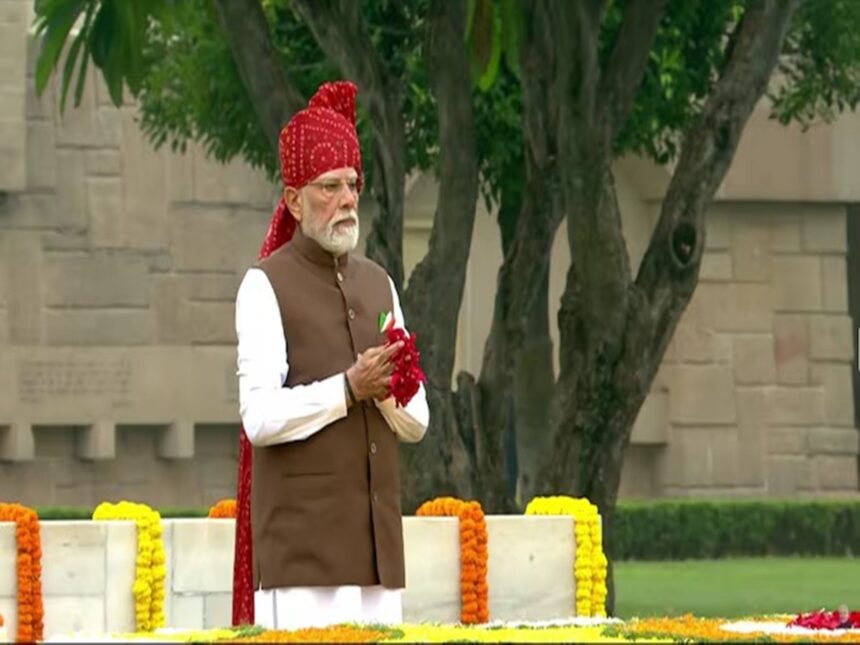
For his 13th Independence Day address from the Red Fort, Modi appeared in a bright maroon Bandhani safa decorated with yellow, green and white patterns.
He paired the traditional headgear with a white kurta-pyjama and brown Nehru jacket, creating a look that combined traditional Indian textiles with his familiar political style.
Earlier in the day, during his tribute to Mahatma Gandhi at Rajghat, Modi wore a plain red turban.
Over the years, his Independence Day safas have drawn inspiration from different parts of India, particularly the textile traditions of Rajasthan and Gujarat.
Why Does the Indian Turban Carry So Much Significance?
The pagadi, pagri or safa is more than a fashion accessory in many Indian communities. Its significance can vary depending on the region, community, occasion, fabric, colour and manner in which it is tied.
In Rajasthan, for instance, the safa has a strong connection with regional identity and traditional culture. Different colours and styles have historically been associated with particular occasions and communities.
Turbans also have deep religious significance within the Sikh tradition. They are associated with identity, dignity and equality, while also covering the hair, which holds religious importance for Sikhs.
In several Hindu traditions, turbans have traditionally represented honour, authority and social standing and are commonly worn during weddings and other important celebrations.
For Modi, the repeated use of regional textile styles has also been interpreted as a celebration of India’s diverse handicrafts and weaving traditions.
Do the Colours of Modi’s Safas Have a Message?
The colours and patterns chosen by Modi have frequently attracted political and cultural interpretations.
His 2025 saffron safa, for example, was widely associated with themes such as courage, sacrifice and the government’s “Viksit Bharat” vision.
Similarly, his 2022 white turban featuring saffron and green stripes closely echoed the colours of the Indian tricolour. The appearance came during the period of the “Har Ghar Tiranga” campaign.
While the Prime Minister does not necessarily assign a specific political meaning to every turban, the recurring use of regional designs and national colours has made his Independence Day clothing a subject of considerable public interest.
PM Modi’s Independence Day Turban Journey: 2014-2026
| Year | Turban/Safa Style | Key Feature |
|---|---|---|
| 2026 | Bright maroon Bandhani | Yellow, green and white dots; paired with white kurta-pyjama and brown Nehru jacket |
| 2025 | Saffron | Monochromatic saffron look with a tricolour stole |
| 2024 | Orange-green-yellow leheriya | Featured a deep pleated tail; associated with the “Viksit Bharat @ 2047” theme |
| 2023 | Multicoloured Rajasthani Bandhani | Worn with an off-white kurta and black jacket |
| 2022 | White with saffron-green stripes | Echoed the tricolour during the “Har Ghar Tiranga” campaign |
| 2021 | Saffron with red patterns | Featured a long pink trail and was paired with a blue jacket |
| 2020 | Orange-yellow | Long trailing design; stole also served as a face covering during the COVID-19 period |
| 2019 | Red-orange with green | Marked his first Independence Day address of his second term |
| 2018 | Orange-red | Plain design with a long trail, paired with a black-and-white stole |
| 2017 | Red-yellow with golden criss-cross pattern | Worn with a beige bandhgala-style kurta |
| 2016 | Pink-yellow Rajasthani safa | Paired with a simple white kurta |
| 2015 | Yellow with multicoloured criss-cross lines | Worn with a beige Nehru jacket and tricolour pocket square |
| 2014 | Bright red Jodhpuri Bandhej | Featured a green trail and marked Modi’s first Independence Day appearance as Prime Minister |
From Personal Style to an Independence Day Tradition
When Modi first appeared at the Red Fort in 2014, his bright red Jodhpuri Bandhej turban was primarily seen as part of his traditional Indian attire.
Over the years, however, the annual safa has become almost as recognisable as his Independence Day speech itself.
Each year’s choice introduces a different colour combination, textile tradition or regional influence. The result is a visual record of India’s diverse textile heritage — from Rajasthani Bandhani and Bandhej to Leheriya-inspired designs.
The turbans have also become among the most photographed elements of the Prime Minister’s Independence Day appearances, generating discussion among fashion writers, textile enthusiasts and political observers.
Whether viewed as a cultural tribute, a personal style signature or a subtle reflection of the year’s political themes, PM Modi’s changing Independence Day safas have become a distinctive part of India’s annual August 15 visual tradition.