
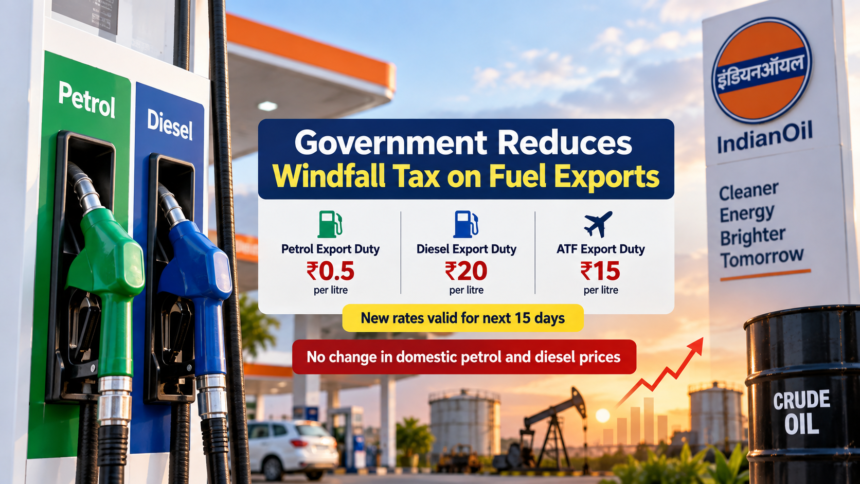
The central government has reduced the windfall tax on petroleum product exports as international crude oil prices remain elevated. The revised levy applies to petrol, diesel and aviation turbine fuel (ATF) exports.
However, there has been no change in the excise duty applicable to petrol and diesel sold for domestic consumption. This means the latest export-duty decision does not directly reduce the prices motorists pay at petrol pumps.
New Windfall Tax Rates on Petrol, Diesel and ATF
According to the Finance Ministry, the revised export duty has been fixed at ₹0.5 per litre for petrol, ₹20 per litre for diesel and ₹15 per litre for ATF. These rates will remain applicable for the next 15 days.
The government reviews the levy on domestically produced crude oil and petroleum product exports every two weeks. The rates are determined after considering international crude oil prices and refinery margins.
The export levies were introduced to help maintain domestic availability of petroleum products by discouraging excessive exports during periods of disruption in global energy markets.
Crude Oil Prices Remain Under Pressure
Crude oil prices have recently moved sharply higher amid escalating tensions involving Iran and strikes in Ukraine targeting Russian military installations. Brent crude crossed $108 per barrel earlier in the week.
In early trading, Brent crude was quoted at around $104.50 per barrel, down 1.22%.
Despite the movement in global crude prices, petrol and diesel prices have remained unchanged again. In Delhi, petrol is priced at ₹102.12 per litre, while diesel costs ₹95.20 per litre. The previous domestic price adjustment took place in May.
The rise in crude prices has, however, put pressure on the margins of government-owned oil marketing companies.
Will Petrol and Diesel Become Cheaper?
The reduction in the export levy should not be confused with a cut in the domestic tax on petrol or diesel. Since the excise duty on fuel sold for domestic consumption has not been changed, there is no immediate direct impact on petrol and diesel prices at retail outlets.
There could be an indirect effect depending on how oil companies balance domestic supplies and exports. Export levies are also used as part of measures aimed at ensuring adequate availability of petroleum products within the country.
For India, international crude prices remain particularly important because the country imports a substantial share of its crude oil requirements. If crude oil stays expensive due to the West Asia crisis, higher input costs could continue to affect petroleum products, transportation expenses and inflation.
What Is a Windfall Tax?
A windfall tax is an additional tax imposed on unusually high profits earned by companies when market conditions suddenly generate extraordinary gains.
For example, if an oil company earns significantly higher profits because international crude oil or petroleum product prices rise sharply, the government can impose an additional levy on a portion of those excess earnings.
Such a tax is known as a windfall tax and is intended to capture part of these exceptional gains during periods of unusually favourable market conditions.