
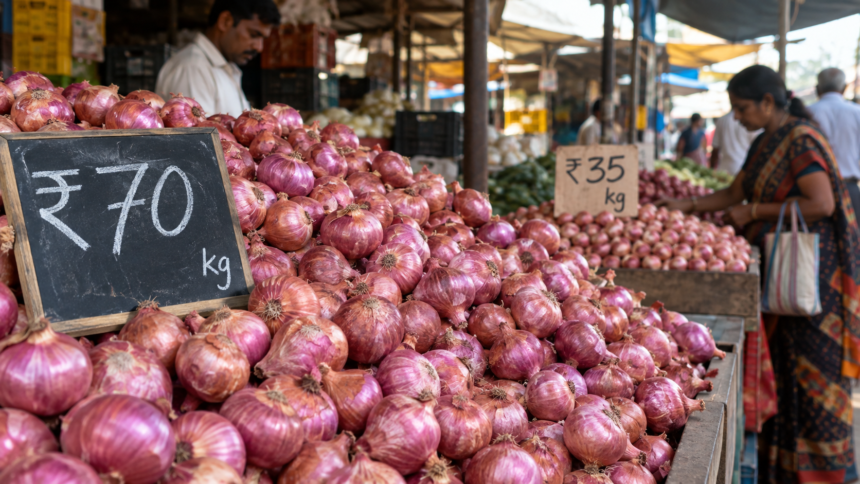
Onion prices have started putting pressure on household budgets again, with retail rates reaching around ₹60–70 per kilogram in many markets. The rise comes despite the government’s efforts to control prices by releasing onions from its buffer stock at ₹35 per kg.
The government began selling buffer-stock onions on August 24 through agencies including NCCF, NAFED and Kendriya Bhandar. Mobile vans are also being used to reach consumers, while the ‘Kanda Express’ is transporting onions from producing regions to major cities.
Why Are Onion Prices Still High?
The current price rise is largely linked to the gap between supply from the old and new crops. The market is currently moving from the Rabi onion season to the Kharif season.
Stocks of Rabi onions are gradually declining, while supplies of the new Kharif crop have not yet reached markets in sufficient quantities. This temporary supply gap has kept retail prices elevated in several areas.
Although the government is offering onions from its buffer stock at ₹35 per kg, these supplies are not reaching every market at the same pace. The time required to move onions from procurement centres to wholesale mandis and then to retail outlets also affects how quickly the lower-priced stock reaches consumers.
Government Increases Onion Procurement Price
For the 2026-27 period, the government has set a target of procuring 2 lakh tonnes of Rabi onions for its buffer stock. Around 1.21 lakh tonnes have already been procured.
To encourage farmers to supply onions for the government buffer, the procurement price has been increased from ₹18.75 to ₹21.25 per kilogram.
The government has also maintained that the country does not face an overall shortage of onions. Production for 2025-26 is estimated at 307.37 lakh tonnes, compared with 307.67 lakh tonnes in the previous year.
When Could Onion Prices Come Down?
The arrival of the Kharif onion crop will be an important factor for the market in the coming period. As supplies from the fresh harvest increase, the pressure created by the current supply gap could ease.
Government estimates from July also indicated that sufficient onion stocks were available in major producing states, including Maharashtra, Madhya Pradesh and Gujarat.
For now, however, consumers in many locations continue to pay significantly more than the government’s ₹35-per-kg buffer-stock selling price, as the availability of lower-priced onions varies from one market to another.