
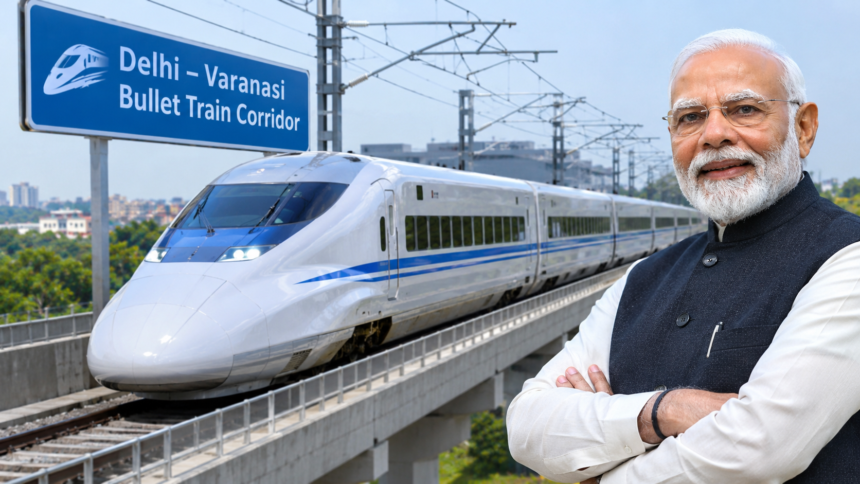
New Delhi: Prime Minister Narendra Modi has approved the proposed Northern Bullet Train Corridor, Railway Minister Ashwini Vaishnaw announced on Saturday. The high-speed rail network is expected to improve connectivity across several cities in northern India, including Uttar Pradesh. Once operational, it could reduce the travel time between Delhi and Varanasi to just 3 hours and 33 minutes.
Speaking to ANI, Vaishnaw said the proposed corridor was being planned as a long-term infrastructure project that could serve the country for several decades and potentially up to a century.
Bullet Train to Reduce Travel Time Between Major Cities
The proposed high-speed rail corridor is expected to make journeys between several important cities considerably faster. According to Railway Minister Ashwini Vaishnaw, the estimated travel times will be:
| Route | Expected Travel Time |
|---|---|
| Delhi to Kanpur | 1 hour 45 minutes |
| Delhi to Agra | 59 minutes |
| Delhi to Lucknow | 2 hours 12 minutes |
| Varanasi to Lucknow | 1 hour 21 minutes |
| Varanasi to Patna | 1 hour |
| Varanasi to Delhi | 3 hours 33 minutes |
| Varanasi to Prayagraj | 33 minutes |
| Varanasi to Agra | 2 hours 34 minutes |
Vaishnaw said the Northern Corridor could bring significant changes to regional connectivity. He highlighted its potential benefits for middle-class households, economically weaker sections, young people, small business owners and the micro, small and medium enterprises (MSME) sector.
Bullet Train Fares Expected to Be Lower Than Air Travel
Addressing concerns that high-speed rail services might be affordable only for wealthy passengers, the Railway Minister said infrastructure development was intended to serve different sections of society, including farmers, middle-class families and economically weaker communities.
He indicated that the proposed Delhi-Varanasi bullet train fare would be lower than the cost of air travel. This pricing approach is expected to make high-speed rail more accessible to a wider range of passengers.
Varanasi’s Namo Bridge Targeted for Completion by 2029
During a recent inspection of the new bridge project over the Ganga in Varanasi, Ashwini Vaishnaw announced that the structure would be named Namo Bridge.
The approximately 2.5-kilometre-long project has an estimated cost of Rs 2,657 crore, with completion scheduled for 2029. Its design will include a six-lane road on the upper deck and four railway tracks on the lower deck.
The bridge is expected to improve connectivity to Kashi Railway Station while providing better access to the Kashi Vishwanath Temple and Namo Ghat.
New Railway Tracks to Increase Train Capacity
The four railway tracks planned as part of the bridge project are expected to create capacity for more than 100 additional trains. This could benefit passengers travelling across Varanasi, Bihar and the Purvanchal region.
The new infrastructure is also expected to ease pressure on existing railway routes and help reduce traffic congestion within the city. The bridge will provide connectivity to Varanasi from three directions, linking the area near the Prime Minister’s adopted village on one side with Namo Ghat on the other.
Together, the proposed Northern Bullet Train Corridor and the Namo Bridge project are aimed at improving transport connectivity and expanding travel capacity across the region.
Disclaimer
This article is based on statements and project details provided in the supplied information. Proposed travel times, project costs, completion schedules and infrastructure plans may be subject to change. Readers should refer to official government and railway announcements for the latest updates and confirmed details.