
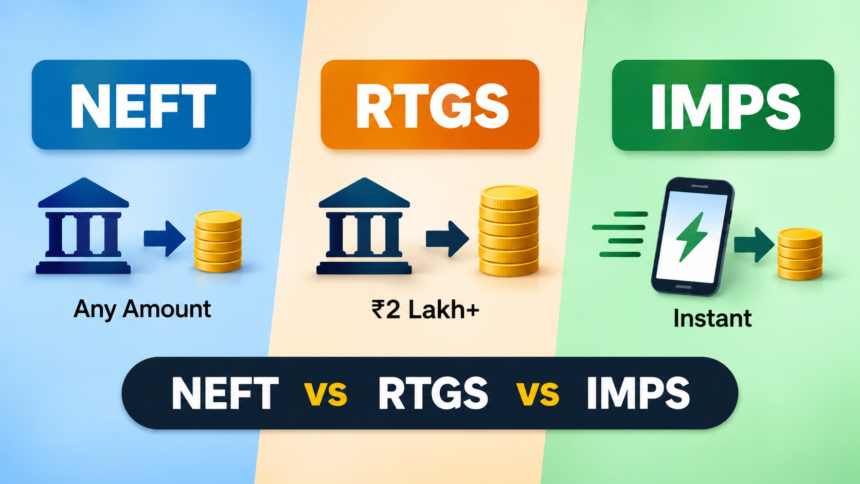
In the age of digital banking, transferring money from one account to another has become quick and convenient. With just a few taps on a smartphone or clicks on net banking, users can send money without visiting a bank branch.
While UPI has become one of the most popular ways to make instant payments, many people still use traditional electronic fund transfer services such as NEFT, RTGS and IMPS. However, these three payment systems work differently and are designed for different requirements.
So, which one is the fastest? Which service is better for large transactions? And when should you choose NEFT, RTGS or IMPS? Here’s everything you need to know.
What Is NEFT?
NEFT, or National Electronic Funds Transfer, is an electronic payment system that allows customers to transfer money from one bank account to another.
The system is operated by the Reserve Bank of India (RBI). Unlike real-time settlement systems, NEFT processes transactions through a batch-based mechanism. This means transactions are cleared in batches instead of being settled individually at the exact moment they are initiated.
One of the key advantages of NEFT is that there is no minimum amount required for a transfer. This makes it suitable for both relatively small and large payments.
NEFT is available 24 hours a day, seven days a week, although the actual credit time can depend on the processing and banking systems involved.
To make an NEFT transfer, customers generally need details such as the beneficiary’s name, bank account number, bank name and IFSC code.
Since transactions are processed in batches, NEFT may not always be as quick as instant transfer systems. Nevertheless, it remains a widely used, secure and economical option for bank-to-bank transfers.
What Is RTGS?
RTGS stands for Real Time Gross Settlement. As the name suggests, transactions through RTGS are settled individually in real time rather than being processed in batches.
RTGS is primarily intended for high-value transactions where immediate settlement is important.
The minimum amount that can generally be transferred through RTGS is Rs 2 lakh, while there is no prescribed maximum transaction limit under the RBI system, although individual banks may impose their own limits.
Because the transaction is settled in real time, RTGS is particularly useful when a large amount needs to reach the recipient without delay.
The service is considered a secure and reliable method of transferring substantial amounts of money and is commonly used for significant personal and business payments.
What Is IMPS?
IMPS, or Immediate Payment Service, is an instant electronic fund transfer facility managed by the National Payments Corporation of India (NPCI).
Its biggest advantage is that money can be transferred 24 hours a day, including weekends and bank holidays.
Depending on the bank and available facility, customers can initiate an IMPS transaction using different details, such as:
- Mobile number and MMID
- Bank account number and IFSC
- Aadhaar number
The instant nature of IMPS makes it a convenient option when money needs to be transferred immediately. It is generally suitable for small and medium-value bank transfers, particularly when UPI may not be the preferred option.
NEFT vs RTGS vs IMPS: Key Differences
| Feature | NEFT | RTGS | IMPS |
|---|---|---|---|
| Full Form | National Electronic Funds Transfer | Real Time Gross Settlement | Immediate Payment Service |
| Processing | Batch-based | Real-time | Instant |
| Availability | 24×7 | Real-time service | 24×7 |
| Minimum Transfer | No minimum | Rs 2 lakh | As per bank limits |
| Best For | Regular/non-urgent transfers | High-value urgent payments | Instant transfers |
| Operated/Managed By | RBI | RBI | NPCI |
Which Money Transfer Method Is Fastest?
If speed is your primary concern, IMPS and RTGS are generally the preferred options.
IMPS is designed for instant fund transfers and is available around the clock. RTGS also settles transactions in real time, making it particularly suitable for high-value payments.
NEFT, on the other hand, uses batch processing, so the transfer may take longer compared with real-time systems.
Which Is Better for Large Transactions?
For a high-value transaction of Rs 2 lakh or more, RTGS is generally the more suitable option when immediate settlement is required.
For example, RTGS can be considered for significant property payments, business transactions or other high-value transfers where the recipient needs the funds quickly.
For large payments that are not urgent, NEFT can also be a practical alternative.
When Should You Use NEFT, RTGS or IMPS?
Choosing the right transfer method depends mainly on the amount involved and how quickly the money needs to reach the recipient.
Choose IMPS When:
- You need to transfer money immediately.
- The transaction is small or medium-sized.
- You need to make a transfer outside regular banking days.
- You want a 24×7 bank transfer facility.
Choose NEFT When:
- The transfer is not extremely urgent.
- You want to send a small or large amount.
- You prefer a widely available and cost-effective bank transfer method.
- You are making regular payments such as rent or other scheduled transfers.
Choose RTGS When:
- You need to transfer Rs 2 lakh or more.
- The transaction is high-value.
- Immediate settlement is important.
- You are making a major personal or business payment.
NEFT vs RTGS vs IMPS: Which One Should You Pick?
There is no single payment method that is best for every situation. IMPS is convenient when speed and 24×7 availability are the priority, while NEFT works well for regular transfers that do not require immediate settlement.
For large-value transactions where real-time settlement is essential, RTGS is generally the preferred choice.
Before initiating any transfer, always verify the beneficiary’s account number, IFSC and other payment details carefully. A mistake in the recipient information can create difficulties in recovering the transferred funds.
Overall, understanding the difference between NEFT, RTGS and IMPS can help you choose the right banking channel based on the transaction amount, urgency and convenience.