
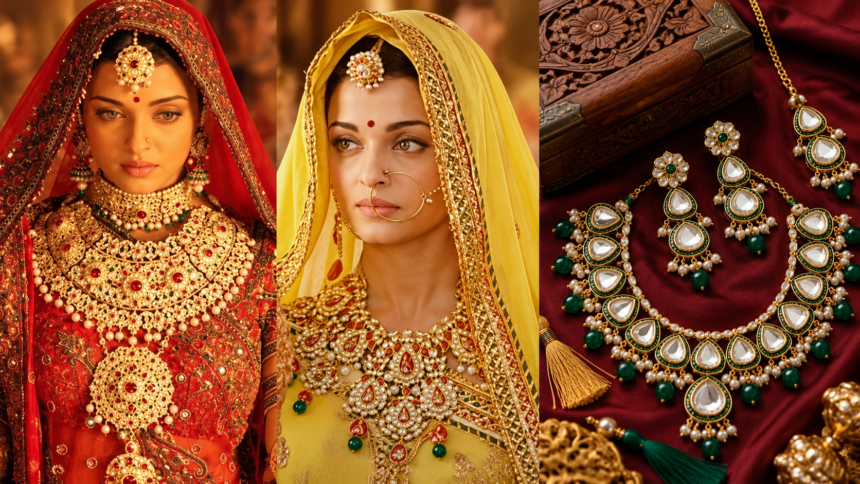
Kundan jewellery carries centuries of Indian craftsmanship and royal heritage within its intricate designs. With roots tracing back to the 3rd century BCE and strong associations with the royal courts of Rajasthan and Gujarat, the traditional craft continued to evolve over generations. Its popularity grew significantly during the Mughal era, while Jaipur eventually emerged as a major centre for Kundan jewellery.
Today, Kundan remains closely associated with Indian bridal fashion and continues to hold a prominent place in wedding jewellery collections in 2026.
What Is Kundan Jewellery?
The term ‘Kundan’ refers to highly refined pure gold. The traditional jewellery-making technique involves carefully placing gemstones within a metal framework, often using gold foil to secure the stones.
The process begins with the creation of the basic framework, known as Ghaat. This is followed by Paadh, during which wax is applied to the framework and shaped according to the required design.
The next stage is Khudai, where stones and uncut gems are carefully fitted into the structure. Meenakari, the decorative enamelling technique used to add colour and intricate detailing to metal surfaces, may also be incorporated into the jewellery.
During Pakai, gold foils are used to secure the gemstones firmly in place. The final stage, known as Chillai, involves polishing the jewellery to give it a finished appearance.
Where Did Kundan Jewellery Originate?
Kundan jewellery is believed to date back to at least the 3rd century BCE, with its early development associated with the royal courts of Rajasthan and Gujarat. It is regarded as one of India’s oldest jewellery traditions and has continued to survive through changing eras and fashion trends.
While elaborate Kundan pieces were associated with royalty, the technique was also adapted for silver jewellery, making the style accessible to people in regions including Rajasthan, Bihar and Punjab.
The craft is particularly distinctive because there is no indication that the same jewellery-making technique was historically practised outside India.
Kundan’s Rise During the Mughal Era
Kundan gained further prominence after receiving royal patronage during the Mughal period. The Mughals, who ruled India from 1526 to 1858, embraced the craft and helped expand its popularity from the 16th century onwards.
In Ain-i-Akbari, Mughal chronicler Abul Fazl described the exceptional purity and flexibility of Kundan gold, comparing its qualities to the legendary gold of Parviz.
The Mughal period also contributed to the development and popularity of Kundan Meenakari. In this style, the front features Kundan gemstone work, while the reverse is decorated with detailed and colourful enamel designs.
With influences from both Rajput and Mughal traditions, Kundan gradually established itself as an important Indian jewellery craft, with Jaipur eventually becoming a traditional centre for its production.
Why Is Kundan So Popular for Bridal Jewellery?
Kundan has long been a favourite among Indian brides, and its popularity continues in 2026. Its elaborate appearance makes it suitable for weddings, festivals and other traditional occasions, while many pieces are also preserved as family heirlooms.
Bridal Kundan jewellery often extends beyond a single necklace. A complete set can include heavy chokers, layered necklaces, chandelier earrings, large naths and maangtikas. The detailed arrangement of gemstones combined with the reflective finish of gold foil complements traditional bridal outfits such as sarees, suits and lehengas.
Popular culture has also played a role in keeping Kundan jewellery in the spotlight. Aishwarya Rai wore elaborate Kundan pieces while portraying Queen Jodha in Jodhaa Akbar. Nita Ambani, who has frequently supported Indian craftsmanship, has also been seen wearing Kundan necklaces on several occasions.
From royal courts to contemporary bridal fashion, Kundan jewellery has continued to evolve without losing its traditional identity. Its journey from ancient India and the Mughal era to modern wedding celebrations reflects the enduring appeal of traditional Indian craftsmanship.