
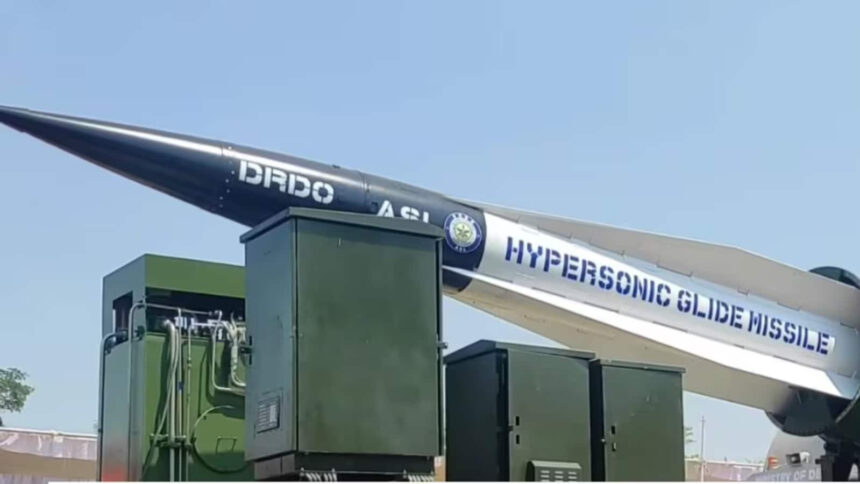
India Missile Programme: Over the past four decades, India has transformed its missile capabilities from a limited indigenous effort into a broad defence technology programme featuring ballistic missiles, cruise missiles, air-defence interceptors and emerging hypersonic systems.
Today, several Indian missiles can travel at speeds many times faster than sound. While range remains an important measure of military capability, speed has become equally significant. A weapon that reaches its target quickly can reduce the time available to an opponent for detection, decision-making and interception.
From the operational BrahMos and Agni families to next-generation systems such as BrahMos-II, India is increasingly focusing on combining speed, accuracy, mobility and survivability.
Why Missile Speed Matters
The higher a missile’s speed, the shorter the window available to an opposing defence system to detect, track and respond to it.
This becomes particularly important when a weapon is approaching a heavily protected target. Even a small reduction in reaction time can make interception more difficult.
High-speed weapons can also allow military forces to respond rapidly against strategically important targets or incoming threats. This is why modern missile development increasingly focuses not only on how far a missile can travel, but also on how quickly it can get there.
BrahMos-II: India’s Hypersonic Next Step
Among India’s most ambitious future missile projects is BrahMos-II, which remains under development.
The proposed system is expected to reach speeds of around Mach 7 to Mach 8, placing it firmly in the hypersonic category. If development targets are achieved, it could become one of the world’s fastest cruise-missile systems.
BrahMos-II is being developed by BrahMos Aerospace as a next-generation successor to the existing BrahMos. The programme is expected to use scramjet propulsion, a technology designed to support sustained hypersonic flight.
The planned missile could eventually be adapted for launch from different platforms, including land, naval and airborne systems. Such flexibility would potentially give India’s armed forces a rapid-strike capability against heavily defended targets.
BrahMos: India’s Supersonic Strike Weapon
The BrahMos has become one of the most prominent weapons in India’s conventional precision-strike arsenal.
The missile can travel at approximately Mach 2.8 to Mach 3, leaving an adversary with limited time to respond. Its combination of high speed, accuracy and low-altitude flight during parts of its trajectory makes it a challenging target for air-defence systems.
Developed jointly by India and Russia, BrahMos can be deployed from land-based launchers, naval vessels and modified Su-30MKI fighter aircraft.
Its ramjet propulsion system allows it to maintain supersonic speeds during much of its flight. Several versions of the missile have been developed for different launch platforms, while a submarine-launch capability has also been demonstrated.
Shaurya: High-Speed and Manoeuvrable
The Shaurya missile is another important Indian surface-to-surface weapon known for its high speed and manoeuvrability.
It has been reported to reach approximately Mach 7.5. One of its notable features is its ability to make trajectory adjustments during the later part of flight, potentially complicating interception.
The missile is designed for canisterised deployment, allowing it to remain stored and ready for launch while offering greater mobility and operational flexibility.
Agni-V: India’s Long-Range Strategic Missile
The Agni-V is a key component of India’s long-range strategic deterrence capability.
It uses a three-stage solid-fuel propulsion system and is deployed from a mobile, canister-based launcher. During its ballistic trajectory outside the atmosphere, the missile reaches extremely high velocities, with speeds exceeding Mach 20 during parts of its flight.
Its long reach and mobility provide India with an important strategic response capability.
Agni Prime: A New-Generation Ballistic Missile
The Agni Prime, or Agni-P, represents a newer generation of India’s ballistic missile technology.
Compared with earlier Agni variants, it is designed to be lighter, more compact and easier to deploy. Its canister-based system also allows quicker transportation and launch readiness.
Advanced navigation and guidance technologies are intended to improve accuracy. As with other ballistic missiles, Agni Prime reaches hypersonic velocities during portions of its flight, making interception a significant technical challenge.
K-4: India’s Underwater Strategic Capability
The K-4 submarine-launched ballistic missile forms an important part of India’s sea-based strategic deterrence.
Designed for deployment from India’s Arihant-class nuclear-powered submarines, the missile travels at hypersonic speeds during its ballistic flight.
Its submarine-based deployment is particularly significant because nuclear-powered submarines can remain underwater for extended periods. This gives India an additional layer of survivability and strengthens the country’s second-strike capability as part of its nuclear triad.
AD-1 and AD-2: Missiles Designed to Intercept Missiles
India’s missile programme is not limited to offensive systems. The country is also developing high-speed interceptor missiles intended to defend against incoming ballistic missile threats.
The AD-1 has undergone successful testing, while AD-2 is under development. These systems are designed to engage fast-moving ballistic targets, requiring extremely rapid detection, tracking and interception capabilities.
The interceptor programme forms part of India’s broader effort to strengthen its layered ballistic missile defence network.
Akash-NG: Strengthening Air Defence
The Akash Next Generation (Akash-NG) is an advanced Indian surface-to-air missile system designed to counter aerial threats such as fighter aircraft, drones and cruise missiles.
The system can reach speeds of around Mach 3 and is designed for rapid engagement of moving targets.
Compared with the earlier Akash system, Akash-NG incorporates improvements including an advanced seeker, a dual-pulse rocket motor and enhanced engagement capabilities. These upgrades are intended to improve its performance against increasingly sophisticated aerial threats.
What Allows These Missiles to Reach Such Speeds?
Different missile categories use different propulsion and flight technologies to achieve high velocities.
Ballistic missiles use powerful rocket motors to accelerate rapidly and climb to high altitudes. Much of their subsequent flight follows a ballistic trajectory before the warhead or re-entry vehicle descends towards its target.
Supersonic cruise missiles, such as BrahMos, use ramjet propulsion to sustain speeds above Mach 1 during flight.
Future hypersonic systems such as BrahMos-II are expected to use scramjet technology, which is designed to operate efficiently at extremely high speeds.
Advances in lightweight materials, onboard computers, navigation systems and guidance technologies also play an important role. High speed alone is not enough; a modern missile must be capable of maintaining its intended trajectory and achieving the required level of accuracy.
India’s Growing Hypersonic Ambitions
India is also investing heavily in hypersonic technology.
The Hypersonic Technology Demonstrator Vehicle (HSTDV) programme has helped demonstrate technologies associated with hypersonic flight and scramjet propulsion. Such research could eventually support future generations of high-speed cruise missiles, defensive systems and other aerospace technologies.
As several major military powers develop hypersonic weapons, India is seeking to establish capabilities in this rapidly evolving area of defence technology.
The Future of India’s Missile Technology
Modern missiles are no longer judged solely by their maximum range. Speed, precision, mobility, manoeuvrability and survivability have become equally important measures of capability.
India’s missile journey has evolved through decades of research involving scientists, engineers, defence organisations and the armed forces.
From the operational BrahMos and Agni families to the emerging BrahMos-II and hypersonic technology programmes, India is developing a diverse range of high-speed systems for different military roles.
As hypersonic technology matures, the next generation of Indian missiles could become not only faster, but also more accurate, manoeuvrable and difficult to counter.