
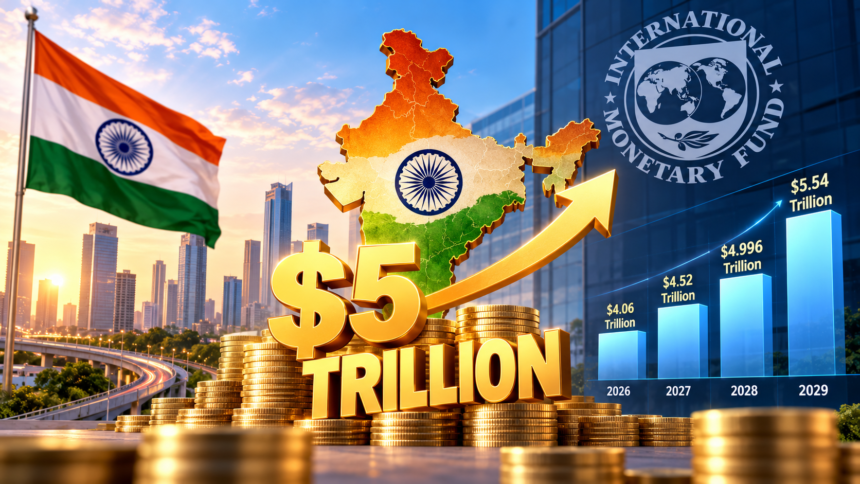
India may have to wait another year to reach the $5 trillion economy milestone, according to the latest projections from the International Monetary Fund (IMF). The organisation now expects India’s nominal GDP to cross the $5 trillion mark in 2029, instead of 2028 as estimated in April.
The revision comes despite stronger projections for economic growth in rupee terms. The main factor behind the delay is the depreciation of the Indian rupee against the US dollar, which reduces the dollar value of the country’s economic output.
In its latest estimates, the IMF has lowered India’s projected nominal GDP for 2028 to $4.996 trillion from the earlier estimate of $5.1 trillion. This highlights how currency movements can affect the international dollar value of an economy even when its domestic output continues to expand.
India’s Economy May Reach $5.54 Trillion by 2029
Despite the delay in achieving the $5 trillion milestone, India is expected to remain one of the world’s fastest-growing major economies. The IMF’s October projections estimate that India’s economy could be worth $4.06 trillion in 2026, rise to $4.52 trillion in 2027 and reach $5.54 trillion by 2029.
The country is also projected to become the world’s fourth-largest economy during this period. However, its position in global rankings will depend partly on exchange-rate movements and the performance of other major economies.
The weakening rupee has reduced the dollar value of India’s GDP, even as economic activity and output continue to grow in domestic currency terms.
Rupee Depreciation Reduces India’s GDP in Dollar Terms
The IMF has revised its exchange-rate projections for the rupee. Its estimate for the average exchange rate in 2028 has increased from ₹93.3 per US dollar in April to ₹95.5 per dollar. For 2027, the projected rate has been adjusted from ₹93 to ₹95 per dollar.
The rupee has weakened by more than 5% since the beginning of the year, putting additional pressure on India’s GDP when measured in US dollars.
At the same time, the IMF has raised its estimate of India’s nominal GDP in rupee terms for 2028 to ₹477.1 lakh crore, compared with ₹471.9 lakh crore in its April forecast. This represents an increase of approximately 1.1%.
Despite the higher rupee-denominated estimate, the projected dollar value of India’s GDP has fallen by around $63 billion.
According to the estimates, India’s economy could have crossed the $5 trillion mark in 2028 if the exchange rate had remained at ₹93.3 per dollar. At the revised projected rate of ₹95.5 per dollar, the same level of economic output translates into approximately $4.996 trillion.
These figures underline the impact that currency depreciation can have on the dollar-denominated size of an economy.
India Could Overtake Japan and the UK by 2027
India’s global economic ranking is expected to improve despite the revised timeline for reaching the $5 trillion target. According to the IMF’s October estimates, India could become the world’s fourth-largest economy by 2027, with a projected GDP of $4.52 trillion.
The UK’s economy is forecast to reach $4.49 trillion that year, while Japan’s GDP is projected at $4.47 trillion. The differences between the three economies are relatively small, meaning changes in exchange rates could influence their rankings.
The IMF also expects India’s economy to continue expanding over the following years. Its projections put the country’s GDP at $6.13 trillion in 2030 and $6.74 trillion in 2031. By 2031, India could overtake Germany to become the world’s third-largest economy.
IMF Raises India’s GDP Growth Forecast to 7%
Alongside its revised nominal GDP estimates, the IMF has raised its forecast for India’s real economic growth. In its October World Economic Outlook, the organisation increased its projection for the 2026–27 fiscal year from 6.4% to 7%.
The IMF attributed the upward revision to strong domestic demand and improving economic momentum.
Its outlook for nominal GDP growth in rupee terms has also improved. For 2027, the IMF now expects nominal GDP growth of 11.7%, up from its earlier projection of 10.8% made in April.
The latest estimates present two contrasting trends: India’s domestic economy is expected to maintain strong growth, but the weakening rupee is reducing the value of that output when converted into US dollars. As a result, the $5 trillion milestone may take longer to achieve, even as India continues to strengthen its position among the world’s largest economies.
Disclaimer: This article is intended for general informational purposes and is based on the IMF projections cited above. Economic forecasts and exchange-rate estimates may change as market conditions and economic developments evolve. The figures should not be treated as guaranteed outcomes or financial advice. Readers should consult official IMF publications and relevant government sources for the latest verified information.