
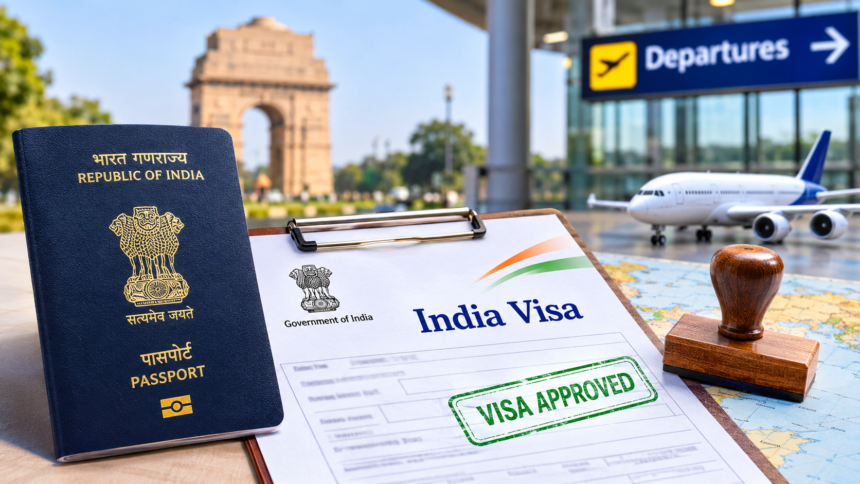
The Central Government has introduced significant changes to India’s visa system to make the application process easier for foreign visitors. Under the revised framework, the number of main visa categories has been reduced from 13 to nine, while the sub-categories have been brought down from 49 to 23.
The Ministry of Home Affairs (MHA) confirmed that the restructuring was carried out on August 27. This follows an earlier revision in October 2025, when the government reduced the main visa categories from 22 to 13 and the sub-categories from 63 to 49.
According to the ministry, the latest changes were introduced after examining visa policies followed by developed countries and considering international standards. The aim is to simplify applications while retaining essential verification requirements.
Tourist Visa Renamed Visitor Visa: New Categories Explained
One of the major changes is the renaming of the Tourist Visa as the Visitor Visa. The revised category has been divided into two sub-categories, V-1 and V-2.
The V-1 visa allows foreign visitors to travel to India for short business meetings, medical consultations, wellness-related visits, brief medical treatment and short courses in Indian languages, music, art and crafts. It provides multiple entries within a 30-day validity period.
The V-2 visa covers the same activities and additionally permits mountaineering. Depending on the purpose of travel, its validity can extend to one, five or 10 years. Foreign mountaineers will be issued multiple-entry visas valid for six months.
Medical and Student Visa Rules Revised
The government has reorganised the Medical Visa framework into four sub-categories to distinguish between different types of treatment and accompanying attendants.
Under the revised system, M-1 is intended for medical treatment other than AYUSH, while M-3 covers treatment under AYUSH systems. The M-2 and M-4 categories are meant for attendants accompanying patients under the respective medical visa categories.
According to the MHA, medical visas and their electronic versions will generally allow multiple entries and carry a validity of one year.
Student visas have also been divided into two categories:
- S-1 Visa: Covers school-level education, graduation and postgraduate studies.
- S-2 Visa: Includes research programmes, PhD courses, visiting faculty, internships, academic exchanges and other educational activities.
Foreign students admitted through the Study in India portal may be eligible for a multiple-entry e-S1 visa. Its validity can extend up to five years or the duration of the academic course, whichever is shorter.
New Business Visa Categories for Foreign Professionals
The revised visa framework also introduces changes to business-related travel and employment activities.
The B-1 visa covers long-term business activities that require licensing, including setting up industrial or commercial ventures in India.
The B-2 category is intended for short-term, contract-based assignments and activities. These include production-related investments, conferences, sporting events, performing arts and film-related work.
Foreign engineers, technical professionals and specialists employed by Indian companies can also apply electronically for a Production Investment Business Visa under the B-2 category. This replaces the earlier e-B4 provision.
Visa Application Forms Simplified by Up to 70%
Along with reducing the number of visa categories, the Ministry of Home Affairs has also simplified the application process.
According to the ministry, the number of fields in application forms across all 23 sub-categories has been reduced by approximately 65–70 per cent. Essential information required for identity verification and other checks will continue to be collected.
Following the latest restructuring, India’s nine main visa categories are:
- Business
- Diplomatic
- Work
- Journalist
- Medical
- Official
- Student
- Visitor
- Miscellaneous
The Miscellaneous category includes eligible individuals of Indian origin, dependants, visitors travelling for specified institutional purposes and certain long-term stays.
The ministry has also indicated that the necessary updates to the IT system are expected to be completed to enable visa issuance under the revised framework by the end of 2026.
Disclaimer: This article is intended for general informational purposes only. Visa categories, eligibility conditions, validity periods and application procedures are subject to government regulations and official notifications. Foreign nationals planning to visit India should consult the Ministry of Home Affairs or the official Indian Visa Portal for the latest requirements before submitting an application.