
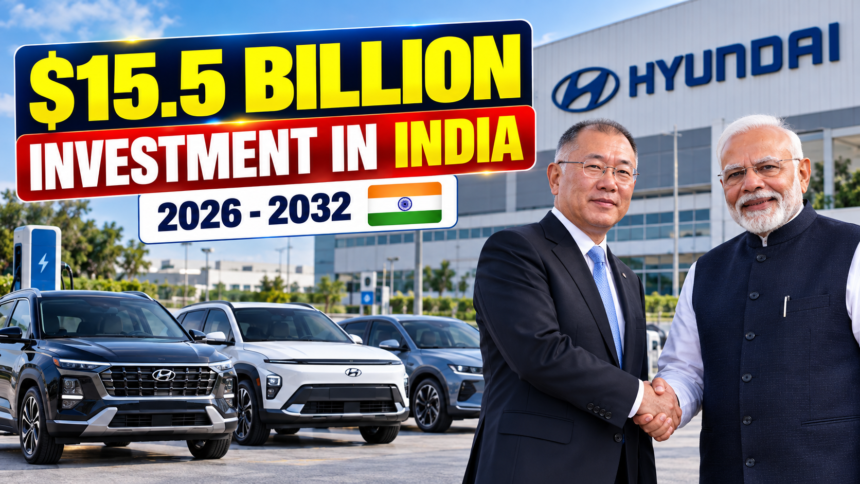
Hyundai Motor Group has announced an investment of $15.5 billion, equivalent to approximately ₹1.47 lakh crore, in India between 2026 and 2032. The South Korean automotive group plans to expand vehicle manufacturing, develop new technologies and strengthen its network of local suppliers.
The investment will cover Hyundai Motor India and Kia India, highlighting the group’s long-term plans for the Indian automobile market.
The announcement was made on October 13 after Hyundai Motor Group Executive Chair Euisun Chung met Prime Minister Narendra Modi in New Delhi. The proposed investment is expected to support manufacturing expansion, research and development, and the development of future vehicles.
Hyundai and Kia Plan to Expand Manufacturing Capacity
Hyundai Motor Group currently has the capacity to manufacture more than 14 lakh vehicles annually across its Indian operations. Its manufacturing facilities are located in Chennai, Anantapur and Pune.
- Chennai, Tamil Nadu: Hyundai’s manufacturing facilities have an annual capacity of 8.24 lakh vehicles.
- Anantapur, Andhra Pradesh: Kia’s plant has the capacity to produce 4.31 lakh vehicles annually.
- Pune, Maharashtra: Hyundai’s newer facility has an annual capacity of 1.70 lakh vehicles, with further expansion planned.
The group intends to increase production at its existing facilities in phases, with Pune expected to be an important part of its expansion plans. These plants will continue to serve Indian customers as well as international export markets.
New Hyundai Cars and Electric SUVs Planned for India
Hyundai has previously announced plans to introduce 26 new or updated models in India by 2030. Its product roadmap includes an electric SUV developed specifically for the Indian market and a new mid-size SUV with a petrol or diesel engine.
The company has also outlined plans for an India-focused electric SUV equipped with Level 2 driver-assistance technology and an updated infotainment system.
Alongside new vehicle launches, Hyundai aims to increase the proportion of locally sourced components to 90% by 2030. Greater localisation could strengthen domestic supplier partnerships and support the development of India’s automotive manufacturing ecosystem.
However, the latest $15.5 billion investment announcement does not include a new model-by-model launch schedule.
₹6,650 Crore Investment Planned for Research and Development
Hyundai Motor Group plans to allocate approximately $700 million, or ₹6,650 crore, to research and development activities in India. The investment will include a vehicle testing track and support further engineering and technology development.
The group’s broader investment plans also cover several other areas:
- Electric vehicle charging infrastructure
- Domestic automotive component suppliers
- Vehicle recycling businesses
- Automotive financing and mobility services
- Partnerships with Indian technology startups
Hyundai intends to establish a dedicated investment entity to coordinate these activities and manage the planned investments.
What Hyundai’s Investment Means for India
Hyundai Motor Group currently employs more than 24,000 people in India. The planned expansion could create additional opportunities in vehicle manufacturing, automotive engineering and component production.
The investment also reflects the company’s intention to strengthen India’s role in its global manufacturing and technology strategy.
However, Hyundai has not yet provided a detailed year-by-year spending schedule or disclosed the number of jobs expected to be created through the investment.
Disclaimer: This article is intended for informational purposes only and is based on the investment plans and company details provided in the report. Actual investment schedules, vehicle launches, manufacturing expansions and employment figures may change as further details are announced.