
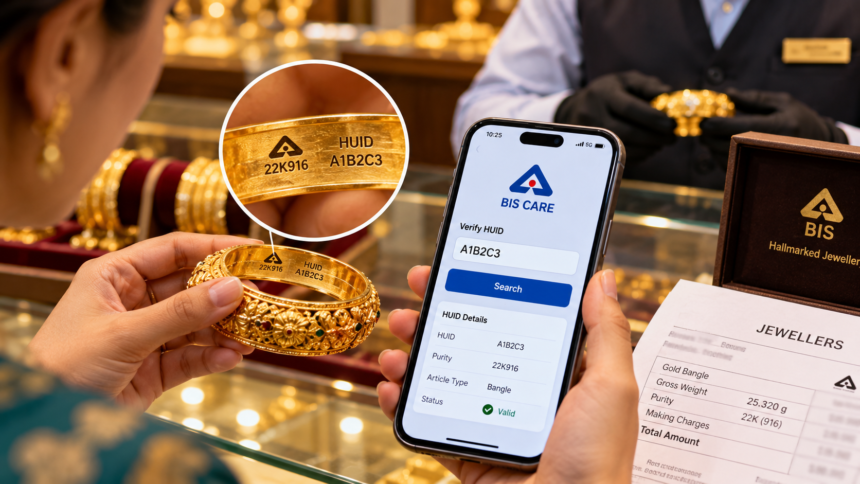
When buying gold jewellery, most customers look for the BIS hallmark before making a purchase. A hallmark provides an important indication of purity, but buyers should not stop their checks there. Consumers are being advised to carefully verify the HUID, purity marking and purchase documents before paying a premium price for gold.
Reports of fake hallmarking and misuse of HUID numbers have raised concerns about consumers being sold jewellery of lower purity as higher-purity gold. In such cases, an HUID may even appear in the BIS CARE app, making it important to compare the information displayed in the app with the actual jewellery.
Buy From a BIS-Registered Jeweller
Purchasing jewellery from a BIS-registered jeweller provides an important layer of assurance. BIS says jewellers selling hallmarked precious-metal articles are required to be registered with the organisation.
Customers should also insist on a proper bill. The invoice should contain details such as the description of the jewellery, net weight of the precious metal, purity in carat and fineness, and applicable hallmarking charges. BIS specifically advises consumers to retain authentic invoices because they can be important in case of a dispute or complaint.
Check the HUID Carefully
Every hallmarked gold jewellery article carries a six-digit alphanumeric HUID along with the BIS mark and purity marking under the current hallmarking system. BIS provides a “Verify HUID” facility through its official BIS CARE app, allowing consumers to check information associated with hallmarked jewellery.
However, simply finding an HUID number in the app should not end the verification process. Buyers should compare the information shown in the app with the jewellery they are purchasing, including the HUID and purity details.
If there is any mismatch between the jewellery, HUID information and documents provided by the seller, customers should seek clarification before completing the purchase.
Check the Gold Purity Mark
The purity marking is another important detail to inspect. Common examples include 22K916 for 22-carat gold, 18K750 for 18-carat gold and 14K585 for 14-carat gold. BIS documentation confirms these purity and fineness markings as part of the hallmarking system.
The actual purity of the gold is what determines its value, so buyers should carefully check the marking on the ornament rather than relying only on the presence of a hallmark.
Never Buy Gold Without a Proper Bill
A proper invoice is an important part of a gold purchase. Customers should ensure that the bill clearly records the jewellery details, weight, purity and price.
Avoiding a bill simply to get a slightly lower price can create problems later if the purity or other details of the jewellery are disputed. Keeping the original invoice also provides useful documentation for future complaints, exchanges or other transactions.
Get Suspicious Jewellery Tested
If the hallmark, HUID or invoice details do not match, consumers can have the jewellery tested at a BIS-recognised Assaying & Hallmarking Centre. BIS states that consumers can get jewellery or samples tested at recognised centres on a chargeable basis, with an assay report issued for the tested article.
The BIS CARE app also provides tools for verifying hallmarked jewellery and accessing information related to BIS services. Consumers should therefore use the available verification facilities and carefully check the jewellery before making a high-value purchase.
Disclaimer
This article is intended for general consumer awareness and information. Buyers should independently verify the hallmark, HUID, purity, invoice and other relevant details before purchasing gold jewellery. Rules, verification facilities and BIS procedures may change over time, so consumers should refer to official BIS information for the latest guidance.