
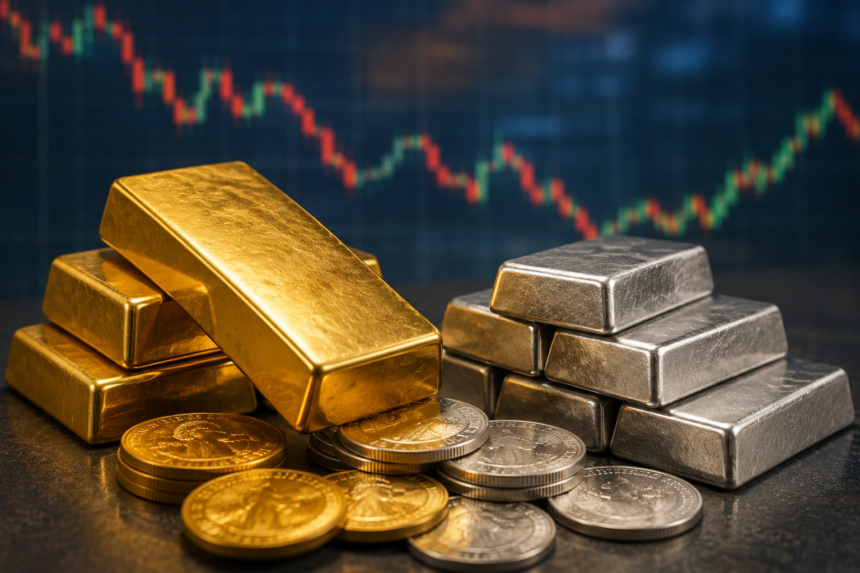
Gold and silver prices moved lower in international markets on Monday despite escalating geopolitical tensions in the Middle East. While growing uncertainty usually boosts demand for safe-haven assets, gains in the US dollar, rising Treasury yields, and surging crude oil prices put significant pressure on precious metals.
During Asian trading hours, COMEX gold fell 0.74% to $4,083.10 per ounce, down $30.60, while COMEX silver declined 1.86% to $59.045 per ounce, losing $1.12.
Rising Oil Prices Add Inflation Concerns
The decline in bullion prices came after Iran announced the closure of the Strait of Hormuz, one of the world’s most important oil shipping routes. The move triggered a sharp rise in energy prices, with Brent crude oil climbing above $78 per barrel.
Higher oil prices have increased concerns about global inflation, leading investors to believe that central banks, particularly the US Federal Reserve, may keep interest rates elevated for a longer period.
Why Are Gold and Silver Prices Falling?
Gold is widely regarded as a safe-haven investment during periods of political and economic uncertainty. However, it does not generate interest or dividends, making it less attractive when bond yields rise.
The surge in crude oil prices strengthened the US dollar and pushed US Treasury yields higher as markets reassessed expectations for future Federal Reserve policy.
A stronger dollar makes gold and silver more expensive for overseas buyers, reducing international demand. At the same time, rising bond yields increase the opportunity cost of holding non-yielding assets such as precious metals.
As a result, these macroeconomic factors outweighed the traditional safe-haven appeal of gold.
Silver faced even steeper losses because it is influenced not only by investment demand but also by expectations surrounding industrial activity and global economic growth.
US Inflation Data to Guide Market Direction
Investors are now focusing on key US economic indicators that could shape the Federal Reserve’s next interest rate decision.
This week’s major releases include:
- US Consumer Price Index (CPI) inflation data
- Retail sales figures
- Housing market data
- Weekly jobless claims
If inflation remains persistent, markets may expect the Federal Reserve to delay interest rate cuts or maintain higher borrowing costs, a scenario that generally weighs on gold and silver prices.
Middle East Conflict Remains a Key Market Driver
Geopolitical developments involving the United States and Iran continue to be closely monitored by global investors.
Any further escalation that pushes oil prices higher could strengthen the US dollar and Treasury yields even more, creating additional pressure on bullion prices.
However, if tensions intensify significantly and investors move away from riskier assets, demand for safe-haven investments like gold could rebound, limiting downside losses.
Outlook for Gold and Silver
Gold and silver are expected to remain highly volatile in the coming days as traders balance geopolitical risks against economic fundamentals.
While uncertainty in the Middle East continues to support safe-haven buying, rising oil prices, inflation concerns, stronger Treasury yields, and a firm US dollar remain major headwinds for precious metals.
The direction of bullion prices will likely depend on upcoming US inflation data, Federal Reserve policy expectations, and further developments surrounding the geopolitical situation in West Asia.