
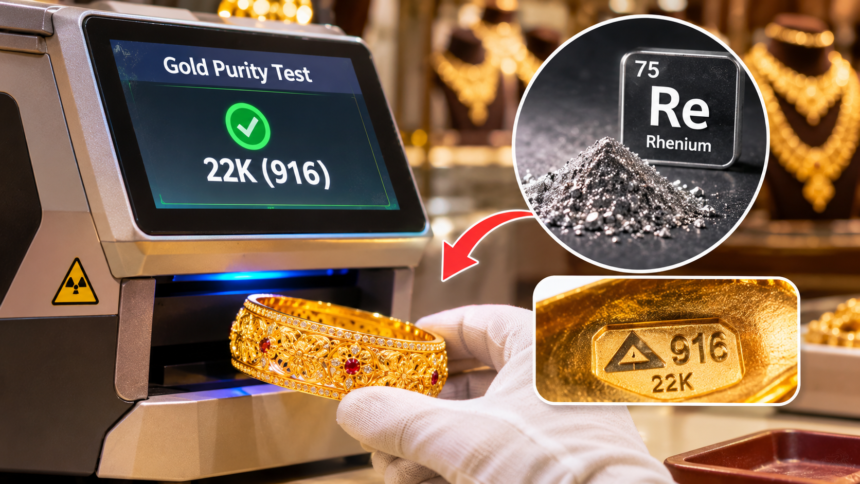
Gold Adulteration: Gold jewellery purchases in India are largely based on trust, purity certificates and hallmarking. Buyers generally check the weight, look for the 916 hallmark and rely on testing machines used by jewellers to confirm gold purity. However, a recent investigation in Rajasthan has raised concerns about whether some commonly used testing machines can identify sophisticated forms of gold adulteration.
The controversy emerged after an investigation in Jodhpur by Dainik Bhaskar reportedly found that rhenium, a heavy metal, could be mixed with gold and potentially escape detection by certain purity-testing machines.
According to the investigation, adding approximately 10% rhenium to gold could increase the jewellery’s weight while still producing readings associated with higher-purity gold. The findings have raised questions about the reliability of existing gold-testing methods and hallmarking procedures. However, the reported experiment has not yet been independently verified by government laboratories.
How Was Gold Adulteration With Rhenium Reportedly Detected?
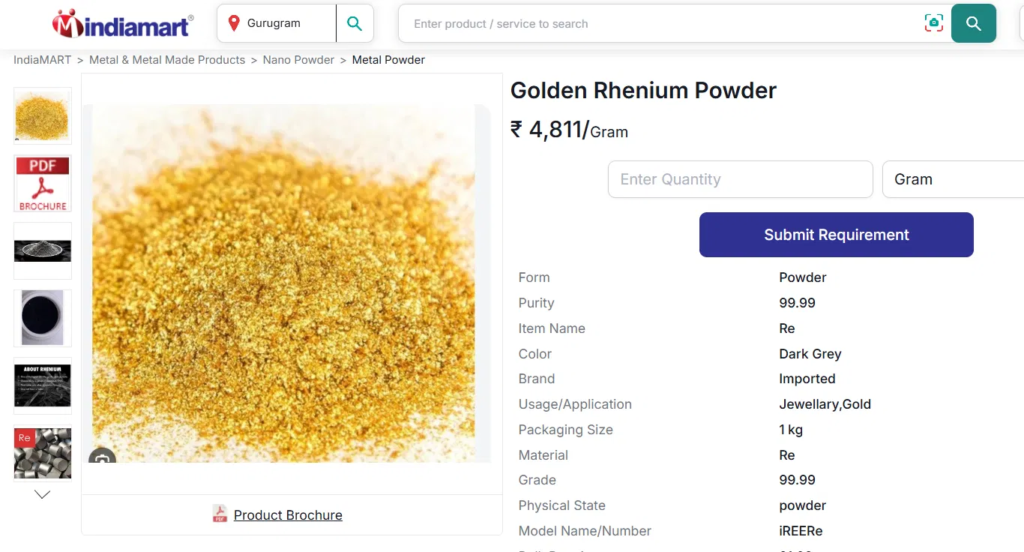
The investigation reportedly involved mixing one gram of rhenium powder with 7.83 grams of pure gold. After combining the materials, the total weight reached 8.83 grams.
The resulting material was reportedly used to make jewellery and tested at different locations. According to the investigation, some testing machines identified the jewellery as 22-carat gold.
It was also claimed that a hallmarking centre issued a 916 purity mark for the tested jewellery.
If these findings are independently confirmed, they could highlight a significant gap in existing purity-testing procedures. A 916 hallmark indicates that jewellery contains 91.6% gold. If some of the gold is secretly replaced with another metal, its actual gold content and market value will be lower than claimed.
What Is Rhenium and Why Can It Be Difficult to Identify?
Rhenium is a rare and heavy metal used in specialised industrial applications, particularly in components designed to withstand extremely high temperatures.
Because of its high density, it can potentially increase the weight of a gold mixture, making simple weight-based checks insufficient to identify adulteration.
Many jewellery retailers use X-ray fluorescence (XRF) machines, commonly known as karatmeters, to examine the composition and purity of gold. These machines primarily analyse the material near the surface of an object.
Certain older or incorrectly configured machines may fail to identify some metals accurately. However, advanced testing equipment can detect rhenium. Therefore, it would be incorrect to assume that this metal cannot be detected by any gold-testing machine.
How Can Gold Buyers Suffer Financial Losses?
Consider a customer purchasing a 10-gram ornament advertised as 22-carat gold. Based on the stated purity, the jewellery should contain approximately 9.16 grams of actual gold.
If some of this gold is secretly replaced with another metal, the customer receives less gold than the jewellery’s declared purity suggests.
The resulting financial loss depends on the actual gold content, the amount charged by the jeweller and the type of metal used for adulteration.
This is why checking the purity of jewellery is important before making a purchase, particularly when buying expensive ornaments.
How Can You Check Whether Your Gold Jewellery Is Genuine?
Gold buyers can take several precautions to reduce the risk of purchasing adulterated jewellery.
The Bureau of Indian Standards (BIS) recommends buying hallmarked ornaments and checking their six-character Hallmark Unique Identification (HUID) number through the BIS Care app.
Customers should also insist on a proper purchase invoice that clearly mentions the jewellery’s weight and purity.
If there are doubts about the quality of an ornament, buyers can approach a BIS-recognised Assaying and Hallmarking Centre for testing. In cases where test results are disputed, laboratory analysis using an appropriate validated method may be required.
The Jodhpur investigation has raised important questions about the ability of commonly used gold-testing machines to identify sophisticated adulteration. However, there is currently insufficient evidence to establish that rhenium adulteration is widespread across India’s jewellery market.
Disclaimer
This article is based on the reported findings of the Dainik Bhaskar investigation and the information provided in the source material. The allegations concerning rhenium adulteration have not yet been independently confirmed by government laboratories. The article is intended for general awareness and should not be treated as proof of widespread gold adulteration. Buyers are advised to verify jewellery purity through recognised testing facilities before making purchasing decisions.