
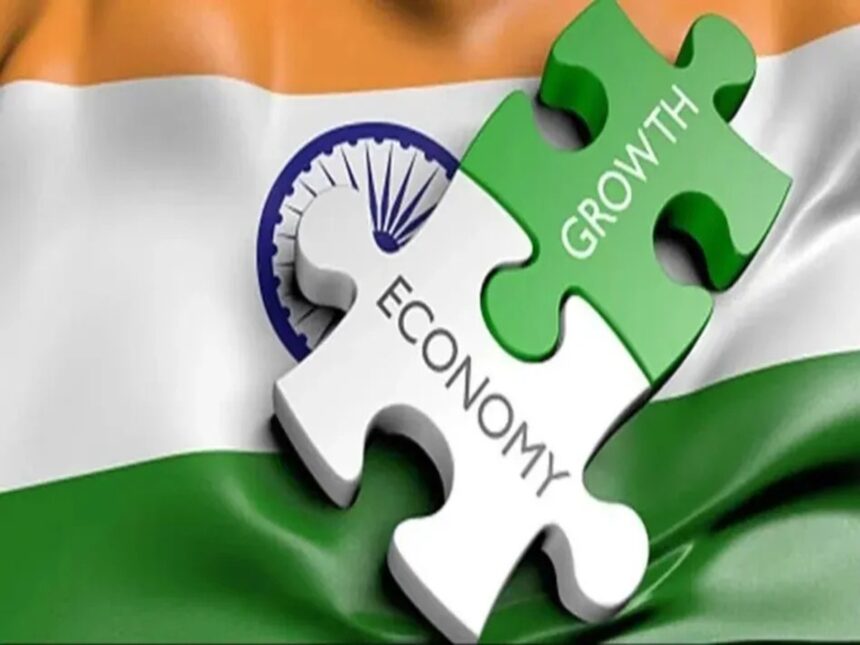
India is set to release its GDP data for the first quarter of financial year 2026-27 on August 31. The figures will cover economic activity between April and June 2026 and provide the first major indication of how the Indian economy performed at the beginning of the new financial year.
The quarterly GDP report will offer more than just a headline growth percentage. It will also reveal which parts of the economy — including consumption, investment, manufacturing, agriculture and services — contributed to growth.
But what exactly does GDP measure? What is included in India’s GDP calculation, and how does the government arrive at a growth figure for an economy as diverse as India?
What Is GDP?
GDP, or Gross Domestic Product, represents the monetary value of all final goods and services produced within a country’s geographical boundaries during a specified period.
In simple terms, GDP provides an estimate of the economic activity taking place within India over a particular quarter or year.
The term “final” is particularly important because GDP calculations are designed to avoid counting the same economic output multiple times.
For example, if a farmer sells wheat to a flour mill, and the flour mill later sells flour to a bakery, adding both transactions separately could result in double counting. Instead, GDP focuses on the value added at each stage of production or the value of the final product.
India’s GDP therefore covers a wide range of activities, from agriculture and manufacturing to construction, banking, insurance, transportation, hotels, telecommunications, information technology and other services.
What Goes Into India’s GDP?
India’s economy can be assessed from both the production side and the expenditure side.
On the production side, economic activity is classified into several broad sectors. These include:
- Agriculture, livestock, forestry and fishing
- Mining and quarrying
- Manufacturing
- Electricity, gas and water supply
- Construction
- Trade, hotels, transport and communication
- Financial, real estate and professional services
- Public administration and other services
The contribution generated by these sectors is measured through Gross Value Added (GVA).
GVA essentially represents the value created by producers after taking into account the cost of inputs used during production.
GDP is calculated from GVA by adding taxes on products and subtracting subsidies on products.
GDP From the Spending Side
Another way to understand the economy is by examining where money is being spent.
The expenditure approach broadly includes:
- Private consumption: Spending by households on goods and services
- Government consumption: Expenditure by the government
- Investment: Spending on machinery, buildings and other productive assets
- Net exports: Exports minus imports
Exports contribute to GDP because they represent goods and services produced domestically. Imports, on the other hand, are deducted because those products are made outside the country.
How Is GDP Calculated?
There are three internationally recognised approaches to measuring GDP:
1. Production Approach
This method calculates the value generated by different economic activities and sectors.
2. Expenditure Approach
Here, GDP is estimated by adding expenditure on final goods and services across the economy.
3. Income Approach
This approach measures the income generated during production, including employee compensation, operating surplus and other related components.
In principle, all three methods should produce the same GDP figure because production creates income, while the resulting output is ultimately purchased through expenditure.
In reality, statistical agencies collect information from numerous databases and sources and reconcile the estimates to arrive at the final figures.
For example, if a company produces goods worth Rs 100, the production approach captures that output. The expenditure approach records the money spent on purchasing the final goods, while the income approach tracks the earnings generated for workers, companies and other participants in the production process.
Why Quarterly GDP Figures Can Change
Quarterly GDP estimates are generally more preliminary than annual estimates because complete information is not immediately available.
As additional data comes in, previous quarterly GDP figures can be revised. Therefore, the first estimate should not always be considered the final picture of economic performance.
Real GDP vs Nominal GDP
One of the most important distinctions when discussing economic growth is the difference between nominal GDP and real GDP.
Nominal GDP calculates economic output using current prices. This means it can increase either because the country produces more goods and services, because prices rise, or because both happen simultaneously.
Real GDP, on the other hand, adjusts for changes in prices and is therefore more useful for assessing the actual growth in the volume of economic activity.
For instance, if a car manufacturer produces exactly the same number of vehicles but raises prices significantly, nominal GDP could rise even though physical production has remained unchanged.
Why Did India Change Its GDP Base Year?
India recently introduced a new GDP series using 2022-23 as the base year, replacing the previous 2011-12 base year. The new series was released by the Ministry of Statistics and Programme Implementation (MoSPI) in February 2026.
The base year serves as a reference period for calculating real economic growth. It needs to be updated periodically so that national income statistics better reflect changes in the structure of the economy.
The government selected 2022-23 as the new reference year because it was considered a relatively stable period following the major disruptions caused by the Covid-19 pandemic. It also offered access to more comprehensive and updated economic data.
What Has Changed in the New GDP Series?
The revised GDP framework incorporates newer data sources and methodological improvements.
These include greater use of GST information, improved coverage of unincorporated businesses, data from the Annual Survey of Unincorporated Sector Enterprises (ASUSE), the Periodic Labour Force Survey (PLFS), e-Vahan data and other administrative databases.
MoSPI has also introduced double deflation for agriculture and manufacturing and modified the methodology used to benchmark quarterly GDP estimates.
The objective is to make national income estimates more comprehensive and improve their ability to capture structural changes in the Indian economy.
Why Is the Q1 FY27 GDP Number Important?
The upcoming Q1 GDP figure will provide the first official assessment of India’s economic performance in FY2026-27.
Beyond the headline growth rate, economists and investors will closely examine the underlying data to determine what is driving the economy. Consumption, private investment, government expenditure, manufacturing, construction, agriculture and services will all be important indicators.
According to rating agency ICRA, India’s GDP growth could slow to 7 per cent in the April-June 2026 quarter, compared with 7.8 per cent in the March quarter of FY26. ICRA attributed the expected moderation partly to slower growth in the services sector.
The agency has projected industrial growth at 7.7 per cent, agricultural growth at 4 per cent and services growth at 7.9 per cent for the June quarter.
For the entire FY2026-27, ICRA expects India’s GDP growth to moderate to 6.7 per cent, compared with 7.7 per cent estimated for FY2025-26.
The Q1 GDP release will therefore be closely watched as it could provide important clues about the direction of India’s economy, the strength of domestic demand and the pace of growth expected through the rest of the financial year.