
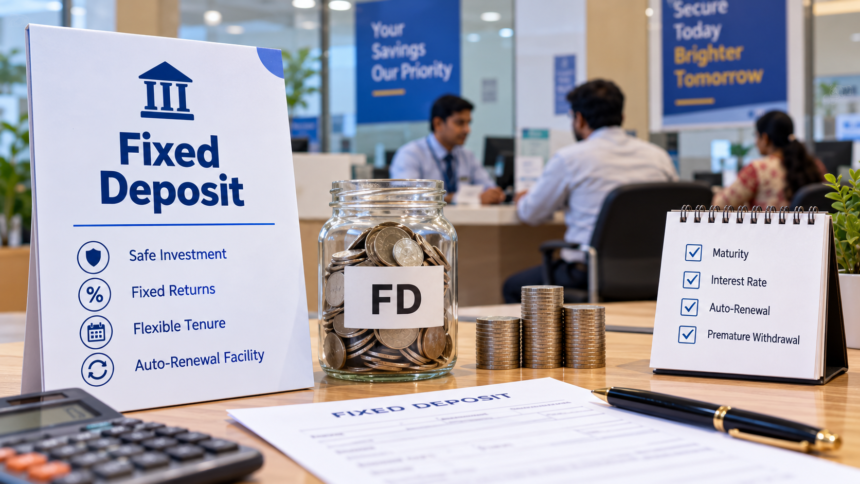
With stock market volatility affecting investor confidence, many people are considering safer investment options such as fixed deposits (FDs). FDs offer predictable interest earnings, making them an attractive choice for investors who prefer relatively stable returns.
The Sensex has reportedly declined by more than 14.5% in 2026, while the Nifty 50 has fallen by around 13.5%, according to the figures provided. Against this backdrop, investors looking for stability should also pay attention to their bank’s fixed deposit rules. One feature that deserves particular attention is automatic FD renewal, which can sometimes result in lower returns or additional charges.
What Is the Auto-Renewal Facility in Fixed Deposits?
Many investors maintain several fixed deposits across different bank accounts. Remembering the maturity date of every deposit can be difficult, so banks offer an auto-renewal facility that renews an FD when its term ends.
This feature can save time and prevent money from remaining in a savings account after maturity. However, automatic renewal does not always mean that the deposit will earn the best available interest rate.
Banks follow different renewal policies. Some renew a deposit for the same period as the original FD, while others may apply a different tenure according to their terms and conditions.
How Auto-Renewal Can Affect Your FD Returns
Interest rates vary according to deposit tenure and prevailing market conditions. Banks may offer special rates on particular tenures, such as 400-day or 15-month fixed deposits.
If an FD is automatically renewed for 12 months instead of a tenure offering a higher rate, the investor could miss out on better returns. Depending on the bank’s rates, the difference could be around 0.50 to 0.75 percentage points, as illustrated in the supplied information.
Interest rates may also change between the original deposit date and the renewal date. Reviewing the available rates before renewal allows investors to compare different tenures and select an option that better matches their financial goals.
Before enabling auto-renewal, customers should check the bank’s renewal policy, applicable interest rates and available deposit options.
Premature Withdrawal After Auto-Renewal May Cost You
Another important consideration is premature withdrawal. Once an FD matures and is automatically renewed, the bank may treat the renewed deposit as a new fixed deposit.
If the customer withdraws the money a few days later, the bank may apply its premature withdrawal rules to the newly renewed FD. Depending on the bank’s terms, this can reduce the interest payable.
For example, a customer who withdraws funds four or five days after renewal may not receive the same interest treatment as someone withdrawing the original deposit on its maturity date.
Banks may apply a penalty of 0.50% to 1% to the applicable interest rate for premature withdrawals, depending on their policies. The interest payable may also be calculated using the rate applicable to the actual period for which the deposit remained with the bank.
As a result, customers could receive less interest than expected. The exact calculation and any applicable penalty depend on the bank’s rules and the conditions agreed upon when opening the FD.
What Should FD Investors Check Before Renewal?
Before allowing a fixed deposit to renew automatically, investors should review its maturity date, the latest interest rates and the available tenure options. They should also check whether the bank applies any penalty for premature withdrawal and how interest is calculated after renewal.
Auto-renewal can be convenient, but reviewing a maturing FD before it renews may help investors make a more informed decision about their savings.
Disclaimer
This article is intended for general informational purposes and does not constitute financial advice. Interest rates, renewal procedures and premature withdrawal penalties vary between banks and deposit products. Investors should review the applicable terms and conditions and confirm the latest details with their bank before making decisions about fixed deposits.