
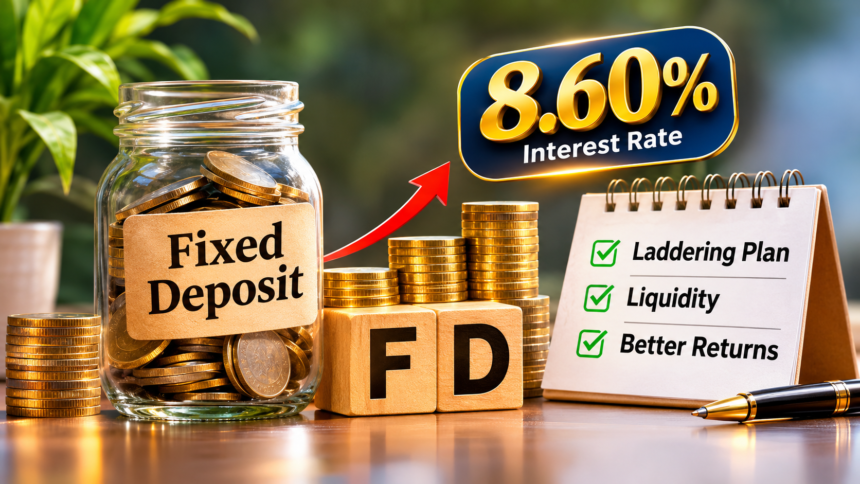
Fixed deposits offering interest rates of up to 8.60% are drawing attention from investors looking for stable and predictable returns. However, investing the entire savings amount in a single FD may reduce access to funds when unexpected expenses arise.
FD laddering is one approach that can help investors manage this concern. It involves dividing the total investment into multiple fixed deposits with different maturity periods, allowing them to balance interest earnings, liquidity and reinvestment risk.
With banks offering attractive FD rates across various tenures, from 444 days to five years, investors need to consider whether to choose one deposit with a higher rate or distribute their savings across several deposits.
For an investment of ₹10 lakh, a laddering strategy can provide access to money at different intervals without having to close one large FD prematurely.
What Is FD Laddering and How Does It Work?
FD laddering is a method of investing in multiple fixed deposits with different maturity dates instead of putting the entire amount into a single deposit.
For example, an investor can divide ₹10 lakh into four FDs of ₹2.5 lakh each. These deposits could mature after approximately 444 days, 555 days, three years and five years.
When each FD reaches maturity, the investor can either use the money for planned expenses or reinvest it at the interest rates available at that time.
This arrangement provides access to funds at regular intervals and reduces the need to depend on a single maturity date.
FD Laddering vs One Large Fixed Deposit
| Parameter | FD Laddering | One Large FD |
|---|---|---|
| Investment | Divided among multiple deposits | Entire amount placed in one deposit |
| Maturity | Different maturity dates | Single maturity date |
| Liquidity | Access to funds at different intervals | Depends on the withdrawal terms |
| Interest rates | Different rates across tenures | One contracted interest rate |
| Reinvestment risk | Spread across multiple maturity dates | Concentrated at maturity |
| Premature withdrawal | Only one deposit may need to be closed | The larger deposit may need to be broken |
| Returns | Depend on the selected rates and tenures | Depend on the chosen interest rate |
| Suitable for | Investors who need flexibility | Investors with a fixed investment horizon |
How to Divide ₹10 Lakh Across Different FD Tenures
An investor can consider spreading ₹10 lakh equally across four deposits, with each FD having a different maturity period.
| Investment Amount | FD Tenure | Purpose |
|---|---|---|
| ₹2,50,000 | 444 days | Near-term liquidity |
| ₹2,50,000 | 555 days | Medium-term expenses |
| ₹2,50,000 | 3 years | Long-term savings |
| ₹2,50,000 | 5 years | Opportunity to access higher long-term rates |
| ₹10,00,000 | Staggered maturities | Liquidity and flexibility |
As these deposits mature at different times, investors can decide whether to withdraw the amount or renew it based on their financial requirements and prevailing FD rates.
This allocation is only an illustration and should not be treated as a recommendation to invest in any particular bank or tenure.
Which Banks Are Offering the Highest FD Interest Rates?
According to the interest rate comparison published by Stable Money on November 12, small finance banks continue to offer some of the most competitive fixed deposit rates.
Suryoday Small Finance Bank is offering an interest rate of up to 8.25% per annum to regular customers and 8.60% to senior citizens on five-year fixed deposits. Ujjivan Small Finance Bank is offering up to 8.10% to regular customers and 8.60% to senior citizens on select tenures.
Among other lenders, Bank of Baroda has increased its highest FD interest rate for regular customers from 6.75% to 6.85%. Senior citizens can earn up to 7.35%.
Indian Overseas Bank is offering 6.75% to regular depositors and 7.25% to senior citizens on its 444-day fixed deposit scheme.
Highest FD Interest Rates Across Selected Banks
| Bank | Regular Customers | Senior Citizens | Applicable Tenure |
|---|---|---|---|
| Suryoday Small Finance Bank | 8.25% | 8.60% | 5 years |
| Ujjivan Small Finance Bank | 8.10% | 8.60% | Select tenures |
| Bank of Baroda | 6.85% | 7.35% | 555 days |
| Indian Overseas Bank | 6.75% | 7.25% | 444 days |
Disclaimer: Interest rates and investment examples mentioned in this article are based on the information provided in the source material and may change over time. Actual returns depend on the bank, deposit tenure, customer category and applicable terms. Investors should check the latest rates and conditions directly with the respective banks before making an investment decision.