
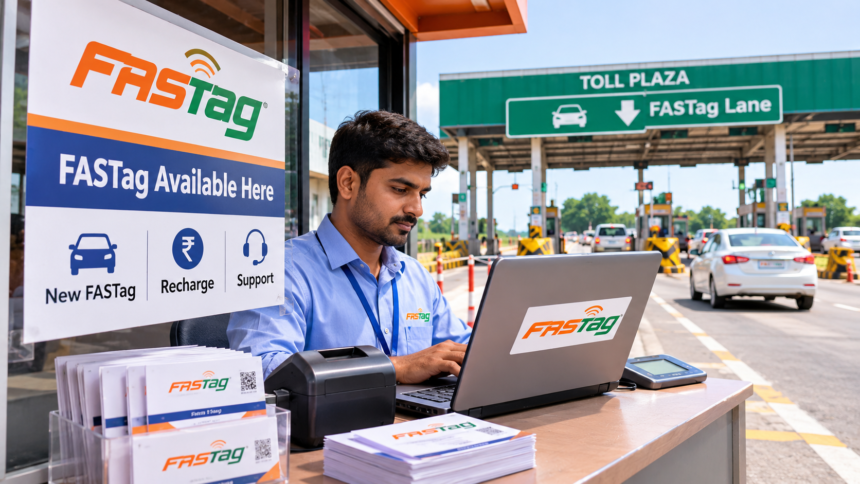
New Delhi: FASTag has become an essential part of highway travel, allowing vehicles to pay toll charges electronically without stopping for cash transactions. Along with its growing use, FASTag sales and recharge services have also created business opportunities for people interested in earning through agent networks.
Many toll plazas have agents who help vehicle owners purchase new FASTags, activate them and recharge existing accounts. However, their earnings are not limited to selling new tags. Commissions from banks, recharge margins and other related services can also contribute to their income.
For those considering this business, understanding how FASTag agents work, how commissions are calculated and what monthly earnings may look like is important.
How Can You Become a FASTag Agent?
People interested in starting a FASTag business generally have two options.
The first is to work as an agent for a bank or a third-party service provider. In this arrangement, agents may receive a fixed monthly salary ranging from ₹12,000 to ₹18,000. Additional incentives may also be available depending on sales performance and assigned targets.
The second option is to operate independently as a freelance agent. Individuals can partner with banks or authorised payment platforms and obtain an agent ID. After completing the required process, they can issue FASTags to customers and provide services such as balance recharges.
This arrangement allows agents to earn commissions based on the services they provide and the number of transactions they handle.
How Much Commission Can You Earn From FASTag Sales?
FASTag agents can generate income whenever they successfully issue a new tag to a vehicle owner. The commission is generally determined by the bank’s policies and the category of vehicle.
According to the illustrative figures in this business example, an agent receives ₹70 for issuing a FASTag for a car and ₹100 for a truck.
Recharge services provide another potential source of earnings. Drivers sometimes reach toll plazas with insufficient FASTag balances and may need assistance adding money to their accounts. Agents can provide recharge facilities and earn a margin on the transaction value.
For example, consider an agent who issues FASTags to eight cars and four trucks in a day.
The estimated commission would be:
- 8 car FASTags × ₹70 = ₹560
- 4 truck FASTags × ₹100 = ₹400
- Total sales commission = ₹960
If the agent additionally handles recharge transactions worth ₹20,000 and earns a 1% margin, the additional income would be ₹200.
This brings the combined daily earnings to ₹1,160 based on these two activities.
The original example also mentions potential daily earnings of ₹1,450, but the additional ₹290 is not explained by the listed commission and recharge figures. Actual earnings will depend on the services offered, transaction volume and applicable commission rates.
How Much Can a FASTag Agent Earn in a Month?
Monthly earnings depend on the number of working days, FASTag sales and recharge transactions completed by the agent.
The example estimates monthly income by assuming 26 working days and daily earnings of ₹1,450. However, the calculation needs correction: ₹1,450 multiplied by 26 comes to ₹37,700, not ₹37,960.
Similarly, using the explained daily earnings of ₹1,160, the estimated monthly income for 26 working days would be ₹30,160.
These figures are illustrative rather than guaranteed earnings. Daily sales and recharge volumes can change depending on customer demand, vehicle traffic and the agent’s business arrangements.
For anyone considering a FASTag agency, understanding the commission structure and checking the terms offered by the bank or authorised service provider is essential before starting.
Disclaimer: This article is intended for general informational and business awareness purposes only. The commission amounts and income examples are illustrative and may vary depending on bank policies, authorised service provider agreements, vehicle categories and transaction volumes. FASTag agency earnings are not guaranteed. Interested individuals should verify the latest commission structure, eligibility requirements and registration process with the relevant bank or authorised provider before investing.