
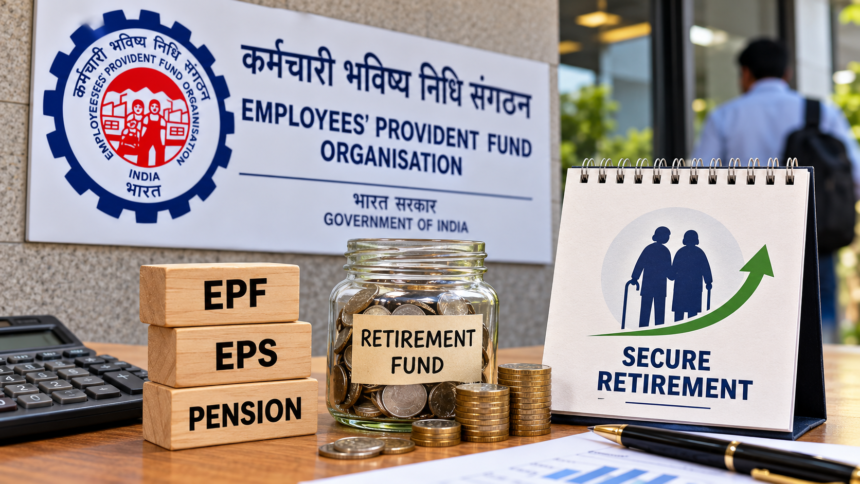
Employees covered under the Employees’ Provident Fund Organisation (EPFO) should understand how changes to the salary ceiling for provident fund coverage could affect their retirement savings and pension benefits. Reports suggesting an increase in the monthly salary limit from ₹15,000 to ₹25,000 have raised questions about how contributions would be divided between the Employees’ Provident Fund (EPF) and the Employees’ Pension Scheme (EPS).
According to the claims outlined in the report, a higher salary ceiling could result in a larger share of eligible employer contributions going towards pension benefits rather than accumulating in an employee’s PF balance. This could affect the lump-sum amount available at retirement. However, the reported figures and any claimed rule change need to be verified through official EPFO announcements before employees rely on them.
How EPF and EPS Contributions Affect Retirement Benefits
EPF and EPS serve different purposes. The EPF account builds retirement savings that eligible members can withdraw according to the applicable rules, while the EPS provides a pension to members who meet the scheme’s eligibility requirements.
The employer’s contribution is divided between these schemes according to the applicable rules. Any change in the salary ceiling or contribution structure could therefore affect the amount accumulated in an employee’s EPF account and the pension benefits available later.
The original report estimates that the retirement lump sum could be around ₹20 lakh lower under the proposed arrangement. It also claims that eligible employees could receive a monthly pension of approximately ₹9,600 from the age of 58. These figures should be treated as reported estimates, not guaranteed benefits, unless confirmed by official notifications and individual calculations.
Who Is Eligible for a Monthly EPFO Pension?
Under the Employees’ Pension Scheme, eligible members generally need at least 10 years of eligible pensionable service to qualify for a regular monthly pension at the age of 58.
Employees who have not completed the required pensionable service may not qualify for a regular monthly pension, although withdrawal benefits may be available under the applicable rules.
Pension eligibility and the amount payable depend on factors such as pensionable salary, eligible service and the rules applicable to the member. Consequently, not every EPFO subscriber will automatically receive the same monthly pension.
What Employees Should Check Before Retirement
Employees should review their service history, Universal Account Number (UAN) details and pension contributions before making retirement plans. They should also confirm whether any reported increase in the salary ceiling has been formally approved and implemented.
For accurate information about contribution limits, pension eligibility and retirement benefits, members should consult the official EPFO website or contact their regional EPFO office. Checking the applicable rules can help employees understand their expected retirement savings and pension entitlement.
Disclaimer
This article is intended for general informational purposes only and does not constitute financial, investment or retirement advice. The reported salary-limit change and estimated pension and retirement figures have not been independently verified and should not be considered confirmed entitlements. EPF and EPS benefits depend on official rules, individual service records and applicable eligibility conditions. Readers should verify the latest notifications directly with EPFO before making financial or retirement decisions.