
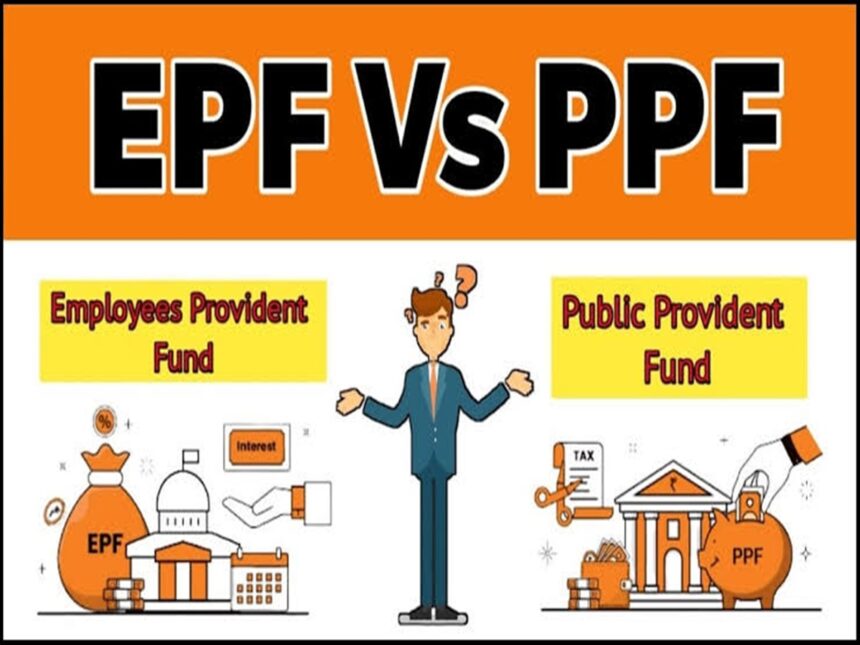
EPF and PPF are both government-backed savings options, but they work very differently. Here’s how the two compare and why using both could strengthen your retirement plan.
Planning for retirement often brings up two familiar investment options in India: the Employees’ Provident Fund (EPF) and the Public Provident Fund (PPF). While both are designed to encourage long-term savings, they are meant for different types of investors and financial situations.
So, should you choose EPF or PPF?
There may not be a single answer. Understanding how each scheme works—and how it fits into your financial goals—can help you make a more informed decision.
EPF: Retirement Savings Linked to Your Job
The Employees’ Provident Fund (EPF) is primarily meant for salaried employees working for organisations covered by the EPF system.
A portion of your eligible salary is contributed to your EPF account every month. Your employer also makes a contribution according to the applicable rules. Over the years, these regular contributions can build into a substantial retirement corpus.
One of EPF’s biggest advantages is that saving happens automatically through your salary. You don’t need to separately transfer money into the account every month.
The employer contribution is another major benefit because it adds to your retirement savings without requiring an equivalent additional contribution from you.
PPF: A Voluntary Option for Long-Term Savings
The Public Provident Fund (PPF) works differently. It isn’t connected to your employer, so salaried employees, self-employed individuals and others who meet the eligibility requirements can use it for long-term savings.
You decide how much to contribute each year within the scheme’s prescribed limits. This flexibility can make PPF useful for people whose income varies or for salaried individuals who want an additional retirement-oriented investment alongside EPF.
Another advantage is that your PPF account is independent of your employment. Changing jobs does not affect the account.
EPF vs PPF: Withdrawal Rules Aren’t the Same
Liquidity is another important difference between the two schemes.
EPF withdrawals are subject to specific rules and conditions. Depending on the circumstances, partial or final withdrawals may be permitted for purposes such as certain medical requirements, housing-related expenses and other eligible needs.
PPF is designed as a long-term investment and has a 15-year maturity period, although the scheme provides specified provisions for partial withdrawals and other permitted transactions.
Therefore, neither account should automatically be treated as an emergency fund. Investors should understand the applicable withdrawal conditions before putting money into either scheme.
Why the Employer Contribution Makes EPF Valuable
For salaried employees, the employer contribution is one of EPF’s strongest advantages.
Your retirement corpus receives contributions from both sides, meaning you can accumulate savings without personally putting an equivalent extra amount into another investment.
This makes EPF an important component of retirement planning for eligible employees. Before looking for additional investments, it can make sense to understand and fully utilise the benefits available through your workplace retirement savings.
PPF Can Complement Your EPF
PPF can play a different role.
If your EPF already provides a retirement foundation, PPF can be used to create an additional pool of long-term savings. This can be particularly useful for investors who want another government-backed savings avenue and have sufficient cash flow to invest beyond their EPF contributions.
For individuals without EPF coverage, PPF can also provide a structured way to build long-term savings.
Retirement Isn’t the Only Financial Goal
While EPF and PPF are useful for long-term wealth building, retirement should not be considered in isolation.
Financial planning may also involve goals such as purchasing a house, paying for children’s education, managing healthcare expenses and maintaining an emergency fund.
That means investors should look beyond the interest rate or expected returns of a particular scheme. Liquidity, investment horizon, tax treatment, risk, and the timing of your financial goals should also influence your decision.
EPF or PPF: Do You Actually Need to Choose One?
For many investors, the answer is no.
EPF and PPF can work alongside each other rather than being competing products.
EPF can provide the core retirement savings associated with your employment, including the benefit of employer contributions. PPF, meanwhile, can supplement those savings with additional long-term investments that remain independent of your job.
The more important question isn’t simply “EPF or PPF?” Instead, ask whether your combined retirement savings are likely to be sufficient for the lifestyle and financial needs you expect in the future.
A well-rounded retirement strategy can use EPF, PPF and other suitable investments according to your income, goals, risk tolerance and time horizon.