
People with sensitive skin often experience stinging after applying skincare products, tightness after washing their face or irritation from products that work well for others. In such situations, adding more serums and treatments may not be the solution. A simpler skincare routine with fewer, carefully selected products can be more beneficial.
According to Dr. Nishita Ranka, Dermatologist and Medical Director, Hyderabad, sensitive skin is not limited to people with dry skin. Individuals with oily or acne-prone skin can also experience sensitivity. The underlying causes may include a weakened skin barrier, increased nerve sensitivity or a combination of both.
The skin barrier acts as a protective layer that helps retain moisture while preventing external irritants from entering the skin. When this barrier becomes compromised, even products that are generally considered gentle can trigger discomfort or irritation.
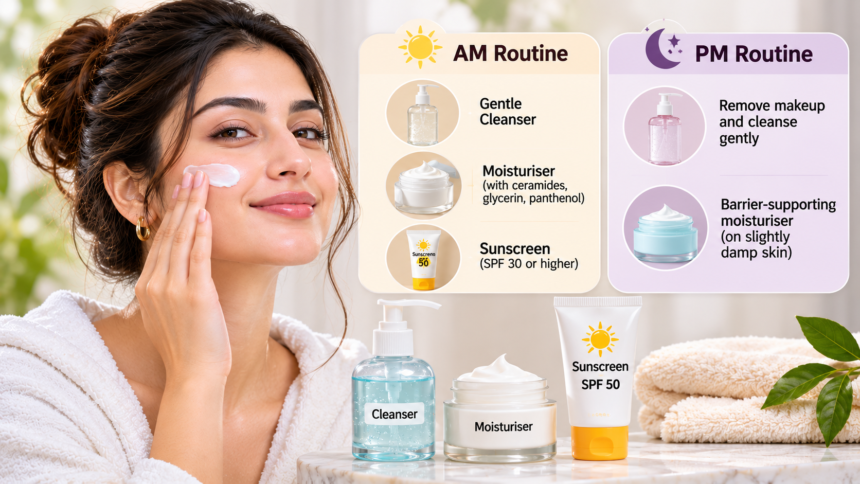
A dermatologist-recommended approach focuses on maintaining skin hydration, strengthening the protective barrier and avoiding unnecessary ingredients. Here is a simple morning and evening skincare routine for sensitive skin.
Morning Skincare Routine: Protect and Prevent
The primary aim of a morning skincare routine for sensitive skin is to maintain hydration and protect the skin from external factors. A gentle cleanser, suitable moisturiser and sunscreen are the three essential steps.
1. Gentle Cleanser
Start your morning routine with a soap-free and fragrance-free cleanser that has a skin-friendly pH. The choice of cleanser should depend on your skin type. Cream-based cleansers are generally suitable for dry skin, while mild gel-based formulations may work better for oily skin.
A good cleanser should remove impurities without leaving the face feeling excessively dry, tight or uncomfortable after washing.
2. Moisturiser
Moisturising is particularly important for sensitive skin because it helps support the skin’s natural protective barrier. Look for products containing ceramides, cholesterol and fatty acids, which help maintain barrier function.
Other useful ingredients include glycerin, which helps retain moisture, and panthenol and colloidal oatmeal, which can help soothe irritated skin.
Choosing a moisturiser with several beneficial ingredients can simplify your skincare routine without requiring multiple separate serums.
3. Sunscreen
Sun protection is an essential part of everyday skincare, especially for people with sensitive skin. Choose a broad-spectrum sunscreen with SPF 30 or higher. SPF 50 may be preferable when spending extended periods outdoors.
If conventional sunscreens cause burning or stinging, mineral-based formulations containing zinc oxide or titanium dioxide may be better tolerated.
Remember to reapply sunscreen every two hours when outdoors to maintain protection.
Night Skincare Routine: Restore and Replenish
The evening routine should focus on removing daily impurities and supporting the skin barrier while you rest. Unlike complicated skincare routines involving several products, sensitive skin often benefits from a straightforward approach.
Begin by gently removing makeup, sunscreen and accumulated impurities. Avoid scrubbing your face or using hot water, as these can contribute to irritation. Double cleansing is not necessary for everyone.
After cleansing, apply a moisturiser that supports the skin barrier while your face is slightly damp. If certain areas are particularly dry, applying a thin layer of plain petrolatum can help reduce moisture loss.
A separate night cream, toner or eye cream is not always necessary. Keeping the routine simple can help minimise exposure to ingredients that may trigger sensitivity.
Active Ingredients and Precautions for Sensitive Skin
Having sensitive skin does not mean you need to avoid every treatment ingredient. You can still address concerns such as acne, pigmentation and visible signs of ageing, but introducing active ingredients requires extra care.
Depending on your skincare concern, low-strength niacinamide or topical tranexamic acid may be considered. However, it is important to introduce treatments gradually and ensure that your skin is comfortable before adding them to your routine.
Avoid starting multiple active ingredients at the same time, particularly retinol, exfoliating acids and highly acidic vitamin C formulations. A burning sensation should never be considered evidence that a skincare product is working.
If your skin experiences a flare-up, temporarily stop using potentially irritating active ingredients. Return to the basic routine of gentle cleansing, moisturising and sun protection until your skin feels comfortable again.
Product selection is equally important. Choose fragrance-free formulations rather than relying only on products labelled unscented. Terms such as natural, botanical and hypoallergenic do not automatically mean that a product will be suitable for sensitive skin.
Before adding a new product to your routine, test it on a small area of skin for seven to ten days. This can help identify possible reactions before applying it more widely.
Persistent burning, itching, redness or scaling should not be ignored. Consult a dermatologist to determine whether an underlying condition, such as rosacea, eczema or contact dermatitis, may be responsible.
Final Thoughts
Managing sensitive skin does not require an extensive collection of skincare products. A consistent routine built around gentle cleansing, barrier-supporting moisturisation and daily sun protection can provide a suitable foundation.
As Dr. Nishita Ranka highlights, the first priority should be making the skin feel comfortable rather than immediately focusing on brighter or younger-looking skin. Once the skin barrier is properly supported and irritation is under control, other skincare treatments can be considered according to individual needs.