
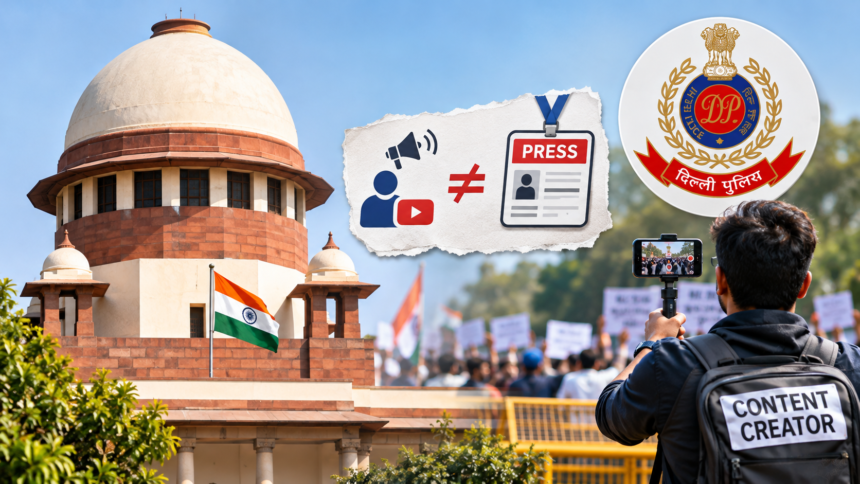
New Delhi: The Delhi Police has informed the Supreme Court that social media influencers and digital content creators cannot automatically be granted the same protections available to journalists covering protests. According to the police, influencers and content creators must also follow general laws relating to public order and crowd management.
The submission was made through an affidavit filed before the Supreme Court in response to petitions concerning recent demonstrations organised by the Cockroach Janata Party (CJP) in Delhi. The protesters had demanded the resignation of Chief Election Commissioner Gyanesh Kumar over alleged irregularities in the Special Intensive Revision (SIR) of electoral rolls.
The matter came up after allegations that police personnel had prevented journalists from covering the demonstrations. During an earlier hearing, the Supreme Court had cautioned the Delhi Police against interfering with the professional responsibilities of media personnel, Bar and Bench reported.
In its latest affidavit, the police denied deliberately obstructing journalists or preventing them from carrying out their reporting duties.
What Did Delhi Police Tell the Supreme Court?
In its affidavit, the Delhi Police stated that it had never intentionally stopped journalists from performing their professional duties, either during the protests or on other occasions.
The police also argued that simply recording an incident or sharing videos on social media does not automatically make someone a journalist. It said the nature and purpose of a person’s activities should be considered when determining whether they are engaged in genuine journalistic work or producing content for other reasons.
According to the police, social media influencers and content creators cannot claim journalistic protections solely because they publish videos or updates about public events.
Is a Press Card or PIB Accreditation Necessary to Cover Protests?
The Delhi Police also acknowledged an important distinction regarding media rights.
It stated that a person’s freedom to collect and share news cannot be denied simply because they do not have Press Information Bureau (PIB) accreditation, an official press card or employment with a recognised media organisation.
This means that the absence of formal media credentials alone cannot be treated as a reason to prevent someone from gathering or reporting information.
Content Creators Must Follow Public Order Rules
The police maintained that influencers and social media content creators remain subject to the general laws of the country, including lawful instructions issued by authorities to maintain public order and manage crowds.
The affidavit therefore distinguishes between protecting genuine journalistic activities and automatically extending special protections to everyone who creates or shares content online.
The issue has brought attention to the distinction between traditional journalism, independent reporting and social media content creation, particularly when public demonstrations are being covered.
Disclaimer
This article is based on the Delhi Police’s affidavit and the proceedings described in the reported source. The statements attributed to the police represent its position before the Supreme Court and should not be treated as the court’s final decision. The matter remains subject to judicial consideration and applicable legal provisions.