
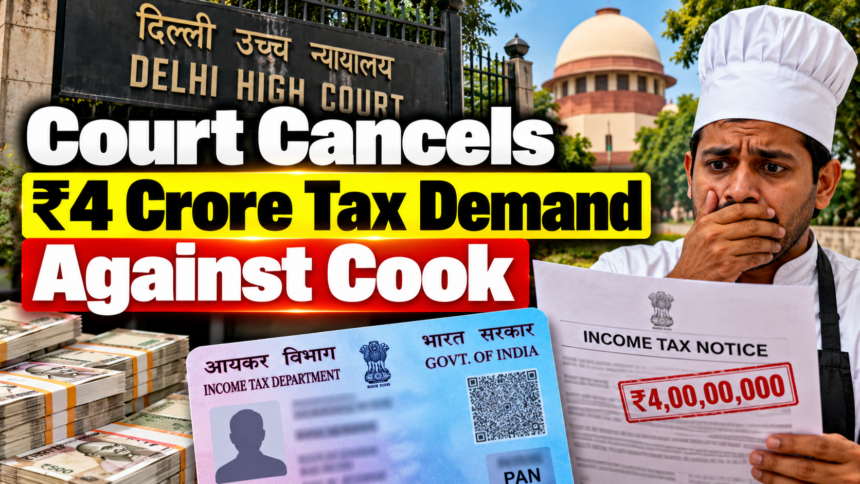
A case involving alleged misuse of a Permanent Account Number (PAN) has highlighted the financial difficulties taxpayers can face when transactions they never made appear in their tax records. According to a report by The Economic Times, the Delhi High Court recently cancelled a tax demand of nearly ₹4 crore against a contractual cook at Hotel Ashoka after authorities linked alleged cash sales worth ₹24.62 crore by a packaging materials company to his PAN without independently establishing his connection to the transactions.
The case underlines the importance of checking income tax records regularly, investigating unfamiliar entries and responding to tax notices within the prescribed deadlines, even when the transactions appear unrelated to a taxpayer’s financial circumstances.
How a Contractual Cook Faced a ₹4 Crore Tax Demand
According to the report, Lalit received an income tax notice on February 26, 2024, alleging that he had conducted cash sales worth ₹24.62 crore through a packaging materials company. The tax department raised a demand of nearly ₹4 crore, along with a penalty for under-reporting income.
Lalit earned a modest salary that was well below the taxable income threshold. After reviewing his Form 26AS, he discovered that the disputed sales had been recorded against his PAN, with tax deducted at source (TDS) at 1% on the amount.
He subsequently approached Greater Kailash Police Station and the Delhi Police Cyber Cell in Saket to file complaints alleging identity theft. Lalit maintained that he had never carried out the transactions and had no association with the packaging business.
His lawyer, A.K. Babbar, told the court that Lalit had worked as a contractual employee at Hotel Ashoka and Vigyan Bhawan. He had previously provided copies of his PAN card to contractors for verification purposes.
The lawyer argued that the appearance of a PAN in tax records was not sufficient, by itself, to establish that the transactions belonged to the person named in those records.
The Assessing Officer reportedly asked Lalit either to pay the outstanding demand or challenge the assessment before the appropriate authority. However, pursuing an appeal involved a significant financial obstacle, as the required pre-deposit was approximately ₹78 lakh.
Why the Delhi High Court Quashed the Tax Demand
On October 6, 2026, the Delhi High Court set aside the tax demand, according to The Economic Times. The court found that the assessment relied on Form 26AS and information available through the tax portal without independent verification establishing Lalit’s connection to the alleged sales.
The Income Tax Department had not established that it independently investigated the packaging materials company or recorded a statement from its owner. The court also identified a calculation issue in which the gross and net figures relating to the same transaction had been counted twice.
The judges noted that Lalit’s employment background, financial position and explanation regarding the withdrawal of provident fund savings and his application for an economically weaker section (EWS) certificate deserved objective examination.
However, the court did not rule out further proceedings altogether. It left open the possibility of fresh action if incriminating evidence emerged, subject to the applicable legal limits.
How to Check Whether Your PAN Has Been Misused
Taxpayers can take several steps to identify unfamiliar transactions and respond if their PAN appears to have been used without their knowledge.
- Review Form 26AS and AIS: Check your Form 26AS and Annual Information Statement (AIS) regularly for unknown transactions, unexpected TDS entries or high-value receipts.
- Check for unauthorised GST registrations: Use the GST portal’s “Search by PAN” facility to look for GST registrations associated with your PAN that you do not recognise.
- Report suspicious activity: If you discover unfamiliar transactions, file complaints with the police and cybercrime authorities, and inform the relevant tax authorities in writing.
- Keep supporting documents: Preserve complaint acknowledgements, salary records, bank statements and other documents that may help establish your actual financial circumstances.
- Respond to tax notices on time: Do not ignore an income tax notice simply because you believe the transaction is fraudulent. Respond within the deadline and request the evidence supporting the disputed entry.
What Should You Do If the Tax Department Raises an Incorrect Demand?
If an assessment appears to be based on transactions you did not conduct, seek clarification from the tax authorities and submit relevant supporting evidence. Keep copies of all correspondence and acknowledgements for future reference.
Where the authorities fail to consider the evidence or the assessment raises concerns about due process, consult a qualified tax professional or lawyer. Depending on the circumstances, available remedies may include filing an appeal or approaching the High Court.
Lalit’s case demonstrates why taxpayers should monitor their tax records and act promptly when unfamiliar entries appear. Early investigation and proper documentation can be important when challenging a demand linked to suspected identity misuse.
Disclaimer: This article is intended for general informational purposes only and does not constitute legal, tax or financial advice. The outcome of an individual tax dispute depends on its facts, supporting evidence and applicable law. Anyone facing a disputed tax demand should consult a qualified tax professional or lawyer regarding the appropriate course of action.