
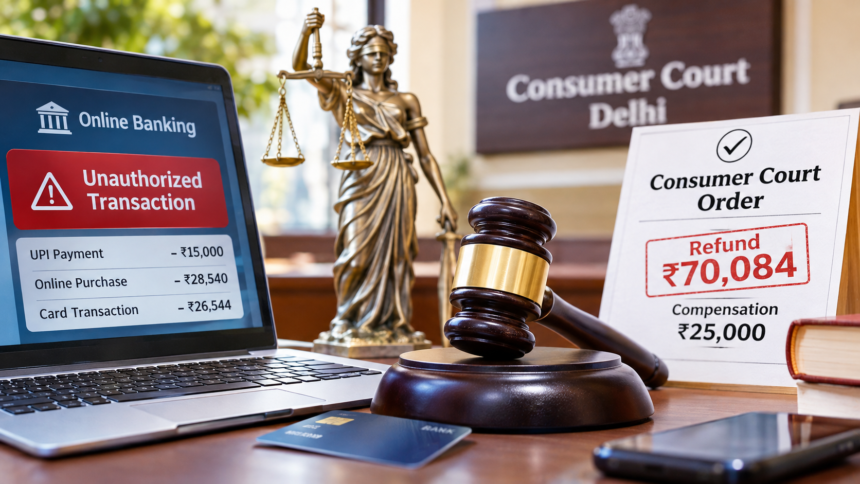
A Delhi consumer commission has directed a private bank to refund ₹70,084 to a woman who lost the amount in unauthorised online transactions in July 2016. The bank has also been ordered to pay ₹25,000 towards compensation and litigation expenses, according to a report by The Indian Express.
The decision highlights the protection available to bank customers under Reserve Bank of India (RBI) guidelines governing unauthorised electronic transactions, particularly when customers report fraud within the prescribed time.
How the Woman Lost Money Through Online Transactions
The woman held a savings account linked to her mobile number. She alleged that transactions worth ₹77,114 were carried out from her account without her knowledge or approval.
At the time, her mobile phone was facing technical issues. Because of these problems, she claimed that transaction notifications and one-time passwords (OTPs) did not reach her promptly.
The disputed loss of ₹70,084 took place on July 9, 2016. After becoming aware of the transactions, she contacted the bank’s customer care team through email on July 10. She requested that her card be blocked immediately to prevent further unauthorised activity.
She also approached the police and filed a complaint. However, the bank did not reverse the disputed transactions.
The woman further claimed that she suffered additional financial losses due to penalty charges and insurance-related payments. After her legal notice failed to resolve the matter, she approached the consumer commission for relief.
Why the Consumer Commission Ordered the Refund
During the proceedings, the commission observed that the woman had informed the bank about the fraudulent transactions promptly. It also found that the bank had failed to establish any negligence on her part.
The commission referred to RBI guidelines dealing with unauthorised electronic transactions caused by third-party breaches. Under these rules, customers can have zero liability when neither the bank nor the customer is responsible for the breach and the incident is reported within three working days.
The commission stated, as quoted by The Indian Express, that the RBI circular clearly places the liability on the bank in such circumstances. It noted that the woman had informed the bank about the unauthorised transactions on July 10, 2016, but the bank failed to reverse the amount.
The consumer commission also referred to a Bombay High Court ruling concerning disputed electronic transactions. According to the precedent cited, banks must establish the customer’s liability in cases involving unauthorised transactions.
After considering these points, the commission directed the bank to return ₹70,084 and pay an additional ₹25,000 towards compensation and litigation costs.
How Bank Customers Can Protect Themselves from Online Fraud
The case underlines the importance of acting quickly when suspicious transactions appear in a bank account.
Customers should regularly check their account statements and transaction notifications. If an unauthorised payment is noticed, they should immediately inform the bank and request that the affected card or payment facility be blocked.
It is also important to preserve emails, messages and complaint acknowledgements submitted to the bank. Customers should file a police complaint when they become victims of online financial fraud.
Timely reporting can be particularly important when seeking protection under RBI’s customer liability guidelines.
When Does Zero Liability Apply to Bank Customers?
RBI guidelines provide protection against unauthorised electronic transactions in certain circumstances, including third-party breaches where neither the bank nor the customer is at fault.
However, the customer’s liability depends on the nature of the transaction, the circumstances of the fraud and how quickly the incident is reported.
Customers should therefore notify their bank as soon as they discover suspicious activity rather than waiting for further losses to occur.
The bank involved in this particular case was not publicly identified in the details provided.
Disclaimer: This article is based on the reported consumer commission ruling and information published by The Indian Express. Customer liability in unauthorised electronic transactions depends on the applicable RBI guidelines and the facts of each case. Readers should contact their bank and refer to official RBI instructions for guidance regarding individual complaints.