
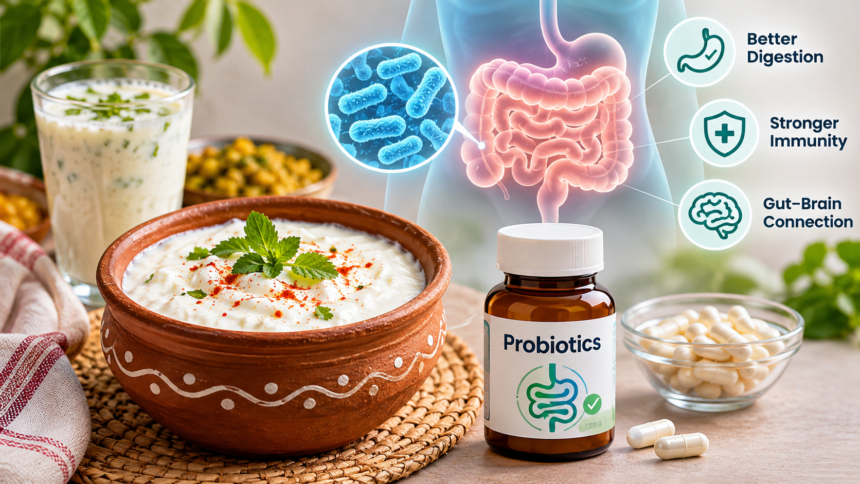
Dahi has long been an essential part of Indian meals. Whether served alongside spicy curries, paired with dal and rice, or consumed as refreshing chaas during summer, it has remained a familiar part of everyday food habits across generations. Long before gut health became a popular subject of discussion, Indian households recognised the value of fermented foods through traditional dietary practices.
Modern scientific research has further highlighted the nutritional importance of dahi and the role of beneficial microorganisms in fermented foods. Dr. M. Ratna Sudha, MD and Founder of Unique Biotech Limited, has explained how dahi contributes to gut health while highlighting the importance of understanding the difference between traditionally fermented foods and clinically studied probiotics.
Not Every Fermented Food Qualifies as a Probiotic
Fermentation naturally involves microorganisms, but this does not automatically mean that every fermented food can be classified as a probiotic. The International Scientific Association for Probiotics and Prebiotics (ISAPP), in its 2021 consensus statement, clarified the scientific requirements for identifying probiotics.
According to the established definition, a microorganism must be clearly identified, remain alive when consumed and demonstrate health benefits through scientific studies to qualify as a probiotic.
Probiotics that meet these conditions can support several important functions in the body. They help maintain the integrity of the intestinal barrier, generate beneficial metabolites and compete with harmful bacteria for nutrients and space in the gut.
Their role also extends beyond digestion. The gut is closely connected to the immune system, while interactions between gut microorganisms and the brain form part of what scientists describe as the gut-brain axis. A major scientific review published in 2019 discussed how gut microbes contribute to communication between these systems.
This distinction is important for consumers. Dahi remains a valuable part of a balanced diet, but not every fermented food or variety of dahi necessarily provides the scientifically established benefits associated with probiotics.
Why the Specific Probiotic Strain Makes a Difference
Identifying the probiotic species is only one part of understanding its effectiveness. The particular strain also plays a significant role in determining its health benefits. Even microorganisms belonging to the same species can produce different results depending on their individual characteristics.
A simple comparison can be made with Basmati and Sona Masoori rice. Both belong to the same food category, but their characteristics and uses differ. Similarly, probiotic strains cannot be assumed to deliver identical health outcomes.
A 2018 analysis covering 228 clinical trials supported this understanding, highlighting that probiotic benefits depend on the specific strain and the health condition being addressed.
India had also recognised the importance of strain-specific evidence through the ICMR-DBT Guidelines for Evaluation of Probiotics in Food, introduced in 2011. These guidelines emphasise that probiotic effects are strain-dependent and recommend identifying the specific strain on product labels.
As consumer awareness increases, manufacturers, marketers and regulators are paying closer attention to probiotic selection and product claims. Health benefits associated with a particular strain must be supported by clinical research conducted on that specific strain.
Consequently, consumers should look beyond general claims about probiotic content and consider which strain a product contains and whether scientific evidence supports its stated benefits.
How Spore-Forming Probiotics Are Changing Everyday Consumption
Clinically studied probiotics have traditionally been available in formats such as capsules and sachets. For many consumers, these products have often felt closer to medicines or supplements than everyday food.
However, spore-forming probiotics are creating new possibilities in functional foods and beverages. Scientific reviews indicate that Bacillus spores can tolerate challenging conditions, including heat, changes in pH and storage, more effectively than many conventional probiotic bacteria.
This natural resilience offers manufacturers greater flexibility when developing probiotic-enriched food and beverage products. It also makes it possible to incorporate certain spore-forming probiotics into everyday dietary options without necessarily requiring refrigeration or capsule-based consumption.
Such developments could make clinically studied probiotics easier to incorporate into different lifestyles, including busy mornings, packed lunches and quick refreshments during working hours.
Preserving Dahi’s Tradition While Embracing Scientific Progress
The growing interest in clinically studied probiotics does not reduce the importance of dahi in Indian food culture. It continues to hold a significant place in everyday diets because of its taste, nutritional value and traditional appeal.
Instead, the availability of scientifically evaluated probiotic products provides consumers with additional choices. Dahi can continue to be enjoyed as a familiar fermented food, while clinically studied probiotics offer specific, research-supported options for gut health.
The key is to understand that all probiotics are not the same. Before choosing a probiotic product, consumers should check the strain it contains and the scientific evidence supporting its claimed benefits.
As awareness of gut health continues to develop, combining traditional dietary practices with scientific understanding can help people make more informed food choices. Ultimately, when it comes to probiotics, knowing the specific strain and its proven benefits matters as much as knowing that a product contains beneficial microorganisms.