
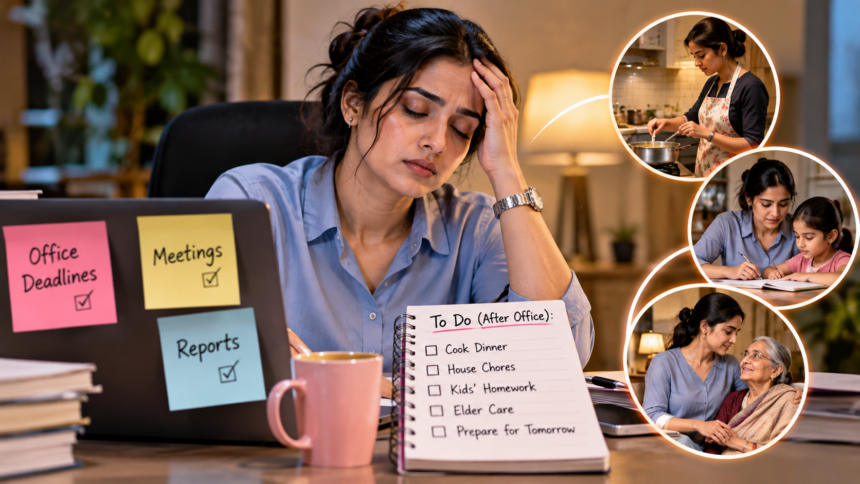
For millions of working women in India, completing office hours does not mean the end of their responsibilities. Once they return home, another set of duties awaits them, including cooking, cleaning, childcare, caring for elderly family members and managing household responsibilities.
Women are often expected to balance professional commitments with family obligations without showing signs of exhaustion. Even when they openly admit that they are overwhelmed, their struggles are frequently dismissed with statements such as, “Every woman goes through this.”
This constant pressure can take a serious emotional and physical toll. Dr Chandni Tugnait, MD (A.M), Psychotherapist, Life Alchemist, Coach and Healer, Founder and Director of Gateway of Healing, explains why workplace burnout among women often remains unaddressed and why so many feel unable to step away from their jobs.
The Double Shift Working Women Face Every Day
For many women, the working day does not end when they leave the office or log out of their computers. Instead, their responsibilities simply move from the workplace to their homes.
After spending hours meeting professional deadlines, they are expected to prepare meals, manage household chores, help children with homework and look after elderly family members. Unlike conventional office schedules, domestic responsibilities rarely come with fixed working hours or designated breaks.
This pressure continues even for women who earn more than their partners. Financial independence does not necessarily translate into an equal distribution of household responsibilities. Women are often still considered the primary caregivers, and they may be held responsible when household tasks remain unfinished, children fall ill or meals are delayed.
Much of this unpaid domestic work goes unnoticed and is rarely acknowledged as an additional workload. The expectation to manage both professional and personal responsibilities without sufficient support contributes significantly to women’s burnout.
Why Walking Away From a Job Is Not Always an Option
Leaving a job may appear to be a straightforward solution to workplace stress, but the decision is far more complicated for many women.
For some, employment is essential for financial security and survival. Their earnings contribute towards their children’s education, their parents’ medical expenses and their own independence. A job also provides them with the freedom to make personal and financial decisions.
There are other concerns that make quitting difficult. Some women worry that leaving the workforce could prevent them from returning to their careers in the future. Others fear being judged by family members or society for prioritising their own well-being over household expectations.
For women who have spent years building professional careers, stepping away can also feel like giving up something they have worked hard to achieve.
As a result, many continue working despite feeling physically and emotionally exhausted because they believe they cannot afford to stop.
Recognising the Signs of Burnout in Women
Women’s burnout is not always recognised for what it is. Emotional exhaustion is sometimes dismissed as mood swings, irritability or excessive sensitivity, overlooking the pressure and responsibilities behind these experiences.
Burnout can affect women in several ways. Some may find themselves crying while preparing dinner, struggling to concentrate during office meetings or forgetting routine tasks. Others experience frequent headaches, back pain and disrupted sleep.
Emotional exhaustion can also lead to increased frustration, anger and feelings of guilt. A woman might maintain a cheerful appearance at work while privately breaking down in a washroom or struggling to cope with her responsibilities.
Despite these difficulties, many continue fulfilling their professional and domestic roles because their families and workplaces depend on them. However, their own emotional well-being often receives little attention.
The Guilt That Makes Burnout Worse
One of the most difficult aspects of burnout among working women is the constant feeling of guilt.
When work demands longer hours, women may feel they are not spending enough time with their children. Taking leave to attend to family responsibilities can create anxiety about falling behind professionally. Even taking time to rest may make them feel unproductive or selfish.
Asking family members for help can bring another layer of guilt, particularly when women have been conditioned to believe that managing the household is primarily their responsibility.
Social expectations often reinforce the idea that a good woman should always be available for her family, avoid complaints and manage every responsibility without asking for support.
This mindset leaves little room for personal needs, rest or emotional recovery. Over time, the pressure to meet everyone’s expectations can make existing exhaustion even more difficult to manage.
Why Families and Workplaces Need to Listen
Addressing women’s burnout requires greater understanding and support from both employers and families. Organisations need to reconsider the tendency to celebrate women for managing multiple responsibilities without acknowledging the additional pressure they face.
Similarly, families must recognise that domestic responsibilities should not automatically fall on women, regardless of their professional commitments or financial contributions.
Being exhausted does not mean a woman has failed to manage her life. It may simply mean she has been carrying more responsibilities than one person can reasonably handle.
For women experiencing these pressures, acknowledging burnout and asking for support should not be seen as a sign of weakness. Recognising personal limits is important, and seeking help is a valid response to prolonged exhaustion.
The conversation around women’s workplace experiences needs to move beyond praising their ability to manage everything. It is equally important to understand what that constant effort costs them.
Sometimes, the most important thing a woman needs to say is also the one she has been afraid to express: “I am burned out, and I need help.”