
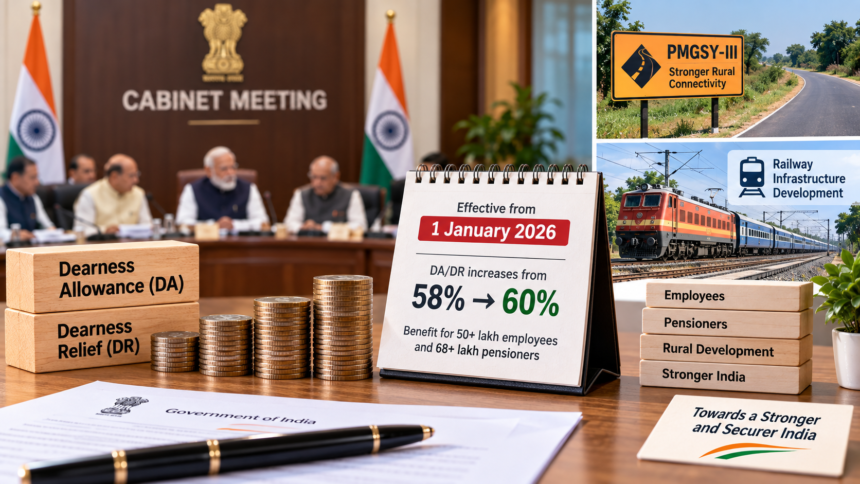
The Union Cabinet has approved a 2 percentage point increase in Dearness Allowance (DA) for Central Government employees and Dearness Relief (DR) for pensioners, effective from January 1, 2026.
The latest revision takes the DA and DR rate from 58% to 60% of basic pay or pension. The increase is intended to provide relief against the impact of rising prices. According to the government, the decision will benefit around 50.46 lakh Central Government employees and 68.27 lakh pensioners.
The combined annual financial impact of the DA and DR increase on the government exchequer is estimated at Rs 6,791.24 crore. The revision has been approved under the existing formula based on the recommendations of the 7th Central Pay Commission.
DA and DR Increased From 58% to 60%
Dearness Allowance is provided to serving Central Government employees, while Dearness Relief is given to pensioners. These components are revised periodically to account for changes in prices.
With the latest decision, the rate applicable to basic pay and pension has increased by two percentage points from the previous 58% level. The revised rate will apply from January 1, 2026.
Cabinet Extends PMGSY-III Till March 2028
In another decision, the Union Cabinet approved the continuation of Pradhan Mantri Gram Sadak Yojana-III (PMGSY-III) until March 2028.
The scheme will cover the consolidation and upgradation of rural roads and major rural links connecting habitations with Gramin Agricultural Markets (GrAMs), higher secondary schools and hospitals.
The revised outlay for PMGSY-III has been set at Rs 83,977 crore, up from the original outlay of Rs 80,250 crore. The extension is intended to enable the completion of planned rural road improvement works.
Two Railway Multi-Tracking Projects Approved
The Cabinet Committee on Economic Affairs has also approved two railway multi-tracking projects with a combined estimated cost of Rs 24,815 crore.
The projects cover the Ghaziabad-Sitapur and Rajahmundry (Nidadavolu)-Visakhapatnam (Duvvada) routes across Uttar Pradesh and Andhra Pradesh. Together, they will cover 601 km of route length and involve 1,317 km of additional track length.
According to the government, the projects are expected to increase railway capacity, improve operational efficiency and enhance service reliability. The projects will cover 15 districts across the two states and are scheduled for completion by 2030-31.