
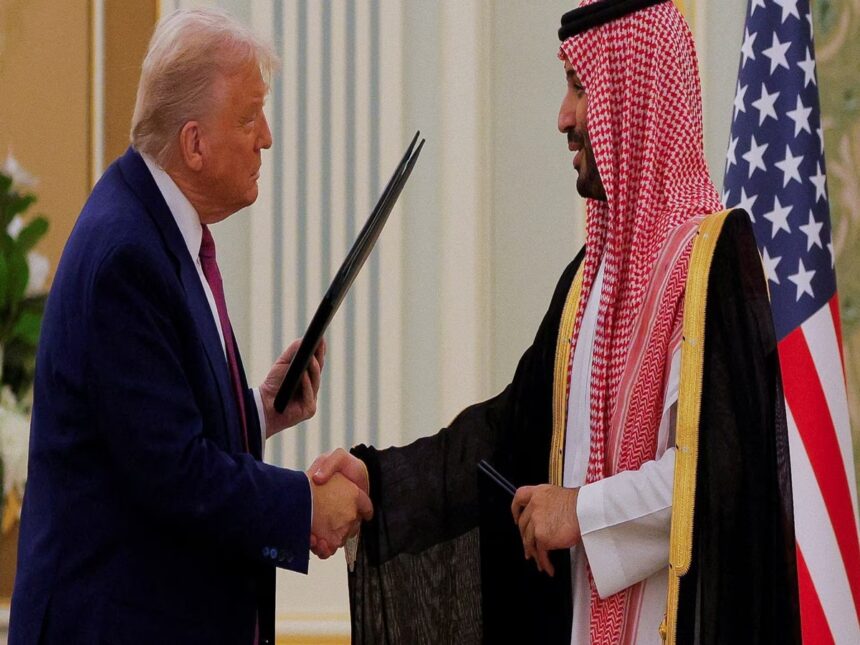
The United States has approved a landmark 30-year civilian nuclear cooperation agreement with Saudi Arabia, marking one of the most significant developments in global nuclear diplomacy in recent years. While the deal is officially aimed at expanding peaceful nuclear energy, one provision has attracted worldwide attention—it could eventually allow uranium enrichment inside Saudi Arabia under a US-supervised framework.
The agreement comes at a time of heightened tensions in the Middle East, following US military operations targeting Iran’s nuclear facilities. This has sparked a key question: Does the new deal give Saudi Arabia the ability to build a nuclear weapon?
The short answer is no. However, the agreement represents a major shift in US policy and could reshape the region’s nuclear landscape.
What Is a Civil Nuclear Agreement?
A civilian nuclear agreement is a formal arrangement between governments that allows cooperation in the peaceful use of nuclear technology. These partnerships focus on energy production and scientific development rather than military applications.
Such agreements generally include:
- Construction of nuclear power plants
- Supply of nuclear fuel
- Transfer of reactor technology
- Nuclear safety and security cooperation
- Training of scientists and technical experts
- Radioactive waste management
- International monitoring and safeguards
The primary objective is to generate electricity, support medical and industrial applications, and reduce dependence on fossil fuels—not to develop nuclear weapons.
In the United States, these agreements are signed under Section 123 of the Atomic Energy Act, which is why they are commonly known as 123 Agreements. The US has similar arrangements with more than 20 countries, including India, Japan, South Korea, Australia, Canada, the UAE and several European nations.
What Makes the Saudi-US Nuclear Deal Different?
Unlike many previous agreements, the Saudi deal reportedly leaves open the possibility of establishing a US-backed uranium enrichment facility within Saudi Arabia, provided future technical studies support the proposal.
According to reports, American companies would play a leading role in developing Saudi Arabia’s civilian nuclear infrastructure, a project expected to be worth tens of billions of dollars over the next three decades.
This enrichment provision has generated considerable debate because uranium enrichment is considered one of the most sensitive parts of the nuclear fuel cycle.
Most US nuclear cooperation agreements seek to restrict enrichment and spent fuel reprocessing to reduce the risk of nuclear weapons proliferation.
For example, the United Arab Emirates (UAE) accepted the so-called “gold standard” by voluntarily giving up the right to enrich uranium domestically in exchange for US nuclear cooperation.
Saudi Arabia, however, has consistently argued that as a member of the Nuclear Non-Proliferation Treaty (NPT), it should enjoy the same rights as other countries to develop a complete civilian nuclear fuel cycle.
The reported agreement appears to strike a compromise by allowing any future enrichment activities to remain under American oversight and international safeguards.
Does Uranium Enrichment Mean Saudi Arabia Can Build a Nuclear Bomb?
Not necessarily.
Uranium enrichment is a dual-use technology, meaning it can be used for both peaceful nuclear energy and, under different conditions, nuclear weapons development.
Natural uranium contains only about 0.7% uranium-235, the isotope required for nuclear reactions.
For civilian nuclear power plants, uranium is typically enriched to 3% to 5%.
Some research reactors use enrichment levels of up to 20%.
Nuclear weapons, however, generally require uranium enriched to around 90% uranium-235, commonly referred to as weapons-grade uranium.
Although the centrifuges used in both civilian and military programmes are technically similar, producing weapons-grade material requires additional infrastructure, extended enrichment, and a much larger number of centrifuges.
Even if Saudi Arabia develops enrichment capabilities, it would still need to:
- Withdraw from international nuclear safeguards.
- Enrich uranium to weapons-grade levels.
- Design and manufacture a nuclear weapon.
- Develop a reliable delivery system.
Such activities would likely be detected by international inspectors and could trigger serious diplomatic and economic consequences.
Why Does Saudi Arabia Want Nuclear Energy?
Despite being one of the world’s largest oil exporters, Saudi Arabia sees nuclear power as an important part of its Vision 2030 economic diversification strategy.
The Kingdom’s electricity demand continues to grow due to:
- Rapid urban development
- Expanding industrial activity
- Large desalination projects
- Growth in artificial intelligence and data centres
Using nuclear energy would allow Saudi Arabia to reduce domestic oil consumption while exporting more crude oil, boosting government revenues.
Officials also argue that nuclear power offers a reliable source of low-carbon electricity as the country works to diversify its energy mix alongside renewable energy investments.
Why the Timing Is Raising Questions
The agreement comes during a period of heightened geopolitical tension.
The United States has repeatedly expressed concerns over Iran’s nuclear programme and recently participated in military operations targeting Iranian nuclear facilities.
Against this backdrop, approving expanded civilian nuclear cooperation with Saudi Arabia has drawn criticism from some observers, who see the move as contradictory.
Supporters of the agreement, however, argue that bringing Saudi Arabia’s nuclear programme under a US-led framework is the best way to ensure transparency and prevent Riyadh from turning to countries such as China or Russia for nuclear technology.
They believe close American involvement offers stronger oversight and better safeguards than leaving Saudi Arabia to pursue its nuclear ambitions independently.
How Does This Compare With India’s Nuclear Agreement?
India’s landmark civilian nuclear agreement with the United States, signed in 2008, followed a very different path.
India already possessed nuclear weapons and is not a member of the Nuclear Non-Proliferation Treaty (NPT). The agreement separated India’s civilian and military nuclear facilities while placing civilian reactors under International Atomic Energy Agency (IAEA) safeguards.
Saudi Arabia, by contrast, remains a non-nuclear-weapon state under the NPT. Any civilian nuclear programme it develops will continue to be subject to international inspections designed to prevent diversion of nuclear material for military purposes.
What Happens Next?
The agreement will now move to the US Congress for review.
Lawmakers are expected to examine the deal closely, particularly the uranium enrichment provision and its potential implications for nuclear proliferation in the Middle East.
Although Congress can attempt to block the agreement, doing so would require passing a joint resolution capable of overriding a presidential veto—a politically challenging process.
Bottom Line
The new US-Saudi civilian nuclear agreement does not give Saudi Arabia permission to build nuclear weapons. Instead, it creates a framework for peaceful nuclear cooperation while leaving open the possibility of closely monitored uranium enrichment under American supervision.
Whether the agreement ultimately strengthens regional stability or raises fresh proliferation concerns will depend on how the programme is implemented, monitored and regulated in the years ahead.