
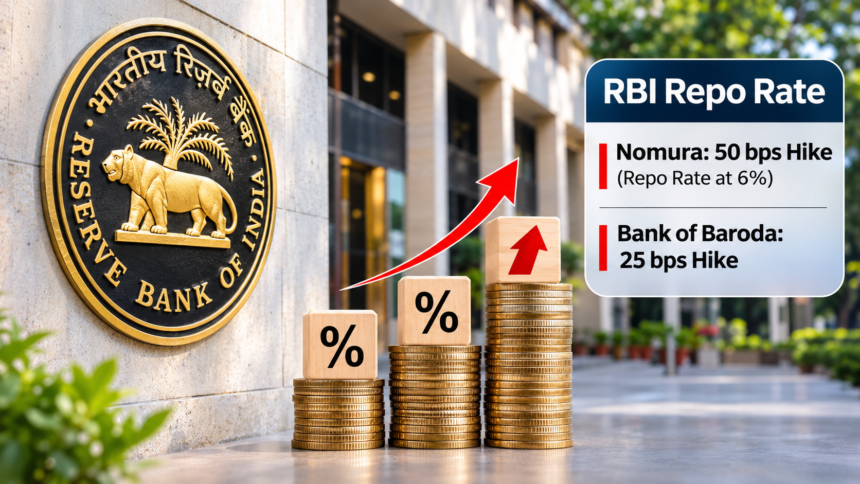
The Reserve Bank of India (RBI) is expected to announce its next monetary policy decision on December 4, and financial institutions have differing views on the possible repo rate hike. Nomura Holdings has increased its forecast, now expecting a 50 basis points (bps) increase instead of 25 bps, citing a faster-than-anticipated rise in food prices.
Bank of Baroda (BoB), however, expects a more moderate increase of 25 bps. The difference in their predictions largely reflects their assessment of inflation trends and the risks facing the Indian economy.
Nomura Predicts Repo Rate Could Reach 6%
Nomura expects the RBI to increase the repo rate by 50 bps, taking it to 6%. The financial firm estimates a 60% probability of a 50 bps hike and a 40% chance of a 25 bps increase.
Its base-case forecast is based on the expectation that the Monetary Policy Committee (MPC) will support the larger increase through a 5–1 vote. Nomura also expects the RBI to maintain its policy stance favouring further tightening.
The firm has highlighted rising food prices as a major reason behind its revised outlook. Its daily food-price indicators show that continued increases in cereal and pulse prices have resulted in the sharpest monthly rise seen in several years.
Rising Food Inflation Raises Concerns
According to Nomura’s estimates, Consumer Price Index (CPI) inflation could increase from 6.1% in October to approximately 6.4% in November. This would take the average inflation rate for the October–December quarter to around 6.3%, exceeding the RBI’s projection of 6%.
Nomura also expects core inflation to remain above 6% for at least two quarters. This is longer than the RBI’s earlier expectation of a one-quarter increase.
The firm attributes the pressure on core inflation partly to higher input costs, which companies are passing on to consumers through increased prices.
Bank of Baroda Expects a Smaller 25 bps Hike
Bank of Baroda has a more moderate outlook and expects the RBI to raise the policy rate by 25 bps. The bank has cited an improved geopolitical outlook following the US midterm elections as one factor supporting its assessment.
BoB highlighted several inflation indicators, including October retail inflation of 6.1%, food and beverages inflation of 8.5% and core inflation of 4.5%.
The bank has also pointed to potential risks from lower reservoir levels, which stood at 61.6% as of November 19, and slower rabi sowing of wheat, pulses and oilseeds.
Despite these concerns, BoB expects inflation to remain broadly aligned with the RBI’s projections of 6% for the third quarter and 5.7% for the fourth quarter. However, goods and services inflation climbed above 4% in October, indicating that price pressures are spreading across different categories.
GDP Growth Estimates Also Differ
Apart from inflation, economic growth will also be an important factor in the monetary policy outlook.
Nomura expects India’s GDP growth to exceed 7.5%, compared with the RBI’s estimate of 7.2%. The GDP figures are scheduled to be released on November 30.
Bank of Baroda, meanwhile, forecasts economic growth of 7.4% in the second quarter and 7.2% for the full financial year.
The two institutions therefore have different expectations for the RBI’s December decision. While Nomura sees stronger inflationary pressure supporting a 50 bps increase, Bank of Baroda expects a smaller 25 bps adjustment. The MPC’s announcement on December 4 will provide clarity on the central bank’s next policy move.
Disclaimer: This article is intended for general informational purposes and is based on the forecasts and economic data provided in the source material. Predictions made by financial institutions are estimates and do not represent confirmed RBI decisions. The actual repo rate decision will depend on the Monetary Policy Committee’s assessment. Readers should refer to official RBI announcements before making financial or investment decisions.