
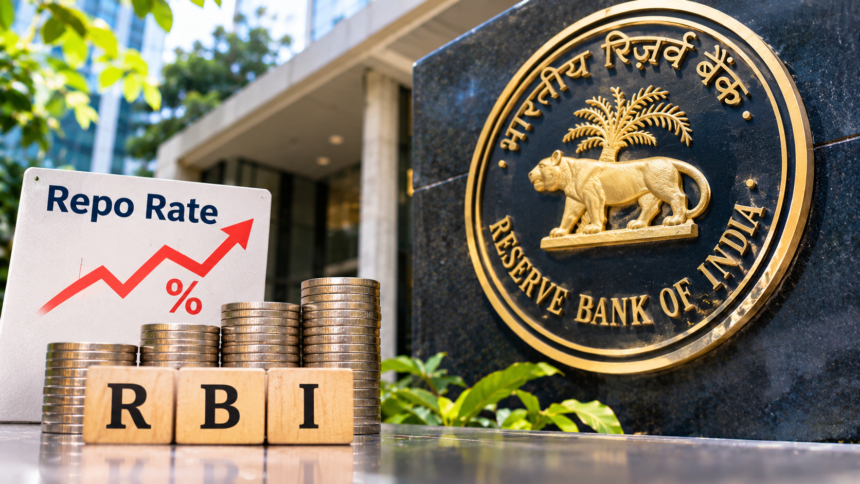
New Delhi: Rising inflation is putting increasing pressure on household budgets in India, raising expectations of another interest rate hike by the Reserve Bank of India (RBI). Retail inflation climbed to 6.09% in October, crossing the central bank’s upper tolerance limit of 6%. This has strengthened expectations that the RBI’s Monetary Policy Committee (MPC) could increase the repo rate by another 25 basis points in its December 2026 policy meeting.
Several economists believe the central bank may continue following a tight monetary policy to control rising prices. Some experts have also indicated that another rate increase could follow in February 2027, depending on how inflation develops in the coming months.
Deepti Deshpande, Principal Economist at Crisil, expects the RBI to maintain a cautious and restrictive approach. According to her assessment, a 25-basis-point increase in December remains a possibility as policymakers continue to deal with persistent inflation.
RBI Repo Rate: Why Another Interest Rate Hike Is Expected
Inflation has remained above the RBI’s preferred range for nine consecutive months, making price stability a major concern for policymakers. India’s retail inflation reached 6.09% in October, moving beyond the central bank’s prescribed upper limit of 6%.
Higher food prices have been a major contributor to the rising cost of living, increasing financial pressure on households.
In October, the RBI raised the repo rate to 5.5%, marking its first interest rate increase in three years. The central bank also changed its monetary policy stance from neutral to calibrated tightening, indicating that further increases could be considered if inflationary pressures continue.
RBI Governor Sanjay Malhotra has also indicated that an immediate reduction in interest rates is unlikely. The possibility of keeping rates unchanged remains, but further increases cannot be ruled out.
Food Inflation Reaches 8.94% in October
Food prices have emerged as a significant concern in the latest inflation figures. According to the Consumer Food Price Index (CFPI), food inflation increased from 7.74% in September to 8.94% in October.
Price pressures are also visible across several other categories. As many as 19 out of 43 Consumer Price Index (CPI) subgroups recorded inflation of 4% or more during the period.
Earlier, the RBI had projected inflation at 6% for the third quarter (Q3) of the current financial year and 5.4% for the fourth quarter (Q4 FY27). However, October’s retail inflation figure has already moved above the forecast for the third quarter.
These developments have increased concerns about the possibility of further monetary tightening in the coming months.
Why Is Inflation Rising Despite Lower Crude Oil Prices?
The recent decline in international crude oil prices has not yet translated into immediate relief from inflation. Brent crude, which experienced considerable volatility during the second quarter, has fallen below $110 and is currently around $93 per barrel.
Economists believe that lower oil prices may take time to influence overall inflation. The earlier increase in crude prices can continue affecting the economy even after international rates begin declining.
Improved expectations of peace in the Middle East have also supported the recent fall in oil prices. However, the delayed impact of previous price increases means consumers may not experience an immediate reduction in inflation.
RBI Rate Hike in February 2027 Also Possible
Economists are also examining the possibility of additional repo rate increases after the December policy announcement.
Madhavi Arora, Chief Economist at Emkay Global, believes that softer crude oil prices and increased foreign portfolio investment (FPI) inflows have provided some support to Indian financial markets and the rupee. However, inflationary concerns remain significant.
Her assessment suggests that the RBI could increase interest rates by a cumulative 75 basis points during the current tightening cycle, including a 25-basis-point hike in December 2026 and another 25-basis-point increase in February 2027.
At the same time, economists caution that the central bank must consider the broader economic impact before raising rates further. If rising inflation is mainly caused by supply-side disruptions, aggressive monetary tightening could also affect economic growth.
The RBI will therefore need to balance controlling inflation with maintaining economic momentum. The upcoming December monetary policy decision will be important in determining the direction of interest rates in the months ahead.
Disclaimer: This article is intended for general informational and financial awareness purposes only. The interest rate expectations and economic forecasts mentioned are based on the views and projections of economists and are not confirmed RBI decisions. Actual monetary policy outcomes may differ depending on economic conditions and inflation trends. Readers should consult official RBI announcements and qualified financial advisers before making financial decisions.