
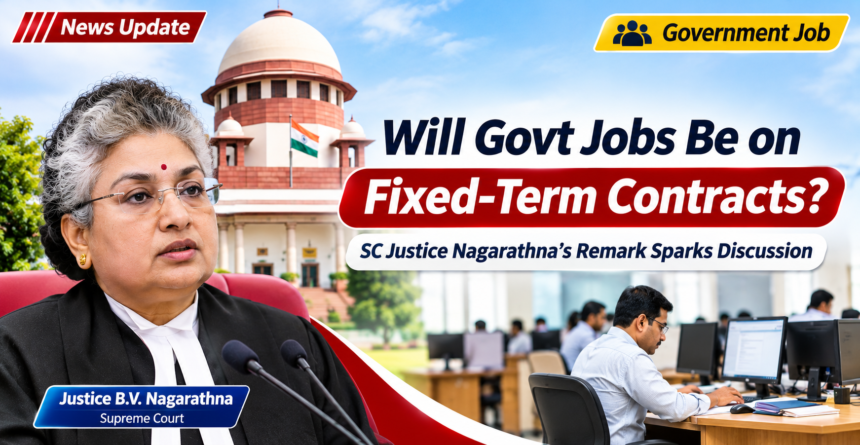
Government jobs are widely associated with long-term employment security, regular salaries and retirement benefits. However, a recent observation by Supreme Court Justice B.V. Nagarathna has brought the issue of accountability and performance among government employees into focus.
While hearing a case related to pending Dearness Allowance (DA) payments for Punjab government employees, Justice Nagarathna questioned the working practices and accountability of government staff. She suggested that the government could consider fixed-term appointments to encourage employees to perform their duties more responsibly.
However, her observation was made during court proceedings and should not be interpreted as a new government policy or a Supreme Court order introducing contractual employment for government jobs.
What Did Justice B.V. Nagarathna Say About Government Employees?
During the hearing, Justice B.V. Nagarathna raised concerns about the performance and accountability of government employees. She observed that government staff receive several employment benefits, including regular salaries, additional allowances and pension benefits after retirement.
Despite these facilities, questions sometimes arise about the efficiency and quality of work in government offices.
The judge suggested that appointing employees for fixed terms could encourage greater responsibility and improve their approach towards official duties.
Her remarks brought attention to the wider debate over employee performance, job security and accountability in government departments.
Questions Raised Over the Working System in Government Offices
Justice Nagarathna also commented on the pace of work in government offices. During the proceedings, she referred to situations where employees might complete only two or three pages of work.
She also pointed out that some employees appointed to High Courts or district courts prefer to move to Secretariat positions.
Through these observations, she highlighted concerns about workplace efficiency and the way responsibilities are handled in government institutions.
Why Are Punjab Government Employees Waiting for Their Pending DA?
The case being heard by the Supreme Court concerns outstanding Dearness Allowance payments owed to employees of the Punjab government.
Employees approached the Supreme Court after their pending DA payments remained unpaid. During the hearing, the Punjab government informed the Court that it was facing financial constraints and did not have sufficient funds to clear the entire outstanding amount.
The state government also explained that its financial resources were being used for various public welfare schemes and free services, making it difficult to release the pending DA payments.
What Did the Supreme Court Direct the Punjab Government to Do?
During the proceedings, the Supreme Court stayed the action initiated against Punjab Secretary K.A.P. Sinha in connection with the non-payment of outstanding DA to government employees.
The Court also sought the Punjab government’s response on whether the pending Dearness Allowance could be cleared by March 31, 2027.
The matter has brought the financial obligations of state governments towards their employees into focus, particularly regarding the timely payment of salary-related benefits.
Will Government Jobs Become Contractual in the Future?
Justice B.V. Nagarathna’s comments have raised questions about whether government departments could move towards fixed-term employment arrangements.
However, there is currently no such order or government announcement introducing contractual appointments for all government employees.
Her remarks were observations made during a court hearing, highlighting the importance of work efficiency and accountability. They do not mean that permanent government jobs are being replaced by contractual positions.
For now, the issue remains part of the broader discussion about improving performance and responsibility within government departments.
Disclaimer
This article is published for general informational and news purposes only. The observations made during court proceedings should not be treated as a final judicial direction or an official government policy. Readers are advised to refer to official Supreme Court records and government notifications for verified updates. This website is not affiliated with any government department or judicial authority.