
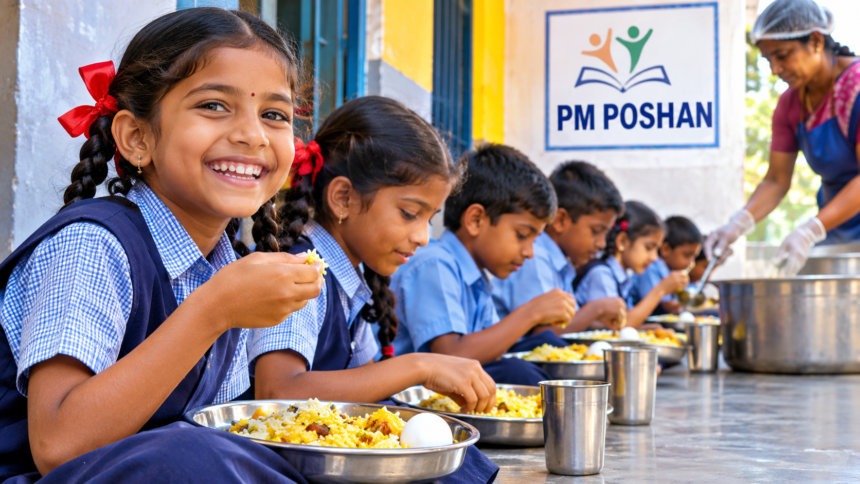
A landmark Supreme Court order in 2001 played a major role in changing the way India addressed hunger and school education. While hearing a case related to drought and starvation filed by the People’s Union for Civil Liberties (PUCL), the Supreme Court directed all states to provide cooked midday meals to children studying in government and government-aided primary schools within six months.
What started as an effort to tackle hunger gradually developed into one of the world’s largest school meal programmes. Over the years, the initiative has helped encourage school enrolment, particularly among children from economically weaker families.
The concept had already been introduced in Tamil Nadu during the early 1960s. Research into the state’s experience showed that providing meals at school helped improve enrolment, especially among girls and children from disadvantaged households. The 2001 Supreme Court directive extended this approach across the country.
How Midday Meals Helped Improve School Enrolment
Research conducted over the years has consistently highlighted the positive impact of India’s midday meal programme on primary school enrolment.
Studies published in peer-reviewed economics journals have found that school meals encouraged more children to attend school. The impact was particularly noticeable among children from low-income households, where the cost of providing food at home could influence decisions about sending children to school.
For many families, the assurance of a regular meal became an additional reason to enrol their children and keep them in education rather than involving them in household responsibilities or work.
PM POSHAN Now Covers More Than 10 Crore Children
The midday meal initiative is now known as the PM POSHAN scheme. According to the latest UDISE+ school census figures cited in the available data, approximately 103.2 million children across around 10.9 lakh institutions receive meals under the programme.
For the 2021–26 period, the central government’s total allocation for the scheme stands at Rs 54,061 crore.
The daily cooking cost has been fixed at Rs 6.78 per primary school student and Rs 10.17 per upper primary student. Although these amounts may appear modest, they support a massive operation that provides meals to children across the country.
Why Millions of Students Are Still Outside the Scheme
Despite its extensive coverage, PM POSHAN does not reach every school-going child in India. The programme currently covers approximately 41.8 per cent of the country’s total enrolled students.
One major reason is that private unaided recognised schools are not included in the scheme. These institutions enrol around 95.8 million children, representing nearly 39 per cent of India’s total student population.
As the programme is designed primarily for government and government-aided schools, children attending private unaided institutions do not receive its meal benefits. This also means that many children from financially weaker families studying in low-cost private schools remain outside the programme, even when their economic circumstances are similar to those of students in nearby government schools.
The Impact of One Meal on Learning and Social Equality
The importance of a school meal goes beyond improving attendance figures. Children who do not receive adequate food may find it difficult to concentrate during lessons, particularly later in the morning.
A dependable midday meal helps address hunger during school hours and gives students a better opportunity to focus on their studies. This support can play an important role alongside improvements in teaching methods, textbooks and educational facilities.
The programme also has a wider social impact. Children from different caste and community backgrounds share meals at school, creating opportunities for interaction and reducing some of the social divisions associated with food and dining practices.
Implementation Challenges and the Need for Continued Monitoring
Despite its achievements, the scheme continues to face several challenges. Complaints about food quality and hygiene are reported from time to time in different states. Rising food prices have also placed pressure on cooking budgets, affecting the resources available for preparing meals.
The exclusion of private unaided schools remains another important limitation, leaving a considerable number of children without access to the programme.
Even with these concerns, research over the past two decades has repeatedly highlighted the contribution of school meals to enrolment and classroom participation.
PM POSHAN remains an important part of India’s education and welfare system. A programme that provides food to more than 10 crore children deserves regular monitoring, proper implementation and public attention. Its contribution should not be overlooked simply because it has become a routine part of school life.
The 2001 Supreme Court order demonstrated how addressing hunger could also support education. The continued success of the programme depends on ensuring that meals are nutritious, safe and accessible to every eligible child.
Sources: People’s Union for Civil Liberties v. Union of India (2001), Supreme Court of India; UDISE+ 2024–25; PM POSHAN scheme coverage and budget data; peer-reviewed economic research on the impact of India’s midday meal programme on primary school enrolment.
Disclaimer: This article is intended for general informational purposes only. The figures and programme details are based on the sources mentioned above. Readers should refer to official government reports and notifications for the latest coverage, funding and implementation information.