
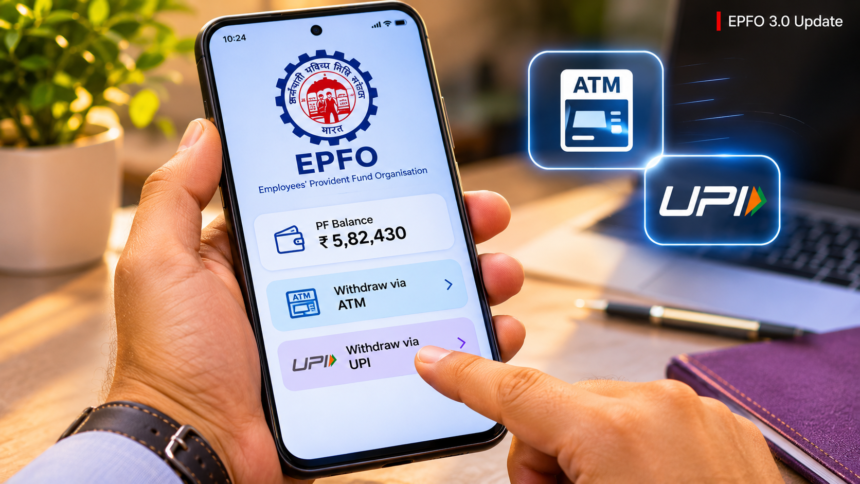
New Delhi: Employees who contribute to the Employees’ Provident Fund (EPF) may soon get a more convenient way to access their savings. The Employees’ Provident Fund Organisation (EPFO) is working on upgrading its digital services under the upcoming EPFO 3.0 system. As part of this initiative, subscribers are expected to get the option of withdrawing their Provident Fund (PF) money through ATMs and UPI.
The proposed facility could make it easier for employees to access their savings during emergencies or when they need money for important expenses such as medical treatment, children’s education and marriage-related costs.
Currently, the new withdrawal system is not available to all EPFO members. Development and testing activities are still underway, and subscribers will have to wait for the official launch.
How Will the EPFO 3.0 ATM and UPI Withdrawal Facility Work?
Under the proposed EPFO 3.0 system, the organisation plans to connect PF accounts with banking services and digital payment platforms. For this purpose, EPFO intends to work with the National Payments Corporation of India (NPCI).
The upgraded system is expected to automatically check a subscriber’s eligibility and calculate the amount available for withdrawal according to applicable rules.
Once the facility becomes operational, eligible members may be able to access their PF money through different methods, including:
- ATM withdrawals: Subscribers may be able to withdraw eligible PF funds using an ATM card.
- UPI payments: The proposed system could allow members to access their eligible funds through UPI.
- EPFO application: Withdrawals may also be possible through the EPFO app.
The objective is to make PF withdrawals faster and reduce the need for lengthy claim and settlement procedures.
How Much PF Money Can You Withdraw Through UPI?
The withdrawal limit is one of the most important aspects of the proposed facility. According to the rules described in the report, EPF subscribers must retain at least 25% of their PF balance in their accounts.
For eligible requirements such as education, marriage and housing, members can withdraw up to 75% of their EPF balance, subject to the applicable withdrawal conditions.
The remaining 25% stays in the PF account and continues to earn tax-free interest.
The proposed ATM and UPI facility is expected to make accessing eligible funds more convenient. However, the applicable withdrawal limits and eligibility conditions will continue to determine how much money a member can access.
PF Money Could Become Available Within Minutes
The introduction of ATM and UPI-based withdrawals could significantly simplify the way employees access their retirement savings.
At present, subscribers generally need to submit withdrawal claims and wait for processing and settlement. With the proposed EPFO 3.0 upgrade, the integration of the UAN portal with UPI services could make the process quicker and more convenient.
This would be particularly useful for employees who need access to eligible PF funds during emergencies or unexpected financial requirements.
When Will the EPFO ATM and UPI Facility Launch?
According to the report, the new PF withdrawal facility is expected to be introduced by the end of December. However, the system is currently undergoing development and testing, and EPFO has not announced a confirmed launch date.
Once implemented, the proposed facility could benefit millions of salaried employees by providing easier access to their eligible PF savings.
Subscribers should wait for an official announcement from EPFO before expecting to use ATM or UPI services for PF withdrawals.
Disclaimer
This article is intended for general informational purposes only and is based on reported information about the proposed EPFO 3.0 facilities. The ATM and UPI withdrawal services, launch timeline and operational procedures may change depending on official decisions and implementation. PF withdrawal limits and eligibility are subject to applicable EPFO rules. Readers should check the official EPFO website and notifications for the latest updates before making any withdrawal-related decisions.