
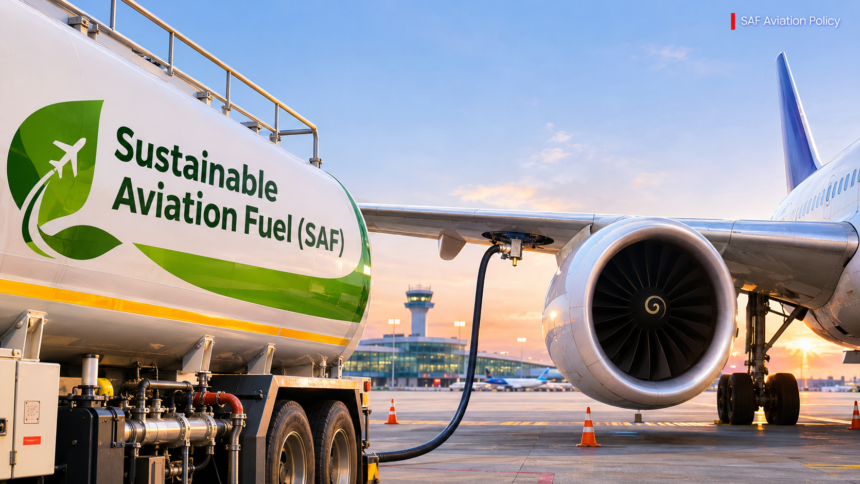
The Ministry of Civil Aviation has released a draft National Policy on Sustainable Aviation Fuels (SAF), proposing mandatory blending of sustainable aviation fuel with conventional aviation turbine fuel (ATF). Under the proposed framework, airlines will be required to begin blending 1% SAF from 2027, with the target gradually increasing over the following years.
The draft policy also proposes that at least 90% of the annual SAF requirement for international flights should be met through fuel produced within India. The initiative aims to encourage domestic production, reduce dependence on conventional aviation fuel and support the country’s transition towards more sustainable air travel.
What Is Indigenously Produced Sustainable Aviation Fuel?
According to the draft policy, indigenously manufactured Sustainable Aviation Fuel refers to renewable jet fuel produced in India using domestic agricultural and industrial resources.
The government has identified several potential raw materials for SAF production. These include sugarcane molasses, agricultural residues, starch-based materials and biomass. Used cooking oil, municipal solid waste and industrial waste streams can also be utilised.
The proposed policy identifies the Alcohol-to-Jet pathway as one of the methods for producing sustainable aviation fuel. Renewable fuels of non-biological origin are also included among the possible sources.
By encouraging the use of locally available feedstocks, the government aims to develop a domestic SAF manufacturing ecosystem.
Government Plans Incentives to Boost SAF Production
The draft National SAF Policy proposes several financial and non-financial measures to make domestic sustainable aviation fuel production more attractive.
The government is considering different forms of support for companies setting up SAF manufacturing facilities. These may include GST exemptions or reductions, viability gap funding for production units, green financing options and assistance for modifying existing refineries.
The draft document also mentions additional tax-related benefits that could be considered by the concerned ministries and departments.
These proposed measures include GST relief, import duty exemptions, income-tax holidays and accelerated depreciation. The objective is to encourage investment in SAF production and improve the commercial viability of manufacturing projects.
Two-Phase Roadmap: SAF Blending Target Could Reach 40% by 2040
The government has proposed a two-stage implementation plan to increase the use of sustainable aviation fuel across the aviation sector.
During the first phase, covering 2027 to 2030, the SAF blending requirement is expected to increase from an initial 1% to 5%.
The second phase will run from 2031 to 2040. During this period, the proposed blending target will gradually increase to 40%.
This phased approach is intended to provide the aviation and fuel industries with time to expand production capacity, develop infrastructure and prepare for higher blending requirements.
India’s ATF Demand and Investment Requirements
India currently consumes approximately 8.2 million tonnes of aviation turbine fuel (ATF) annually. According to government estimates, this demand could increase to nearly 14.2 million tonnes by 2030.
The draft policy estimates that India could achieve an annual SAF production capacity of around 10 million tonnes by 2040.
However, reaching this level of production will require substantial investment. The estimated investment requirement is between USD 70 billion and USD 85 billion.
Developing production facilities, supporting new technologies and expanding the domestic supply chain will be important for achieving the proposed targets.
National Council on Sustainable Aviation Fuel to Be Established
The draft policy also proposes setting up a National Council on Sustainable Aviation Fuel (NC-SAF). The council will act as the country’s apex body for coordinating and monitoring the implementation of the SAF policy.
Its role will be to promote transparency, coordination and effective execution of the proposed measures across different stakeholders.
Additionally, the government plans to establish a dedicated SAF Registry under the supervision of the Directorate General of Civil Aviation (DGCA). This digital platform will record, monitor and verify transactions related to sustainable aviation fuel.
According to the draft policy, the registry will help ensure transparency and accountability while supporting interoperability with domestic and international carbon markets.
Through the proposed policy, the government aims to establish a domestic sustainable aviation fuel industry, increase renewable fuel adoption and prepare India’s aviation sector for the transition towards lower-carbon operations.
Disclaimer
This article is intended for general informational purposes only and is based on details provided in the draft National Policy on Sustainable Aviation Fuels. The proposed targets, incentives and implementation measures may change following government consultations and final approval. Readers should refer to official Ministry of Civil Aviation notifications for the latest policy details.