
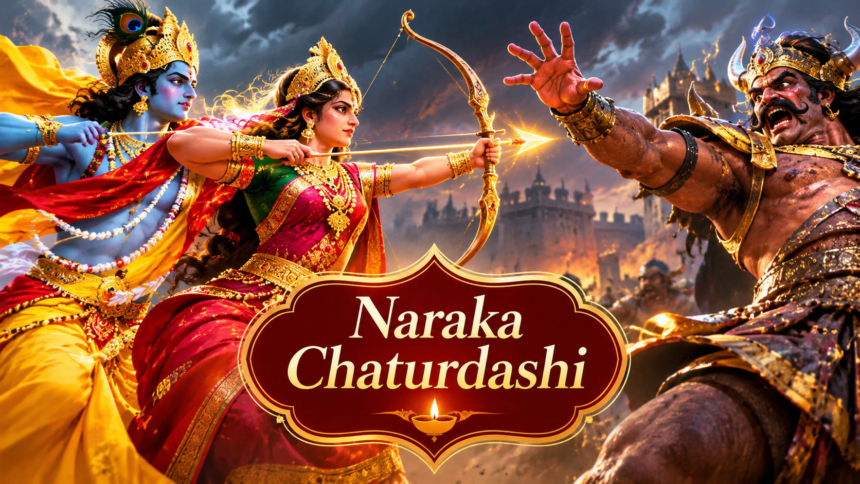
Diwali celebrations hold different religious and cultural meanings across India. In several South Indian communities, the festival is closely connected with Lord Krishna’s victory over the demon king Narakasura. This event is remembered as Naraka Chaturdashi, a day that symbolises the triumph of good over evil and the freedom of people from oppression.
On this occasion, families traditionally wake up before sunrise, perform a special oil bath, wear new clothes and prepare festive dishes. Prayers, sweets and other celebrations mark the beginning of the festival.
While Diwali in North India is widely associated with Lord Rama’s return to Ayodhya, the story of Narakasura holds special importance in South Indian traditions. Here is the story behind this belief and the significance of Naraka Chaturdashi.
Who Was Narakasura? The Story Behind the Demon King
According to Hindu mythology, Narakasura, also known as Bhaumasura, was the son of Bhudevi, the Goddess of Earth. He ruled the kingdom of Pragjyotishapura and gradually became known for his arrogance and cruel behaviour.
The Bhagavata Purana describes several misdeeds committed by Narakasura. He reportedly stole the earrings belonging to Aditi, the mother of the Devas, took Varuna’s royal umbrella and imprisoned thousands of women.
His increasing power and oppressive actions created serious problems for the celestial world. Unable to stop him, Indra approached Lord Krishna and requested his intervention.
Krishna accepted the challenge and decided to put an end to Narakasura’s rule.
How Lord Krishna Defeated Narakasura
According to the traditional account, Lord Krishna travelled to Narakasura’s kingdom on his vehicle Garuda, accompanied by his wife Satyabhama.
The demon king had surrounded his capital with strong fortifications and placed powerful warriors in charge of its protection. Before reaching Narakasura, Krishna fought and defeated the demon Mura, who guarded the city.
He then confronted Narakasura in a fierce battle and ultimately killed him using his Sudarshana Chakra.
Following the victory, Krishna entered the palace and released the women who had been held captive. He also recovered Aditi’s stolen earrings and returned them to her.
Narakasura’s kingdom was subsequently handed over to his son, Bhagadatta. The episode is remembered as the restoration of justice and the end of oppression.
Why Is Satyabhama Associated With Narakasura’s Death?
Satyabhama also has an important place in several regional versions of the Narakasura story, particularly in Telugu traditions.
According to a popular account, Satyabhama was an incarnation of Bhudevi, who was Narakasura’s mother. A boon received by the demon stated that he could only be killed by his mother.
Because of this connection, Satyabhama became instrumental in his defeat. Some traditional versions describe her as delivering the final blow during the battle alongside Lord Krishna.
However, different religious accounts present the event differently. The Bhagavata Purana describes Krishna as the one who kills Narakasura, whereas the version involving Satyabhama’s final strike is popular in regional traditions.
Why Do South Indians Celebrate Naraka Chaturdashi With an Oil Bath?
Naraka Chaturdashi is observed on the Chaturdashi Tithi of Krishna Paksha during the Hindu month of Kartik. It commemorates the defeat of Narakasura and the liberation of those suffering under his rule.
In North India, this occasion is commonly known as Choti Diwali. In several South Indian communities, however, it forms an important part of the main Deepavali celebrations.
One of the most recognisable customs is Abhyanga Snanam, a traditional oil bath performed before sunrise.
As part of the ritual, family members apply sesame oil to their bodies and heads before taking a bath. They then wear new or freshly washed clothes and begin the celebrations with prayers and traditional food.
The practice is associated with physical and spiritual purification and is believed to represent the removal of negativity. A popular belief also connects the ritual bath with Lord Krishna’s purification after defeating Narakasura.
Many families mark the occasion by lighting lamps, preparing traditional sweets and enjoying fireworks.
Spiritual Significance of Narakasura’s Defeat
The story of Narakasura is not only about the victory of Lord Krishna over a powerful demon. It also carries a deeper message about righteousness, humility and the consequences of misusing power.
Lord Krishna represents divine wisdom and dharma, while Narakasura symbolises arrogance, cruelty and oppression. His defeat represents the removal of darkness and the restoration of justice.
For devotees who celebrate Diwali through this tradition, the occasion is a reminder to overcome negative qualities, leave harmful actions behind and move towards a more positive life.
Whether people celebrate Lord Rama’s return to Ayodhya or Lord Krishna’s victory over Narakasura, the central message of Diwali remains the same: good ultimately triumphs over evil, and light overcomes darkness.
Disclaimer: This article is based on traditional Hindu mythology, religious scriptures and regional cultural beliefs. Different scriptures and communities may narrate certain events differently. The information is intended for general religious and cultural awareness.