
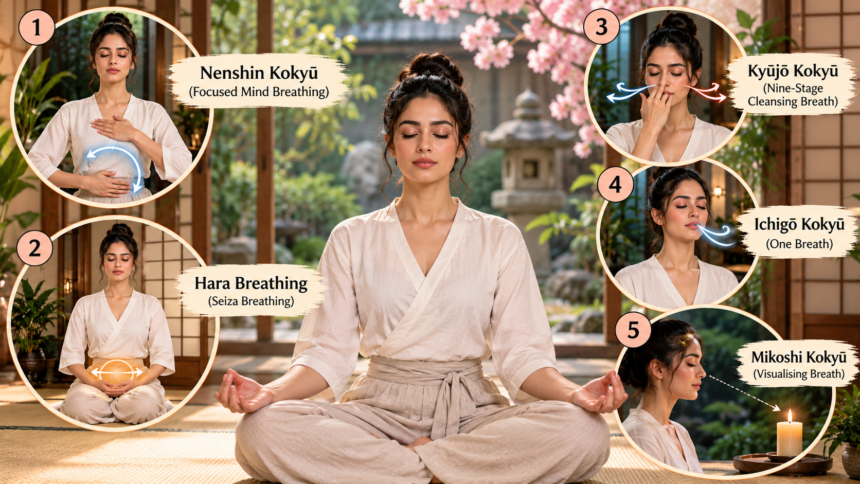
With constant notifications, busy schedules and everyday distractions, maintaining concentration can be challenging. Japanese breathing practices, commonly referred to as Kokyūhō, offer techniques that combine controlled breathing, mindfulness and mental awareness to encourage a calmer state of mind.
Influenced by traditional mindfulness practices and martial arts, these exercises emphasise slow, intentional breathing and awareness of the Hara, the lower abdominal centre. Incorporating these techniques into a daily routine can help create moments of relaxation, improve mental clarity and support better focus. Here are five Japanese breathing exercises to explore for improved concentration.
5 Japanese Breathing Techniques for Better Mental Focus
1. Nenshin Kokyū (Focused Mind Breathing)
Nenshin Kokyū is a mindful breathing technique that focuses on reducing mental distractions and bringing attention back to the present moment.
How to practise: Find a comfortable sitting position and keep your back straight. Place one hand over your abdomen and the other on your chest.
The technique: Breathe in slowly through your nose, allowing your abdomen to expand rather than lifting your chest. Hold the breath for three counts before gradually breathing out through your mouth. As you exhale, allow your abdomen to relax and imagine releasing unnecessary thoughts and mental tension.
Duration: Practise for 5 to 10 minutes.
2. Hara Breathing (Seiza Breathing)
Hara breathing focuses on the lower abdominal area, traditionally considered the body’s centre of balance and stability. The technique is commonly associated with Seiza, a traditional Japanese kneeling position.
How to practise: Sit in the Seiza position or choose another comfortable posture. Direct your attention towards the Hara, located approximately two inches below the navel.
The technique: Inhale gently through your nose and focus on the sensation of your lower abdomen expanding. As you breathe out through your mouth, make a gentle ‘shhh’ sound while gradually releasing the air. Keep the inhalation relaxed and make the exhalation slow and controlled.
Duration: Five minutes, particularly before beginning a task that requires concentration.
3. Kyūjō Kokyū (Nine-Stage Cleansing Breath)
Kyūjō Kokyū is a breathing practice associated with Tibetan Buddhist traditions that is also used in Japanese mindfulness and martial arts settings. It involves alternate-nostril breathing and is intended to encourage relaxation and mental balance.
How to practise: Sit comfortably and prepare to practise the three breathing stages.
The technique:
- Stage 1 – Right Nostril: Close your left nostril using your thumb. Breathe in deeply through the right nostril and slowly breathe out through the same nostril. Repeat three times.
- Stage 2 – Left Nostril: Close your right nostril and inhale through the left nostril. Slowly exhale through the same side. Repeat three times.
- Stage 3 – Both Nostrils: Release both nostrils and take a deep breath through them. Exhale slowly through both nostrils. Repeat three times.
The three stages together complete the nine-part breathing exercise.
4. Ichigō Kokyū (One Breath)
Ichigō Kokyū is a simple breathing technique associated with activities such as Japanese calligraphy and martial arts, where maintaining attention during a single action is important. It focuses on using one complete breath to bring the mind back to the present.
How to practise: Sit upright in a comfortable position and relax your shoulders.
The technique: Take a slow, deep breath, allowing the inhalation to begin from the abdomen and gradually expand towards the chest. Follow this with one long, steady and controlled exhalation. Repeat the complete process three times to encourage a sense of calm and mental clarity.
5. Mikoshi Kokyū (Visualisation Breathing)
Mikoshi Kokyū combines controlled breathing with mental visualisation. The exercise uses an imaginary flow of light or energy to help maintain attention and reduce distractions.
How to practise: Sit or stand comfortably and select a fixed point to look at, such as a candle, a spot on the wall or a distant tree.
The technique: While inhaling, imagine drawing light or focused energy through your nostrils towards your brain or third-eye area. As you exhale, visualise that light spreading throughout your body and gradually releasing tension and distractions. Continue breathing slowly while keeping your gaze gently fixed on the chosen point.
Duration: Practise for approximately five minutes.
Final Thoughts
Japanese-inspired breathing practices offer simple ways to introduce mindfulness and controlled breathing into everyday life. Techniques such as Nenshin Kokyū, Hara breathing and visualisation breathing encourage individuals to slow down, become more aware of their breathing and bring their attention back to the present moment.
Whether practised before studying, working or beginning a demanding activity, these exercises can provide a structured opportunity to pause and refocus. Regular practice can make mindful breathing a useful part of a daily relaxation routine.